Clear Sky Science · en
Mapping the positions of Two-Level-Systems on the surface of a superconducting transmon qubit
Hunting Hidden Flaws in Quantum Chips
Superconducting quantum computers promise to tackle problems that overwhelm today’s machines, but they are held back by tiny flaws that quietly sap their performance. This study shows how to locate those troublemakers, called two level systems, on the surface of a popular type of quantum bit, helping engineers see exactly which parts of a chip hurt its reliability the most.
Why Tiny Defects Matter
In the solid materials that make up a quantum processor, some atoms do not sit still in one spot but can tunnel between two nearby positions. Each such defect behaves like a tiny switch with two states, known as a two level system. When these switches carry charge, they interact strongly with the delicate electric fields that store information in a superconducting qubit. If a qubit’s energy can flow into a nearby defect, the quantum state fades more quickly, shortening the useful lifetime of the qubit.
Turning Quantum Bits into Local Sensors
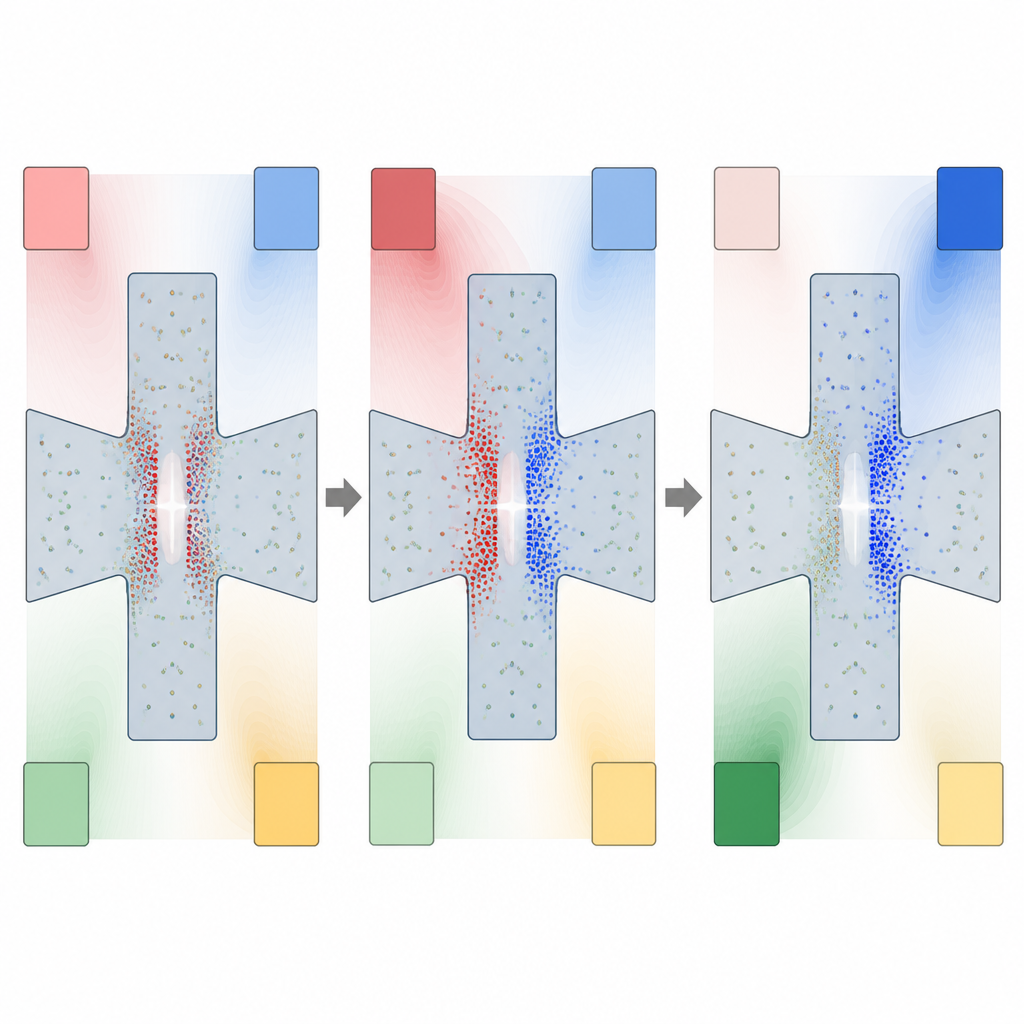
The researchers use a transmon qubit, a widely used design built from a cross shaped metal island connected to a surrounding ground plane through a pair of Josephson junctions. Around this structure they patterned four extra metal pads that act as gate electrodes. By applying carefully chosen static voltages to these pads, they create local electric fields that gently shift the natural frequencies of nearby defects. Because each defect responds differently to each gate, the qubit and its surroundings effectively become a tiny sensor array that can sense where individual defects are located.

Mapping Defects by Their Electrical Footprint
To find a defect, the team first uses a timing experiment called swap spectroscopy. They excite the qubit, briefly tune its frequency, and then measure how much energy remains. When the qubit’s frequency matches that of a defect, energy swaps between them and the qubit relaxes faster, revealing the defect as a dip in lifetime. Repeating this while sweeping the voltages on each gate electrode shows how strongly that defect shifts when each pad is biased. The pattern of these shifts is then compared to detailed computer simulations of the electric fields around the qubit, allowing the team to triangulate the most likely position of each defect on the chip surface.
Where the Defects Really Live
Using this method, the researchers mapped 55 individual surface defects on a single transmon qubit. Surprisingly, almost sixty percent of the troublesome defects clustered near the narrow leads of the Josephson junctions, even though most of the chip’s area and electric field energy sit in the large capacitor pads and ground plane. The analysis suggests that the density of defects is roughly twice as high near the junction leads as on the wider metal surfaces. This points to the chip fabrication process itself especially the lift off technique used to pattern the junction wiring as a likely source of extra disorder, residue, and roughness that encourage defect formation.
Guiding Better Quantum Hardware
By showing not only how many defects couple to a qubit but exactly where they are most common, this work gives chip designers a new tool to focus their efforts. The results argue for cleaner and more gentle processing near junction leads, for shaping wires to spread out electric fields, and for using on chip electrodes to nudge the most harmful defects away from qubit frequencies. In simple terms, the study offers a map of the worst trouble spots on a quantum chip and suggests practical routes to calmer, longer lived qubits.
Citation: Lisenfeld, J., Händel, A.K., Daum, E. et al. Mapping the positions of Two-Level-Systems on the surface of a superconducting transmon qubit. npj Quantum Inf 12, 80 (2026). https://doi.org/10.1038/s41534-026-01272-5
Keywords: superconducting qubits, two level systems, quantum decoherence, Josephson junctions, quantum hardware fabrication