Clear Sky Science · en
Degenerate quantum erasure decoding
Why losing quantum bits is a big deal
Future quantum computers will be built from fragile quantum bits, or qubits, that are constantly at risk of disappearing or leaking out of the system. In many leading hardware platforms—from ultracold atoms to superconducting circuits—the dominant failure mode is not a subtle nudge but outright loss: a qubit simply vanishes. This paper asks a practical question with huge implications: can we design quantum error-correcting codes and fast decoders that almost perfectly undo this kind of loss, while using as little extra hardware and processing time as possible?
Turning qubit loss into a cleaner kind of noise
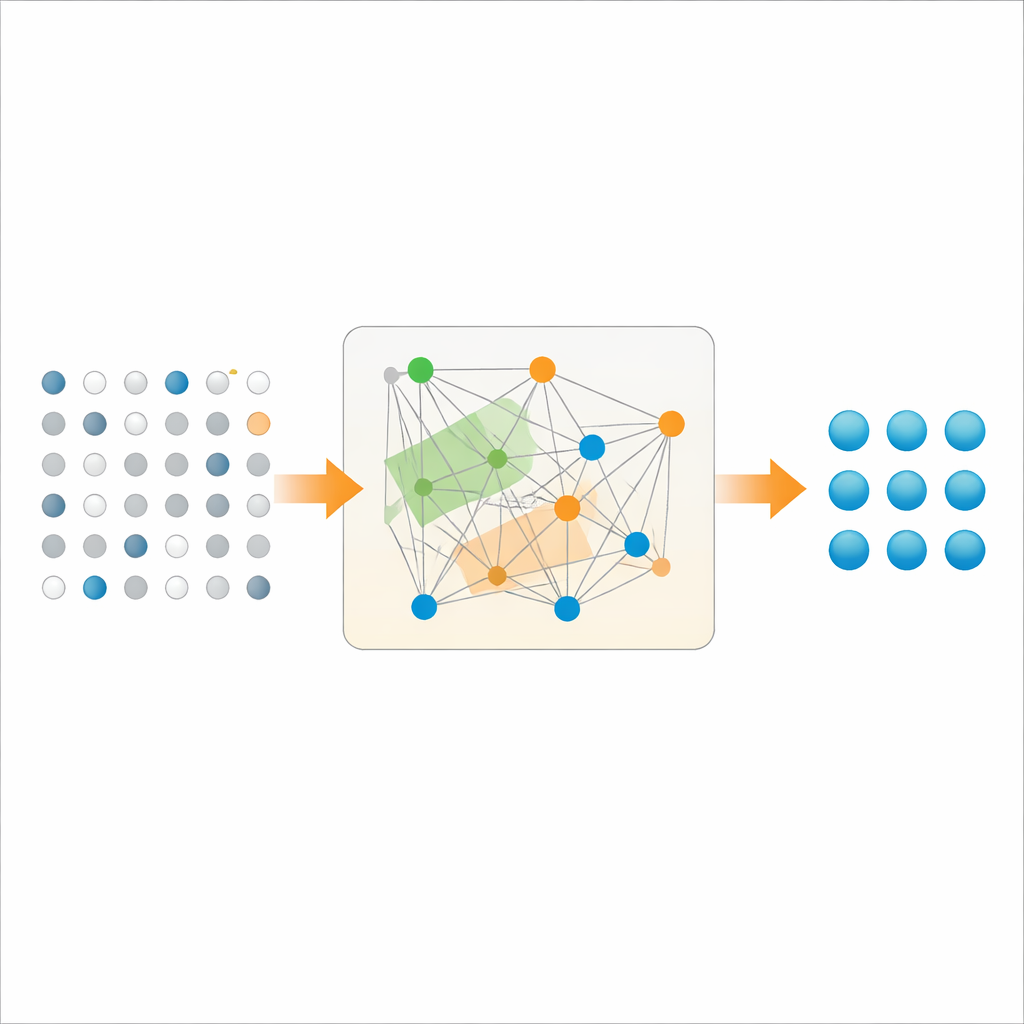
Modern experiments can often detect when a qubit has leaked away and mark its location. This is called erasure conversion: the messy physical leakage is converted into a well-defined “erasure” at a known position. On an erasure channel of this kind, there is a sharp theoretical limit to how efficiently we can protect quantum information: at most a fraction 1 − 2p of the hardware qubits can store useful information if each qubit is erased with probability p. Until now, only a special class of two-dimensional topological codes was known to reach this limit under erasure, and they do so at the cost of a vanishing information rate as the systems get larger. That makes them expensive in hardware, motivating a search for better codes and faster decoders tailored to erasures.
Building high-rate codes that approach the ultimate limit
The authors show that several families of quantum low-density parity-check (QLDPC) codes—notably bicycle codes and lifted-product codes—can in fact reach or nearly reach the erasure capacity over a broad range of code rates. Using mathematically optimal maximum-likelihood decoding, implemented via Gaussian elimination, these codes correct erasures as well as the theory allows: the achievable rate closely matches 1 − 2p for practical error probabilities. The same framework also covers familiar two-dimensional topological codes, confirming that their best possible erasure performance is recovered when decoded optimally.
From slow optimal decoding to fast, near-optimal schemes
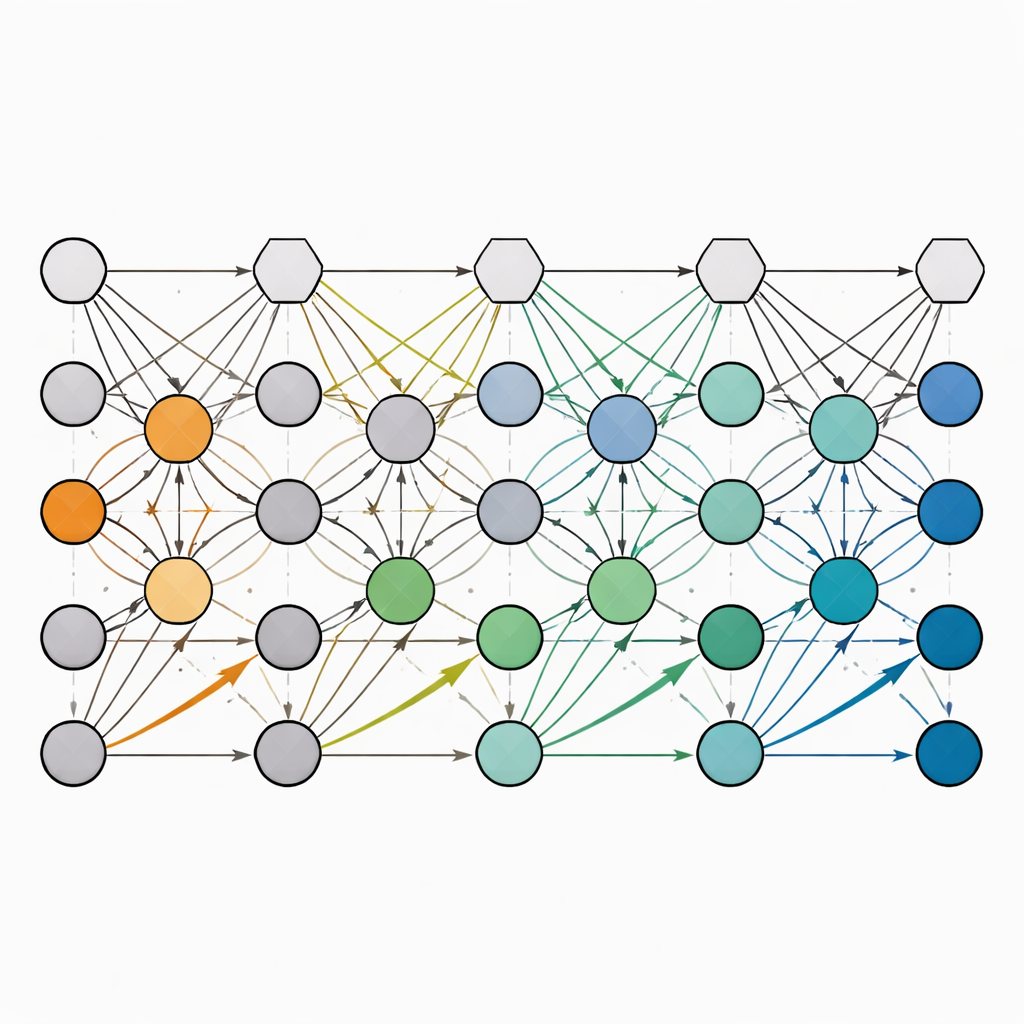
The catch is that maximum-likelihood decoding scales poorly: the required linear algebra grows roughly with the cube of the number of qubits, too slow for real-time operation in a large quantum processor. To overcome this, the paper develops a family of belief-propagation (BP) decoders that run in essentially linear time in the system size. These decoders treat the code as a graphical network of constraints and iteratively pass “messages” along the edges to infer the most plausible pattern of errors. Crucially, they are designed to exploit a uniquely quantum feature called degeneracy: many different error patterns can have exactly the same effect on the encoded information. By steering the BP updates toward any member of these large, symmetric sets of equivalent errors, the decoders find good solutions without needing to single out the exact microscopic error.
Refining message passing to handle tough error patterns
The authors introduce variations of BP that incorporate ideas from gradient descent optimization and neural-network–like memory effects. A simple “flip” version updates hard bit values and occasionally takes a greedy step when progress stalls, while more advanced “soft” versions operate on graded confidence values instead of strict 0/1 decisions. These soft decoders temper and recycle past messages, adjust their step sizes, and in some cases treat different types of quantum errors jointly rather than separately. The result is a suite of algorithms that, for the tested code families, achieve thresholds very close to the maximum-likelihood ones, yet with runtime that grows only linearly with the number of qubits and only mildly with decreasing error rate.
Extending to more realistic and mixed noise
Real hardware rarely suffers pure erasures. The authors therefore test their decoders on more complex scenarios: channels that combine known-location erasures with ordinary random flips, and channels where qubits can be deleted without their locations being flagged. By concatenating QLDPC codes with small permutation-invariant inner codes, local deletions are first converted into effective erasures, which the BP decoders then handle efficiently. Numerical experiments show that the same family of decoders can manage these mixed error models with high accuracy, suggesting that the approach is robust well beyond the idealized erasure-only setting.
What this means for future quantum machines
Overall, the work closes a key gap between theory and practice for quantum systems dominated by qubit loss. It demonstrates that capacity-achieving or near-capacity performance on erasure channels is possible with structured quantum codes that have non-vanishing information rates, and—most importantly—that this can be done with decoders whose cost grows only linearly with the system size. For a lay reader, the takeaway is that by cleverly exploiting the symmetries of quantum errors, we can protect quantum data almost as well as the laws of physics permit, without overwhelming the hardware with either extra qubits or heavy classical computation. This significantly strengthens the case for building large-scale quantum computers and networks in platforms where qubit loss can be detected and converted into erasures.
Citation: Kuo, KY., Ouyang, Y. Degenerate quantum erasure decoding. npj Quantum Inf 12, 75 (2026). https://doi.org/10.1038/s41534-026-01212-3
Keywords: quantum error correction, erasure errors, belief propagation decoding, quantum LDPC codes, fault-tolerant quantum computing