Clear Sky Science · en
Non-Markovian exceptional points by interpolating quantum channels
Quantum crossroads that amplify tiny effects
Imagine being able to tune a quantum device to a sweet spot where an incredibly small nudge produces an outsized response. This paper explores exactly such sweet spots, called exceptional points, in the language of quantum information. By showing how to create and measure these fragile points directly in the operations used by quantum technologies, the authors open paths to sharper sensors and new ways to steer quantum systems even when they are noisy and interacting with their surroundings.
How open quantum systems usually get described
Real-world quantum systems are never completely isolated: they constantly exchange energy and information with their environment. Traditionally, physicists describe this messy interaction using a smooth, memoryless evolution governed by a mathematical object called a Liouvillian. Exceptional points in that setting have already been linked to unusual behaviors such as direction-dependent transport and enhanced sensing. But this Markovian picture assumes that the environment has no memory and that the system’s evolution is generated in a very specific way. Many realistic devices, including those with strong noise, feedback, or measurements, fall outside this framework.
A broader lens: thinking in terms of quantum channels
Instead of insisting on a particular equation of motion, the authors treat each step of evolution as a quantum channel: a general input–output map that is guaranteed to be physically valid, but may include memory effects and other non-Markovian features. Any single-qubit channel can be represented as a simple linear distortion and shift of the Bloch sphere, the familiar ball that encodes all possible qubit states. Because the matrix describing this distortion is real, its nontrivial eigenvalues can only appear in two ways: all real, or as one real value plus a complex-conjugate pair. The team uses this natural division to define two phases of a channel, which they label “K-exact” (all real eigenvalues) and “K-broken” (a complex pair), echoing but not relying on the usual parity-time symmetry ideas.
Creating exceptional points by mixing quantum processes
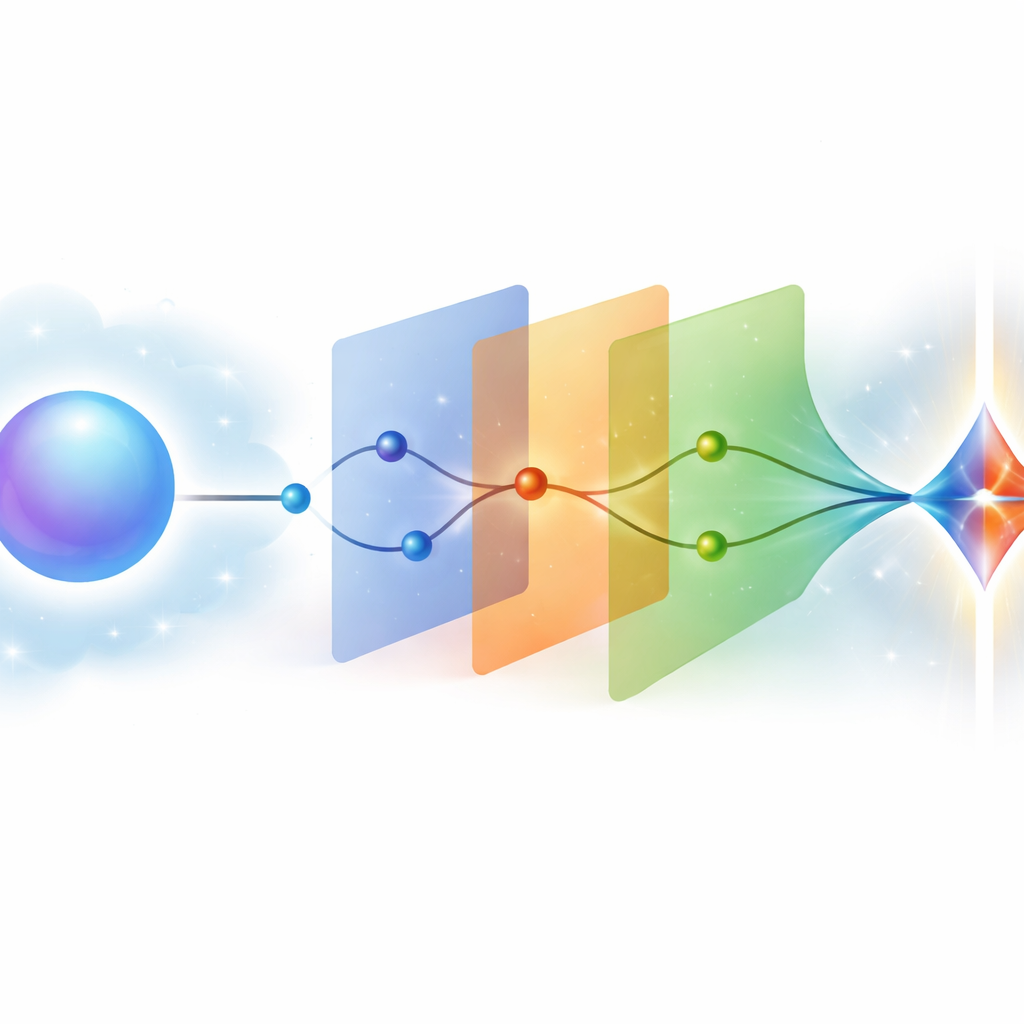
The central insight is that smoothly interpolating between channels from different phases forces a transition where eigenvalues collide. At special settings, both the eigenvalues and their associated eigenvectors merge, and the channel sits at an exceptional point. The authors work out a concrete example with two single-qubit channels whose action is simple to write down and implement. As the mixing parameter is varied, two eigenvalues approach each other and coalesce exactly halfway, marking a second-order exceptional point. At this point, the channel admits a Jordan-chain structure: states aligned along one special direction in Bloch space are mapped onto another preferred direction, while states already along that second direction are collapsed to a fully mixed state. This produces a one-way, highly asymmetric conversion between families of states, analogous to chiral excitation seen in optical and acoustic experiments at exceptional points.
From theory to tabletop quantum hardware
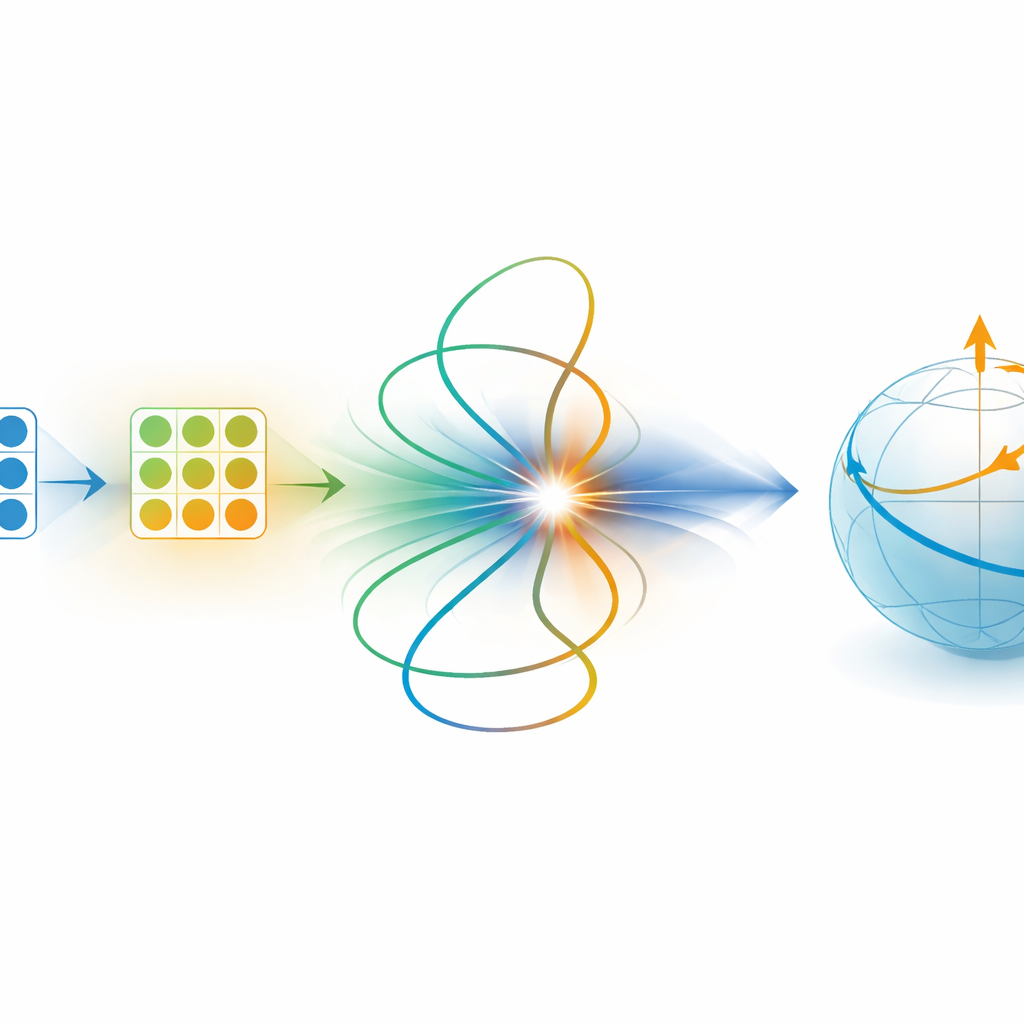
To show that these non-Markovian channel exceptional points are not just mathematical curiosities, the team implements them on a small nuclear magnetic resonance (NMR) quantum computer. A two-qubit molecule provides one “signal” qubit, which experiences the channel, and one “ancilla” qubit that helps simulate the environment. Rather than using a deep three-qubit construction, they cleverly decompose the desired channel into a mixture of two simpler “quasiextreme” channels, each realizable with a compact circuit of single-qubit rotations and controlled operations. Using quantum process tomography, they reconstruct the full channel for many interpolation settings and track its eigenvalues. The measurements match theory with over 93% fidelity, clearly revealing the point where the two eigenvalues merge.
Richer behavior with three channels and higher order points
The framework naturally extends beyond two channels. By interpolating among three carefully chosen single-qubit channels, the authors map out a triangular parameter space. Along certain lines, they find continuous curves of second-order exceptional points—exceptional lines rather than isolated spots. Even more striking, two such lines meet at a single point where three eigenvalues and their eigenvectors coalesce, forming a third-order exceptional point. They show that this higher-order point lies firmly in the non-Markovian regime under broad definitions. The same construction can be generalized to larger systems, where many more eigenvalue pairings and higher-order coalescences become possible, suggesting a rich landscape of phase transitions in multi-qubit channels.
Why this matters for quantum technology
By working directly with quantum channels, this study unifies exceptional-point physics with the standard tools of quantum information. The authors provide a recipe: pick channels from different spectral phases, interpolate between them, and search for the parameter values where eigenvalues and eigenvectors fuse. Their NMR experiment demonstrates that such channel-based exceptional points can be engineered and characterized with today’s hardware. Because higher-order exceptional points are predicted to boost the sensitivity of devices to tiny parameter changes, this approach offers a scalable route to enhanced quantum sensing and new control schemes in quantum heat engines, computers, and other open quantum systems.
Citation: Wong, W.C., Zeng, B. & Li, J. Non-Markovian exceptional points by interpolating quantum channels. npj Quantum Inf 12, 63 (2026). https://doi.org/10.1038/s41534-026-01205-2
Keywords: exceptional points, quantum channels, non-Markovian dynamics, quantum sensing, open quantum systems