Clear Sky Science · en
Quantum simulation via stochastic combination of unitaries
Why this matters for future quantum machines
Today’s quantum computers are powerful in principle but fragile in practice: they have only a modest number of qubits, and long, complicated programs quickly fall apart under noise. Yet some of the most important uses of quantum computers—such as simulating molecules, materials, and noisy quantum devices themselves—traditionally demand deep circuits and many helper qubits. This paper presents a new way to run those demanding simulations using only short, hardware-friendly circuits, trading depth for extra measurements in a way that fits the strengths of current machines.

A new way to mix simple quantum steps
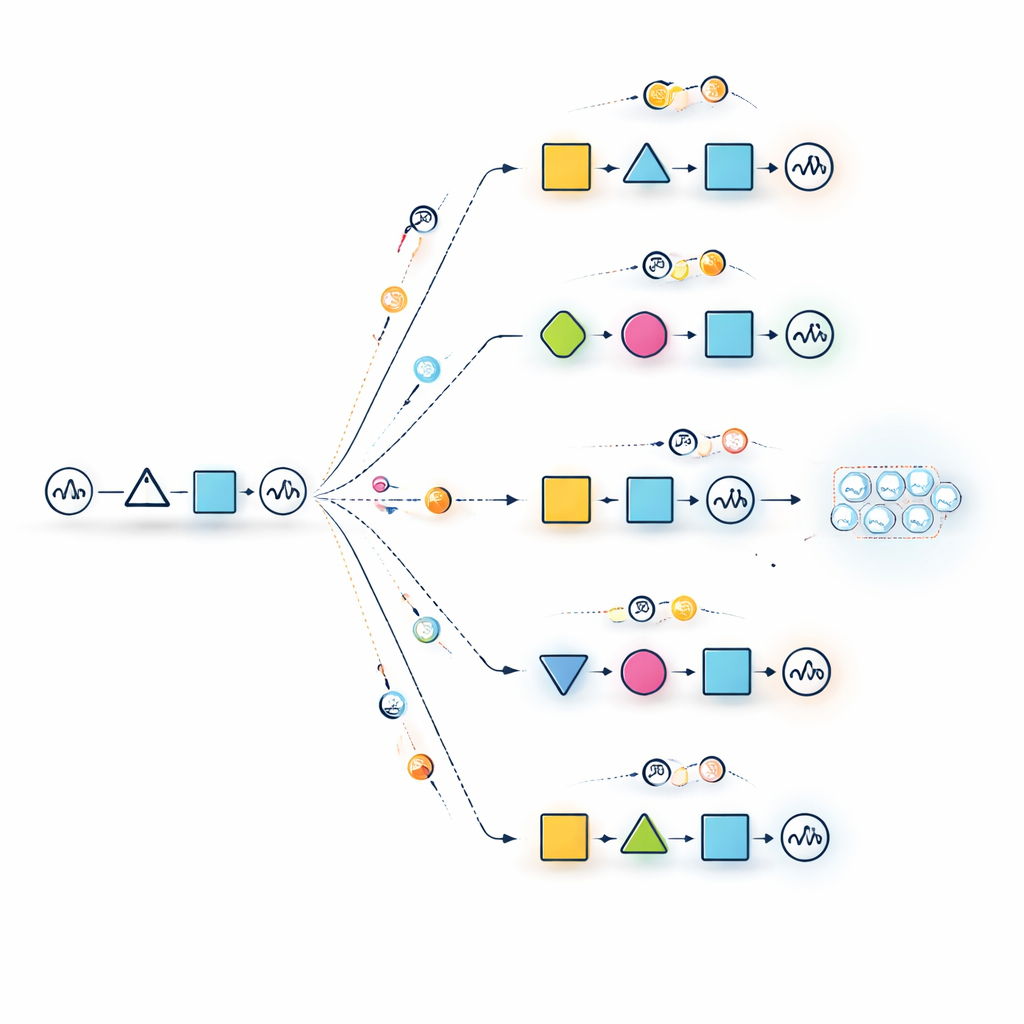
The authors introduce “stochastic combination of unitaries” (SCU), a framework for describing complex quantum processes as random mixtures of much simpler operations. A quantum process, or channel, can usually be written as a sum of basic transformations, each with a certain weight. Instead of building one large circuit that embeds this whole sum using many helper qubits—as in the mainstream “linear combination of unitaries” approach—SCU samples from that list of transformations. Each run of the experiment applies just one simple circuit (or a small circuit with a single helper qubit) chosen with the right probability. By repeating and averaging the measurement results, the overall effect faithfully reproduces the original, complicated process.
Shallow circuits instead of large helper networks
This stochastic strategy directly addresses a key bottleneck in quantum algorithms: the number of ancilla (helper) qubits and the depth of the circuit. Standard linear-combination methods pack many operations into a single coherent routine, controlled by registers of ancilla qubits and followed by a delicate “post-selection” step that often has to be repeated until it works. That design is elegant mathematically but punishing for near-term hardware. SCU, in contrast, uses mostly ancilla-free circuits and, when needed, only a single helper qubit measured in a straightforward way. The price is more repetitions—more measurement “shots”—but the gain is extremely shallow circuits that are much more realistic for today’s devices.
Testing noisy quantum links with entangled states
To show that SCU can handle genuinely open, noisy quantum systems, the team applies it to a classic entangled state known as a GHZ state, built from eight qubits on IBM’s ibm_hanoi processor. In a real network, the operations used to create such entanglement suffer from energy loss and other imperfections. The authors model this using a simple damping process applied after each two-qubit gate, implemented via SCU as random choices among a few short circuits. They then measure how closely the resulting state matches an ideal GHZ state using a method based on multiple quantum coherences, which probes both populations and delicate phase relationships. Across several noise strengths, the measured signals and overall fidelities track theoretical predictions closely, with deviations mainly attributable to background hardware noise rather than the SCU method itself.
Rethinking how to simulate quantum dynamics
Beyond static noisy channels, the paper tackles one of quantum computing’s central challenges: simulating how quantum systems evolve in time under a Hamiltonian. Building on SCU, the authors develop two new algorithms. The first, called convex Taylor sampling, rearranges the standard mathematical series for time evolution into a weighted mixture of unitary building blocks that can be sampled stochastically. The second augments familiar Suzuki–Trotter “product formulas” by treating their error terms as additional sampled corrections rather than simply accepting them as fixed limitations. Strikingly, for both algorithms the number of quantum gates needed does not blow up as the required energy resolution becomes more stringent; instead, costs are governed mainly by how much extra sampling overhead one is willing to tolerate.
Cutting gate counts for model quantum magnets
To quantify the payoff, the authors estimate resources for simulating the transverse field Ising model, a standard testbed describing a chain of spins in a magnetic field. They compare their SCU-based methods to leading alternatives, including the widely used randomized scheme qDRIFT and higher-order product formulas. For system sizes ranging from tens to hundreds of qubits and for very strict accuracy targets, their approaches cut the required number of two-qubit gates by up to several orders of magnitude. Even after accounting for the extra measurement repetitions implied by the stochastic sampling, the total runtime can be substantially reduced because each individual circuit is much shorter and less error-prone.
What this means going forward
In practical terms, this work shows that many demanding quantum simulations can be rebuilt around short, easily executed circuits combined with smart random sampling. Instead of trying to perfectly emulate a complicated process in one shot, SCU spreads the task across an ensemble of simple experiments and lets statistics do the heavy lifting. This strategy opens a path to studying noisy quantum networks and intricate quantum dynamics on current and near-future hardware, and it suggests that clever use of randomness may be a key ingredient in bringing realistic quantum simulations within reach.
Citation: Peetz, J., Smart, S.E. & Narang, P. Quantum simulation via stochastic combination of unitaries. npj Quantum Inf 12, 52 (2026). https://doi.org/10.1038/s41534-025-01168-w
Keywords: quantum simulation, stochastic algorithms, open quantum systems, Hamiltonian dynamics, noisy quantum hardware