Clear Sky Science · en
Altered cerebrovascular haemodynamics in Parkinson’s disease: Insights from 4D flow MRI
Why blood flow matters in Parkinson’s disease
Parkinson’s disease is best known for causing tremor and stiffness, but many people are more troubled by the thinking and memory problems that often appear as the disease progresses. Doctors know that damaged brain cells and abnormal proteins play a role, yet these factors alone do not explain why some people develop serious cognitive problems while others do not. This study asks a simple but important question: could changes in the brain’s large blood vessels, and the way blood flows through them, help explain this hidden side of Parkinson’s?
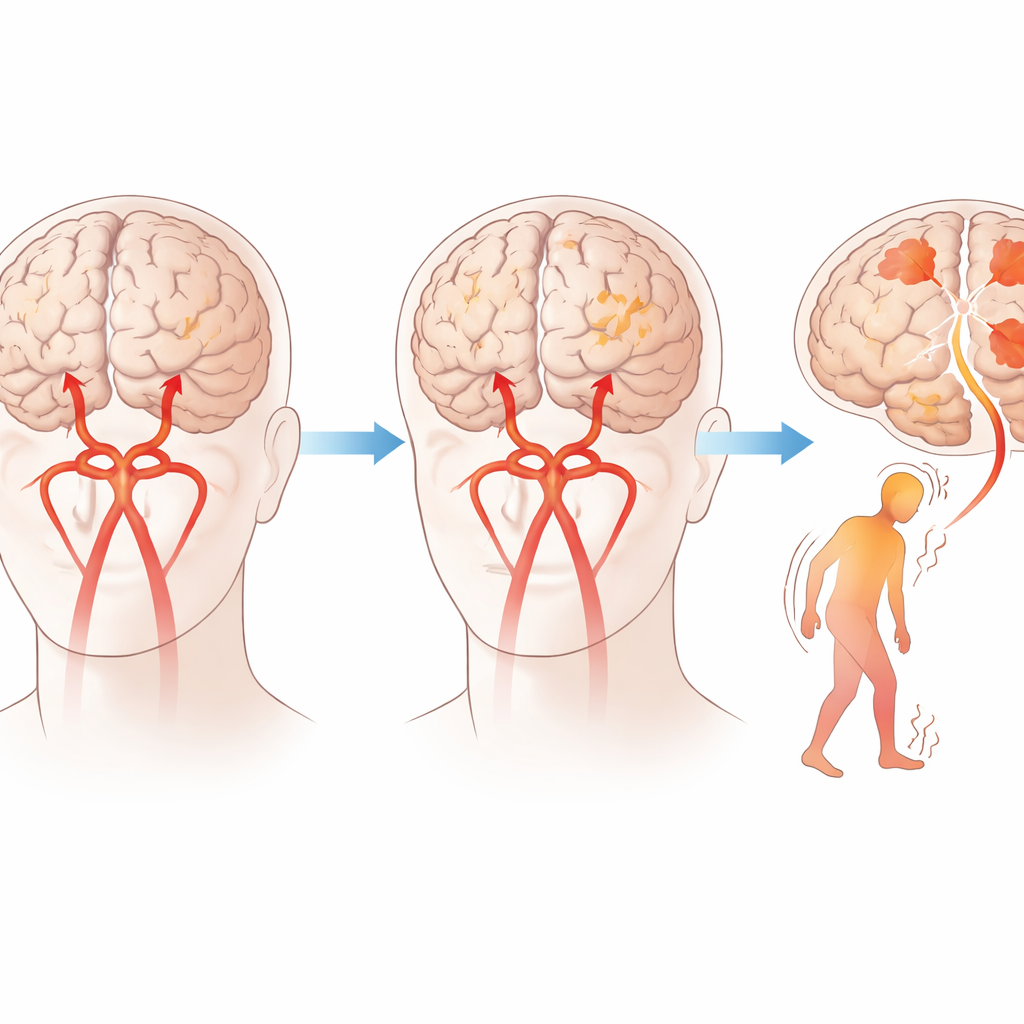
The brain’s safety ring of arteries
At the base of the brain lies a ring-shaped network of arteries called the Circle of Willis. Its job is to share and reroute blood so that all parts of the brain receive a steady supply, even if one vessel is partially blocked or pressure changes. The researchers focused on this structure because it is a central control point for brain blood flow and has been linked to ageing and Alzheimer’s disease. If this hub is not working properly in Parkinson’s disease, it could subtly starve brain tissue or expose it to damaging pressure swings long before overt strokes or visible vessel damage appear on standard scans.
Watching blood move in four dimensions
To probe this hidden circulation, the team used a technique called 4D flow MRI in 80 people with Parkinson’s and 34 similar adults without the disease. Rather than taking a static picture, 4D flow tracks the speed and direction of blood through the arteries across the heartbeat cycle, allowing the researchers to measure how much blood passes through each segment, how fast it moves, and how strongly it pulses. They also recorded each participant’s thinking abilities, movement symptoms, heart health, and overall brain volume, then used advanced statistical models to tease apart which differences were truly linked to Parkinson’s.
Slower, weaker flow without obvious blockages
The study revealed that people with Parkinson’s had lower average blood speed and total blood flow across the Circle of Willis than those without the disease, roughly a ten percent drop, even though the arteries were not noticeably narrower or more malformed. In fact, in those with early thinking problems, some arteries appeared slightly widened after accounting for flow, suggesting a loss of normal "tone"—the fine control that lets vessels tighten or relax as needed. Normally, larger arteries and faster flow go hand in hand, but in Parkinson’s this relationship was blunted, pointing to a breakdown in this regulatory system rather than simple clogging or shrinkage of the vessels.
Linking blood flow to thinking and movement
Lower blood flow and slower velocities in the Circle of Willis were tied to poorer performance on memory and thinking tests, as well as worse motor scores. In people whose cognition was already slipping, the pulse of blood became sharper and more resistant, signs of stiffer vessels that can transmit damaging pressure waves into the brain’s fragile small vessels. These changes were not explained by loss of brain tissue alone, and they showed only limited connection to the dose of Parkinson’s medication, though the study was not large enough to settle the drug question. The patterns fit with a broader picture of disrupted blood pressure control and autonomic dysfunction—problems with the body’s automatic regulation of heart and vessels—that are common in Parkinson’s.
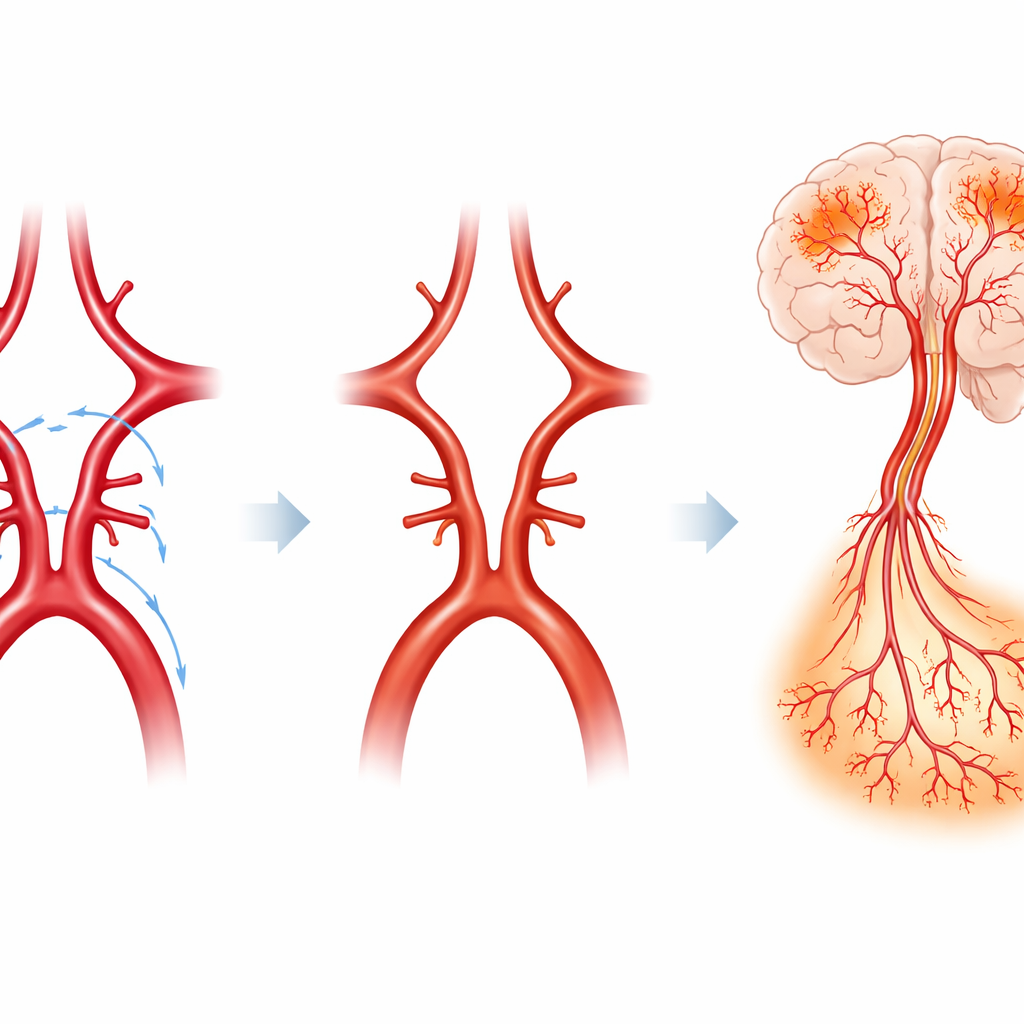
What this means for people with Parkinson’s
For a lay reader, the key message is that Parkinson’s disease appears to disturb not just brain cells but also the plumbing that feeds them. The large arteries at the brain’s base in Parkinson’s patients carry blood less efficiently and may become abnormally stiff, and these changes track with both thinking problems and movement difficulties. Rather than dramatic blockages, the danger seems to lie in subtle, chronic mismanagement of blood flow and pressure. This insight suggests that protecting or restoring healthy brain circulation—by monitoring blood pressure carefully, understanding medication effects on vessels, and eventually targeting vessel tone and stiffness directly—could become an important part of preventing or slowing cognitive decline in Parkinson’s disease.
Citation: Deane, A.R., Myall, D.J., Pilbrow, A. et al. Altered cerebrovascular haemodynamics in Parkinson’s disease: Insights from 4D flow MRI. npj Parkinsons Dis. 12, 78 (2026). https://doi.org/10.1038/s41531-026-01276-0
Keywords: Parkinson’s disease, cerebral blood flow, Circle of Willis, vascular stiffness, cognitive impairment