Clear Sky Science · en
Atomistic modeling of molecular interactions with copper oxides for corrosion inhibition
Why copper needs invisible bodyguards
Copper quietly powers much of modern life, from circuit boards and car electronics to water pipes and heat exchangers. But in air that contains moisture and pollution, copper slowly corrodes and loses performance. This review article explains how scientists use computer simulations to understand and improve thin molecular films that protect copper from this silent damage, with a special focus on the realistic, messy surfaces that form in the real world rather than in idealized lab models.
Everyday metal and its hidden weakness
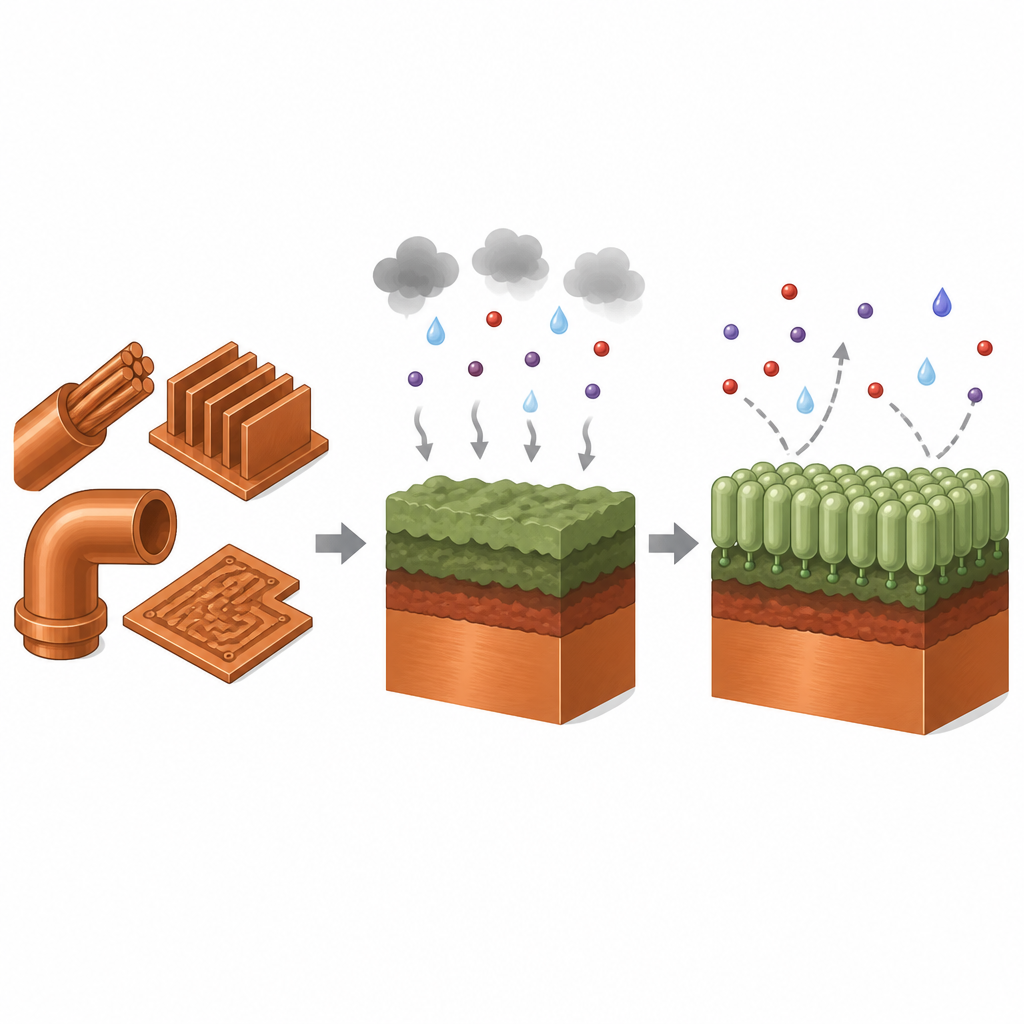
Copper is popular because it conducts heat and electricity well and can be shaped easily. Yet as soon as it is exposed to air, its bright pink surface begins to react with oxygen and water. A thin red layer of copper oxide forms, which at first slows down further attack. Over time, however, moisture, salt and other pollutants disturb this protective film. The oxide thickens, defects appear, and new greenish corrosion products can grow on top. These changes can cut the conductivity of thin copper foils used in electronics and leave industrial components vulnerable to failure.
How protective molecules build a shield
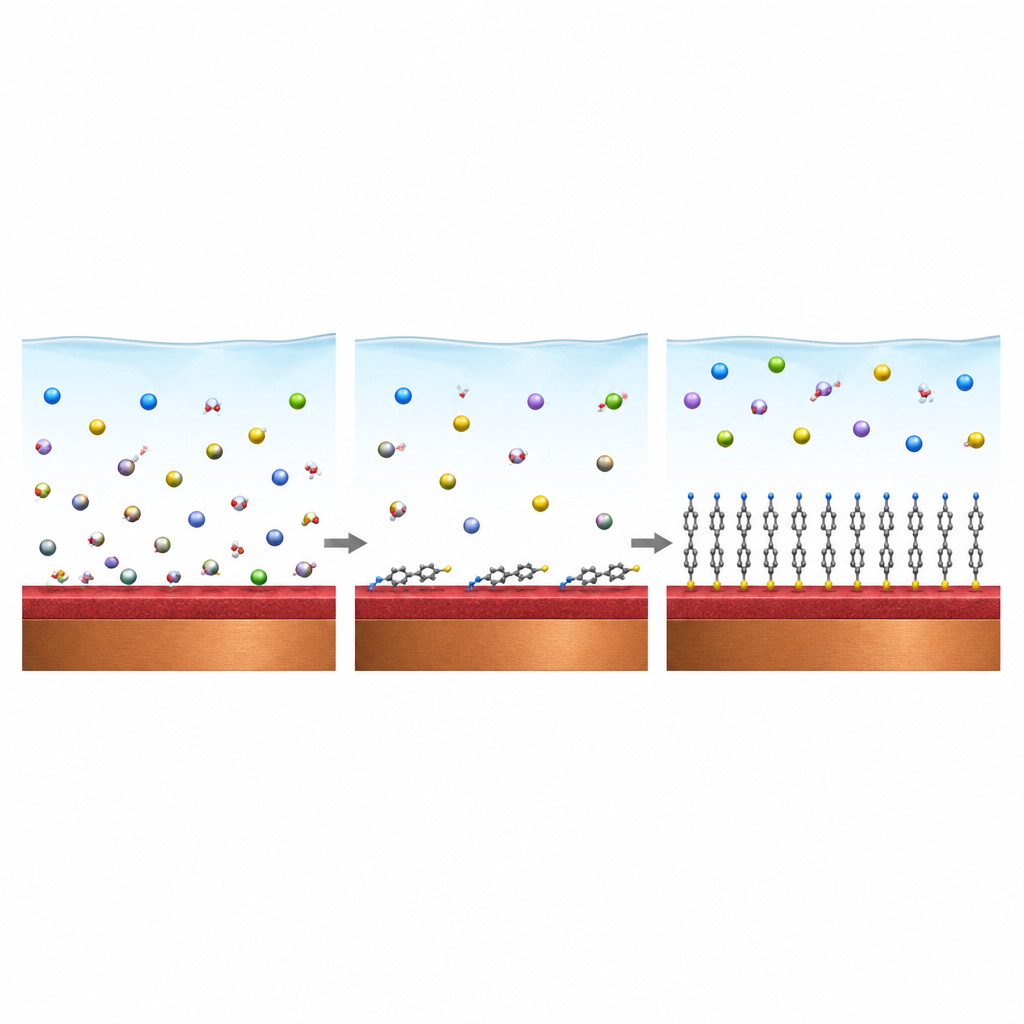
To limit corrosion, engineers apply special inorganic salts or organic molecules that cling to copper and form a barrier film. Many successful organic inhibitors, such as azoles and related compounds, contain atoms like nitrogen or sulfur that can share electrons with copper atoms. They stick to the surface either weakly or strongly and can assemble into a dense, ordered layer that blocks water and aggressive ions from reaching the metal. Experiments show, for example, that 2-mercaptobenzimidazole and similar molecules can form self-assembled monolayers on copper that work in both acidic and salty solutions.
Why realistic surface models matter
Most computer studies have treated copper as a perfectly clean, flat metal surface. In reality, copper is normally covered by one or more layers of oxide that are rough, stepped and sometimes partly broken, especially when chloride ions are present. This review brings together work that moves beyond the simple picture. Researchers now model copper oxide slabs of different thicknesses, sometimes supported by a copper base, sometimes including vacancies, steps, and locally bare patches. They also explore how water layers and dissolved salt ions sit on top of these oxides and compete with inhibitor molecules for the same binding spots.
Peering into corrosion with digital microscopes
Several levels of simulation are used. Classical molecular dynamics treats atoms as interacting beads and can run for long times to show how water, ions and inhibitors move near the surface, but it cannot handle changes in electron distribution that underlie chemical bonding. Density functional theory, a quantum method, provides detailed information about preferred binding sites, bond strengths and charge transfer between molecules and copper oxides, but is limited to smaller systems and short times. Hybrid approaches and newer machine learning models aim to combine the accuracy of quantum methods with the reach of large-scale dynamics, and can even start to include the effect of applied voltage, which is essential in real electrochemical corrosion.
Open questions and future tools
Despite progress, important gaps remain. Many current models still use oxide layers that are too thin, ignore the slight tilt between oxide and metal crystals seen in experiments, or do not fully include bulk water and dissolved ions. Most crucially, very few simulations account for the electric potential that drives corrosion reactions in service conditions. The authors argue that more realistic copper oxide surfaces, explicit liquid films with salt and careful treatment of electrode potential are needed to predict how inhibitor films form, rearrange and sometimes fail. They highlight promising routes such as hybrid quantum–classical schemes and machine learning potentials designed for copper, its oxides, water and inhibitor molecules.
What this means for protecting copper
For non-specialists, the key message is that computer models are becoming powerful enough to show, atom by atom, how protective molecules push aside water and salt to cling to copper oxides and slow down corrosion. By making these models closer to real conditions, researchers hope to explain why some inhibitors work better than others and to guide the design of safer, more effective compounds. In the long run, this deeper understanding could help keep the copper inside our devices, vehicles and infrastructure working reliably for longer, even in harsh environments.
Citation: Iqbal, M., Martins, E.d.F., Todorova, N. et al. Atomistic modeling of molecular interactions with copper oxides for corrosion inhibition. npj Mater Degrad 10, 62 (2026). https://doi.org/10.1038/s41529-026-00779-8
Keywords: copper corrosion, corrosion inhibitors, copper oxides, molecular modeling, self-assembled monolayers