Clear Sky Science · en
Hygrothermal degradation of short-glass-fiber reinforced polycarbonate: effect of fiber content and orientation, and modeling
Why this matters for everyday products
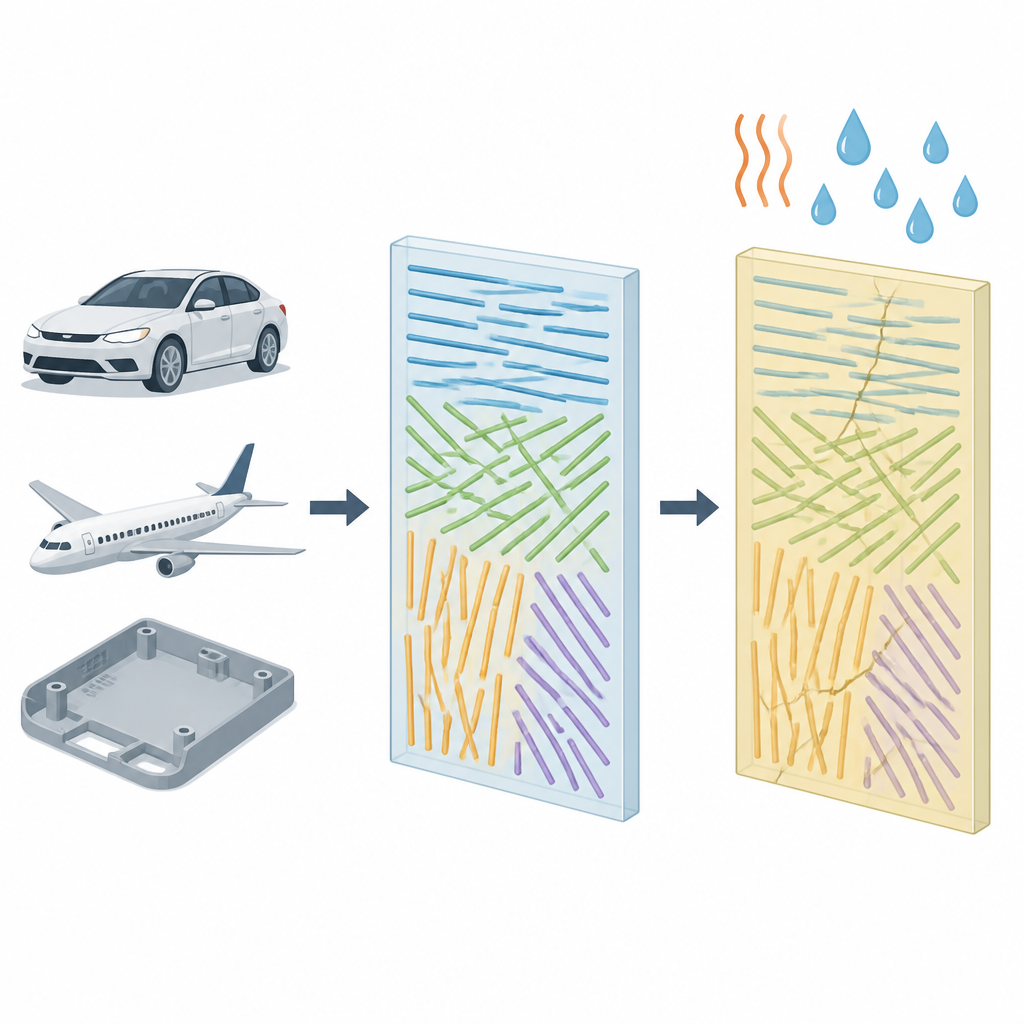
From car dashboards to laptop shells and aircraft interiors, many everyday products rely on tough plastic parts reinforced with tiny glass fibers. This study explores how these popular materials slowly weaken when they sit for years in hot, humid conditions, like those inside vehicles and electronics, and shows how a simple surface measurement can help predict when they may start to fail.
What the researchers set out to learn
The team focused on polycarbonate reinforced with short glass fibers, a material prized for its impact resistance, stiffness, and moldability. They asked three linked questions: how do different amounts of glass fiber and different fiber directions affect damage over time, what actually happens to the plastic and the glass–plastic boundary in heat and humidity, and can a quick, non-destructive chemical reading on the surface stand in for more complex mechanical tests when judging long-term strength.
How they tested the plastic and glass mix
Engineers molded flat plates containing 10, 20, or 30 percent glass fibers by weight and then cut test pieces at three angles relative to the main flow direction: along the fibers, at a slant, and across them. These samples were placed in an 85 degree Celsius chamber at 85 percent relative humidity for up to about six weeks. At set times, the team weighed the specimens to track water uptake, measured how glass transition temperature and molecular weight changed, pulled them in tension to record stiffness, strength, and stretch at break, and used electron microscopes and infrared spectroscopy to watch cracks, fiber pull-out, and chemical changes develop.
What happens inside under heat and moisture
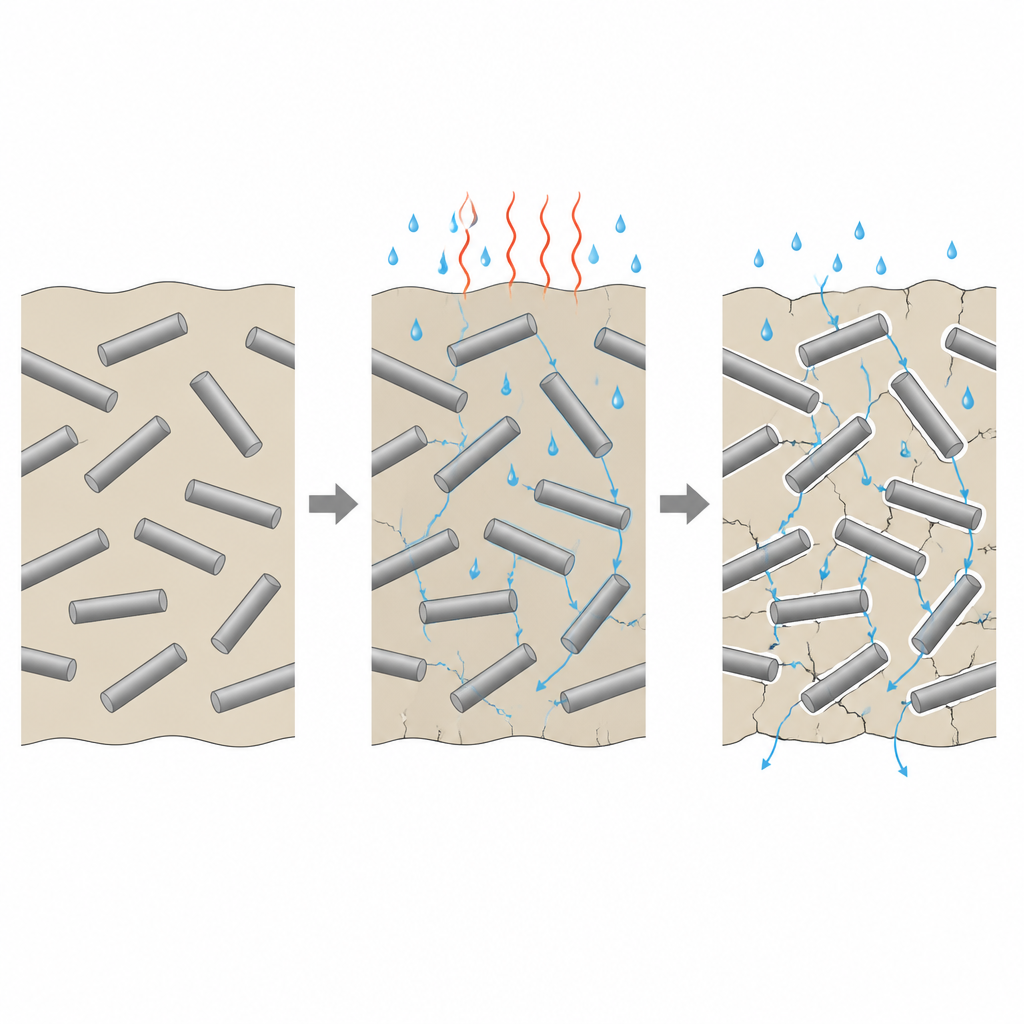
The pictures and measurements painted a consistent story. As moisture crept in, especially along tiny surface cracks and the narrow gaps where glass meets plastic, the polycarbonate chains began to break chemically, forming more hydroxyl groups and slightly lowering overall molecular weight and glass transition temperature. Surfaces became more cracked, with some regions showing mud-crack patterns and exposed fibers. While the stiffness stayed almost unchanged, the material became less forgiving: its tensile strength fell by roughly a quarter and its ability to stretch before snapping almost halved, and fracture surfaces shifted from rough and ductile to smoother, with fibers cleanly pulled out. Parts with more glass and fibers oriented across the pulling direction suffered most, because they contained more interfaces and defects that guide water inward and concentrate stress.
A chemical index that tracks hidden damage
Infrared spectra revealed a broad signal tied to hydroxyl groups on or near the surface that grew steadily with exposure time. The researchers turned this into a single number, a hydroxyl index, by comparing the area of this signal with that of a stable reference band in the polymer backbone. This index rose in a simple power-law fashion with time, nearly independent of fiber content, suggesting that the basic pace of chemical breakdown is set by the polycarbonate itself. When they plotted strength and stretch at break against this index instead of against time, data from all fiber amounts and directions collapsed onto common curves. Using these relationships, they built simple equations that take the index and exposure time as inputs and return expected strength and ductility, and cross-checks showed that the model’s estimates typically differed from measurements by less than 5 percent.
What this means for safer, longer-lasting parts
For non-specialists, the main message is that reinforced plastics in hot, damp service do not suddenly lose stiffness, but they do quietly become more brittle as water-driven chemistry and interface damage advance from the surface inward. This work shows that by shining infrared light on a part’s surface and reading out the hydroxyl index, engineers can gauge how far that hidden degradation has progressed and use straightforward formulas to estimate remaining mechanical safety. That approach offers a practical tool for designing and monitoring car, electronics, and aircraft components made from glass fiber–reinforced polycarbonate so they stay reliable over the many years we expect them to perform.
Citation: Park, Gm., Lee, JM., Lee, J. et al. Hygrothermal degradation of short-glass-fiber reinforced polycarbonate: effect of fiber content and orientation, and modeling. npj Mater Degrad 10, 58 (2026). https://doi.org/10.1038/s41529-026-00774-z
Keywords: polycarbonate composites, glass fiber reinforced plastic, hygrothermal aging, infrared damage index, material durability