Clear Sky Science · en
Mechanistic investigation of hydrostatic pressure effects on stress corrosion cracking in Ti-6Al-4V welded joints
Why deep-sea welds matter
As exploration and industry push farther beneath the ocean surface, the safety of vessels, pipelines, and equipment depends heavily on how well their metal joints survive harsh conditions. This study looks at a widely used titanium alloy, Ti-6Al-4V, and asks a practical question: when it is welded and then exposed to cold, salty water under high pressure, which part of the weld fails first and why? The answers help engineers design safer structures for deep water.
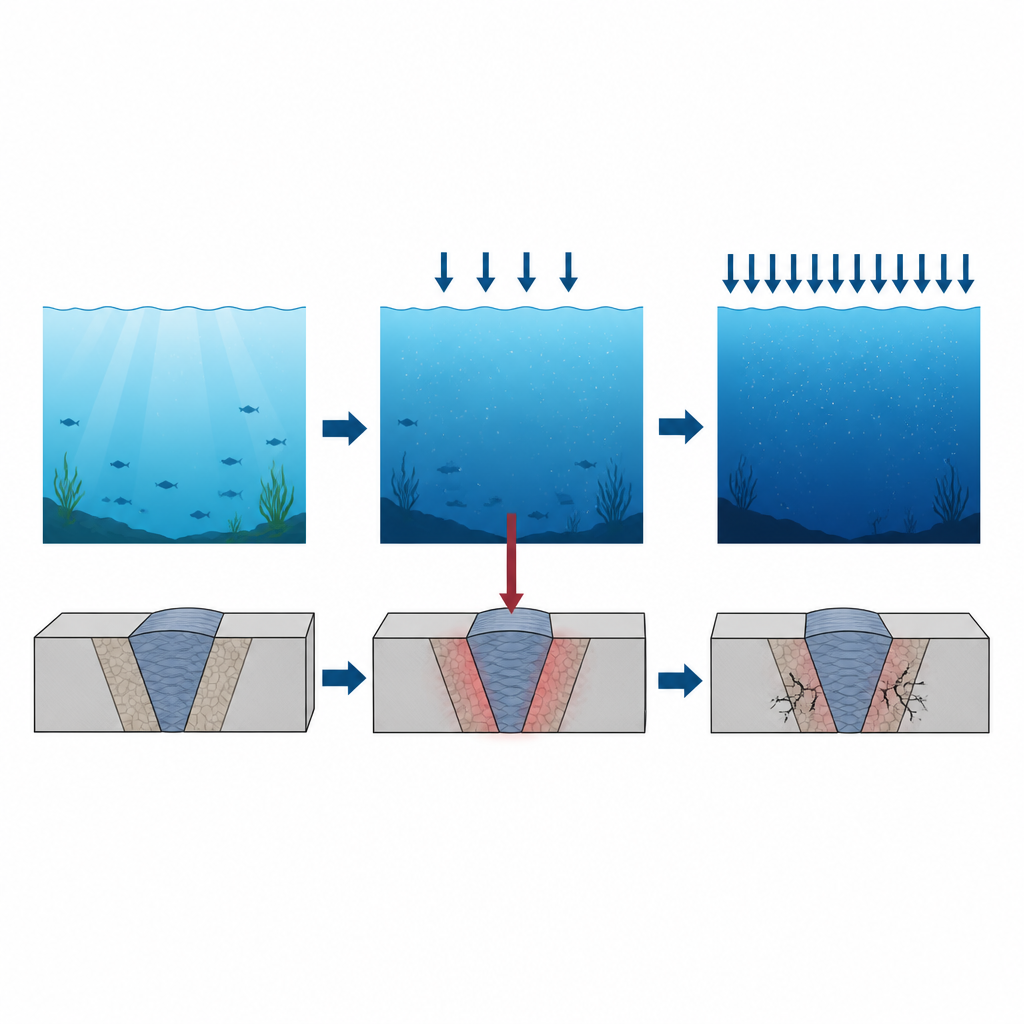
Different zones in a single weld
A welded titanium plate is not uniform. Heating and cooling during welding create three main regions: the base metal, which keeps its original structure; the weld metal at the center, which cools quickly and forms a fine, needle-like pattern; and a narrow band between them called the heat-affected zone. In this middle band, the metal partly transforms and develops complex, plate-like features. These subtle differences in internal structure mean that each region stretches, hardens, and resists cracking in its own way.
How pressure changes strength and cracking
The researchers pulled samples taken from each region in a simulated deep-sea tank filled with salty water, comparing normal pressure with a much higher pressure similar to that found hundreds of meters below the surface. They found that the base metal remained the strongest and most stretchable. The heat-affected zone and the weld metal were both weaker and less ductile, and high pressure made things worse for all three. A measure of stress corrosion sensitivity rose most sharply in the heat-affected zone, showing that this narrow band is the most likely place for cracks to start and grow in deep water.
What the broken surfaces reveal
By examining the broken ends of the samples under an electron microscope, the team could see how the metal failed. The base metal usually showed many tiny dimples, a sign of ductile, energy-absorbing failure. In salty water at high pressure, however, all regions developed smoother, flatter areas with river-like patterns that signal more brittle behavior. This shift was strongest in the heat-affected zone, where the crack paths became straighter and less tortuous. That straightening means less energy is needed for cracks to advance, making fracture easier once damage begins.
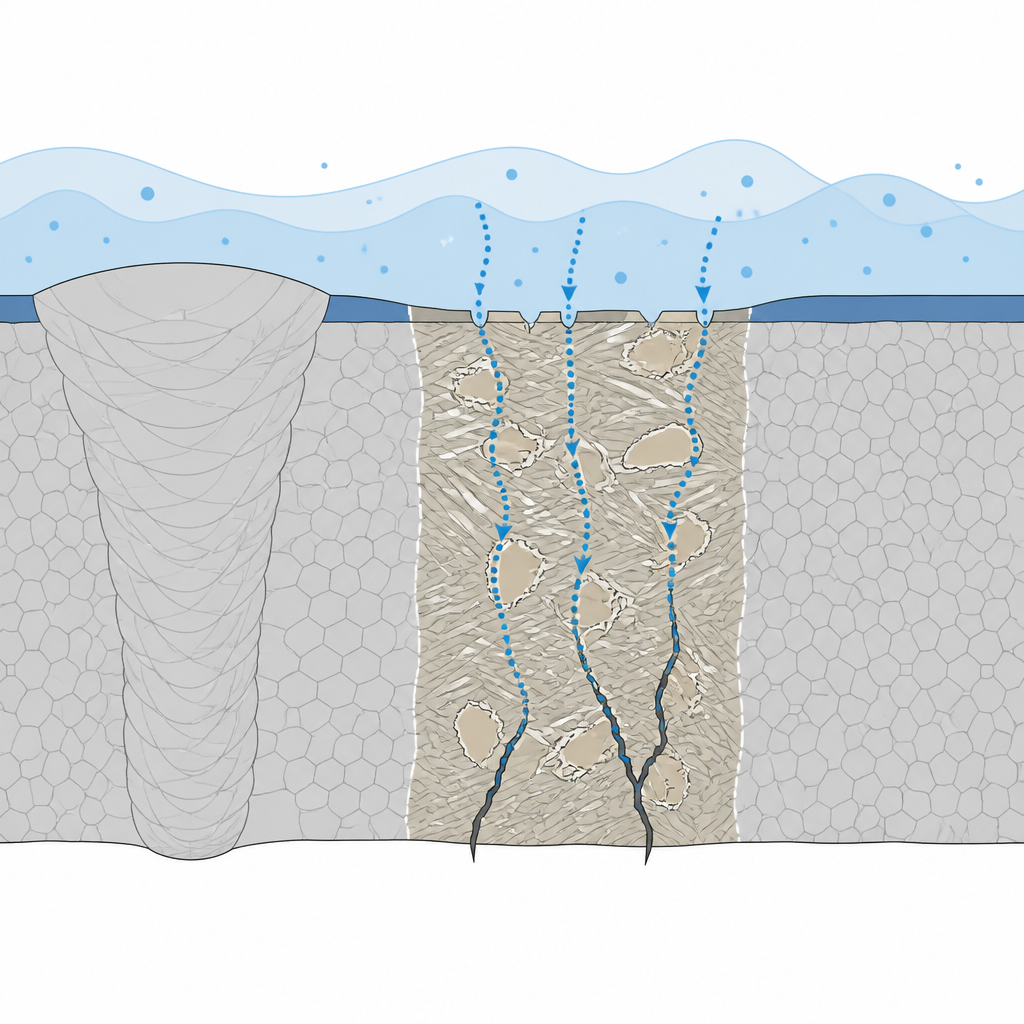
Hidden strain paths and a weakened skin
To understand why the heat-affected zone is so vulnerable, the authors mapped grain orientations and local distortions inside the metal. Under pressure, strain did not spread evenly. Instead, it concentrated in bands that cut through the plate-like structures in the heat-affected zone and forced the weld metal to deform through multiple slip paths, rapidly consuming its ability to stretch. At the same time, electrochemical tests showed how the protective surface film that normally guards titanium from corrosion grew more slowly and was less compact under pressure. This protective skin was thinnest and most unstable in the heat-affected zone, where it tended to break down rather than heal.
What this means for deep-sea safety
To a non-specialist, the key message is that not all parts of a titanium weld are equally safe when pushed deep underwater. The thin heat-affected zone, altered by the welding heat, combines two problems: it cannot spread strain smoothly, and its protective surface film struggles to repair itself in high-pressure salty water. Together, these factors make it the preferred path for cracks driven by both stress and corrosion. Recognizing this weak link allows designers and welders to adjust processes and inspection routines, improving the reliability of titanium structures that operate in demanding deep-sea environments.
Citation: Cui, Y., Liu, R., Liu, J. et al. Mechanistic investigation of hydrostatic pressure effects on stress corrosion cracking in Ti-6Al-4V welded joints. npj Mater Degrad 10, 61 (2026). https://doi.org/10.1038/s41529-026-00772-1
Keywords: titanium welds, deep sea corrosion, stress corrosion cracking, hydrostatic pressure, Ti-6Al-4V