Clear Sky Science · en
Hierarchal structures tuned electrocaloric and electromechanical performance in PVDF-based tetrapolymers
Cooler Homes Without Warming the Planet
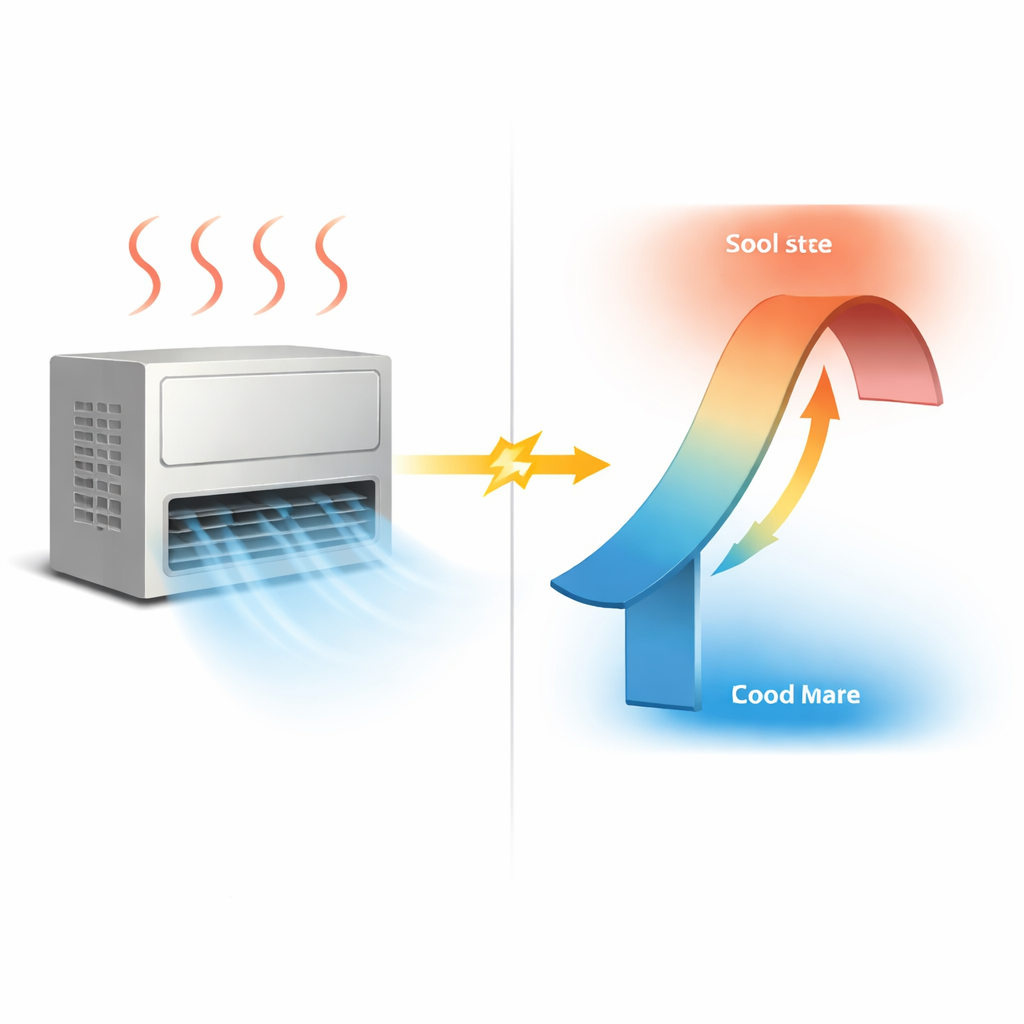
Air conditioners keep us comfortable, but they rely on gases that can leak into the atmosphere and trap heat. Engineers are searching for new kinds of cooling systems that do not depend on these gases and that use less electricity. This study explores a special class of plastics that can both pump heat and flex like tiny muscles when a voltage is applied, pointing toward thin, quiet, and highly efficient solid-state cooling devices.
A Plastic That Heats and Cools on Demand
The work centers on a fluorinated plastic known as a ferroelectric polymer, which naturally carries tiny electric dipoles that can be flipped by an applied field. When these dipoles rearrange, the material can either absorb or release heat, a behavior called the electrocaloric effect. At the same time, the dipoles tug on the material’s structure, causing it to expand or contract, which produces an electromechanical response. The team studies a "tetrapolymer"—a carefully designed blend of four chemical building blocks—that had already shown unusually strong cooling and mechanical effects at low voltages in earlier research.
Heat Treatment as a Hidden Tuning Knob
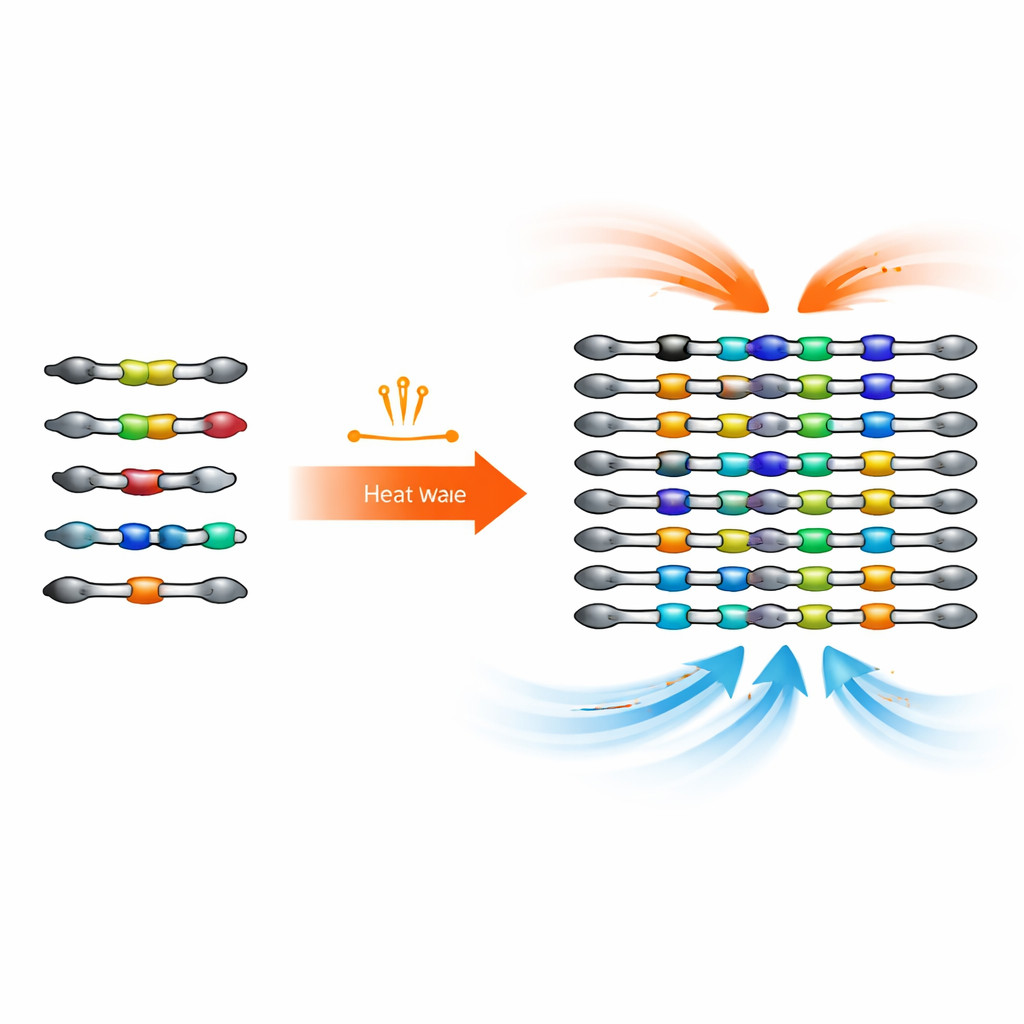
Although the ingredients of the polymer are fixed, their detailed arrangement inside the solid can be changed after the film is made. The authors focus on what happens when thin polymer films are heated to different temperatures for many hours, or rapidly melted and chilled. At first, the material forms thin, folded crystalline layers in which most of the bulkier chemical units are pushed out, leaving crystals that behave like a more ordinary ferroelectric plastic. When the films are annealed near their melting point, however, the chains have enough mobility to slide and straighten, transforming these thin layers into much thicker, extended ones. This structural reorganization opens space for previously excluded units to slip into the ordered regions.
Defects That Turn Into Helpful Features
Two types of added units play starring roles: double-bonded segments that locally stiffen the chain, and bulky side groups known as CFE. In thin crystals they are mostly banished to the softer surroundings, where they do little. After strong annealing, measurements of X-ray scattering show that the crystalline layers grow to three times their original thickness and now host many more of these units. The double-bonded segments can be pulled into and out of the ordered regions when an electric field is switched on and off, driving large reversible changes in structure. The CFE groups act more like anchors or “pins,” breaking up large domains into nanoscopic regions whose dipoles can reorient easily. Together, these effects convert the material’s behavior from a stiff, conventional ferroelectric into a more agile, weakly relaxor-like state that is highly responsive to electric fields.
Big Cooling and Big Motion at the Same Time
The pay-off of this internal rearrangement is dramatic. Films that were simply quenched or gently heated showed modest cooling capacity and small electric-field-driven strain. In contrast, films annealed at 120 °C, just below their melting point, displayed an electrocaloric entropy change of about 66.5 joules per kilogram per kelvin and a thickness contraction of roughly 6 percent under an applied field—several times higher than untreated samples. When the same optimized films were operated around 50 °C, close to a natural peak in their dielectric response, both effects became even stronger, reaching about 100.8 joules per kilogram per kelvin and 7.6 percent strain. The researchers further demonstrated a simple bendable device in which such a film is bonded to a metal strip; under voltage, it both moves and changes temperature, hinting at compact self-actuated cooling pumps.
What This Means for Future Cooling Technology
For non-specialists, the key message is that careful heat treatment can dramatically boost the performance of advanced cooling plastics without changing their chemical recipe. By thickening and reorganizing the tiny crystalline regions inside the polymer, the researchers created a material in which small electric fields can trigger large, reversible shifts in structure that simultaneously move heat and cause motion. This dual behavior is ideal for solid-state refrigerators that can shuttle themselves between hot and cold surfaces while pumping heat, all without compressors or greenhouse gases. The design principles uncovered here—using thermally tuned structures and smartly placed "defects"—offer a roadmap for crafting the next generation of quiet, efficient, and environmentally friendly cooling devices.
Citation: Rui, G., Zhu, W., Zou, Q. et al. Hierarchal structures tuned electrocaloric and electromechanical performance in PVDF-based tetrapolymers. npj Flex Electron 10, 50 (2026). https://doi.org/10.1038/s41528-026-00553-5
Keywords: electrocaloric polymer cooling, ferroelectric fluoropolymers, solid-state refrigeration, electromechanical actuation, thermal annealing of polymers