Clear Sky Science · en
Multifunctional, energy-autonomous textile sensors enabled by spray-coated two-dimensional heterostructures
Smart Clothes That Power Themselves
Imagine a T‑shirt that quietly tracks your temperature, the humidity around you, and even disease-related chemicals on your breath—without ever needing a battery. This paper describes just such a step toward truly intelligent clothing: fabrics that both generate their own electricity from your movement and use that energy to monitor your health and surroundings.
Turning Fabric Into an Active Material
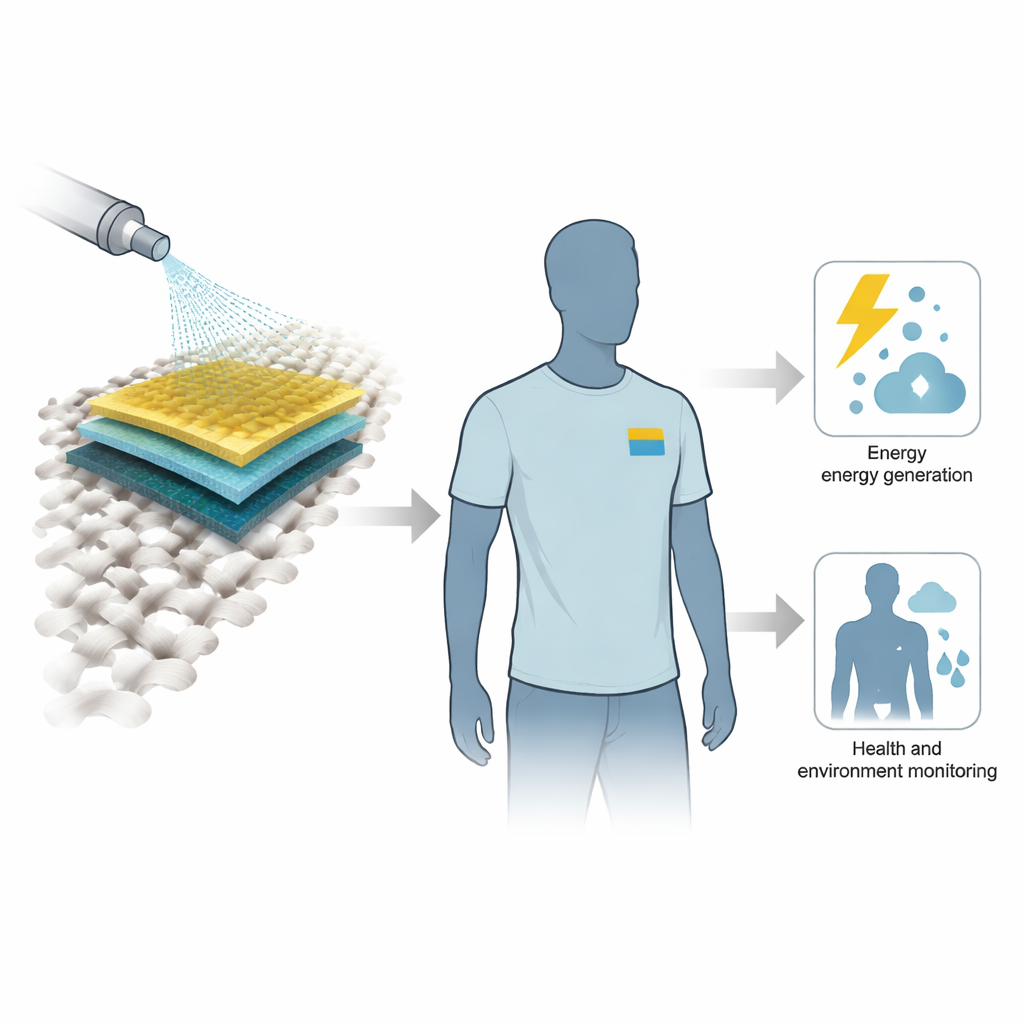
The researchers start by transforming ordinary polyester fabric into an electronic material using ultrathin "flakes" of carbon and metal compounds dispersed in a water–alcohol mixture. They use ultrasonic spray coating—similar in spirit to fine-paint airbrushing—to lay down microscopic layers of multilayer graphene (a highly conductive carbon material) and transition metal dichalcogenides such as molybdenum disulfide. These solutions act like electronic dyes, covering each fiber evenly while keeping the textile soft, flexible, and breathable. By stacking these coatings into carefully controlled heterostructures, they convert passive cloth into a structured surface that can move charges around when touched or pressed.
Harvesting Energy From Simple Motion
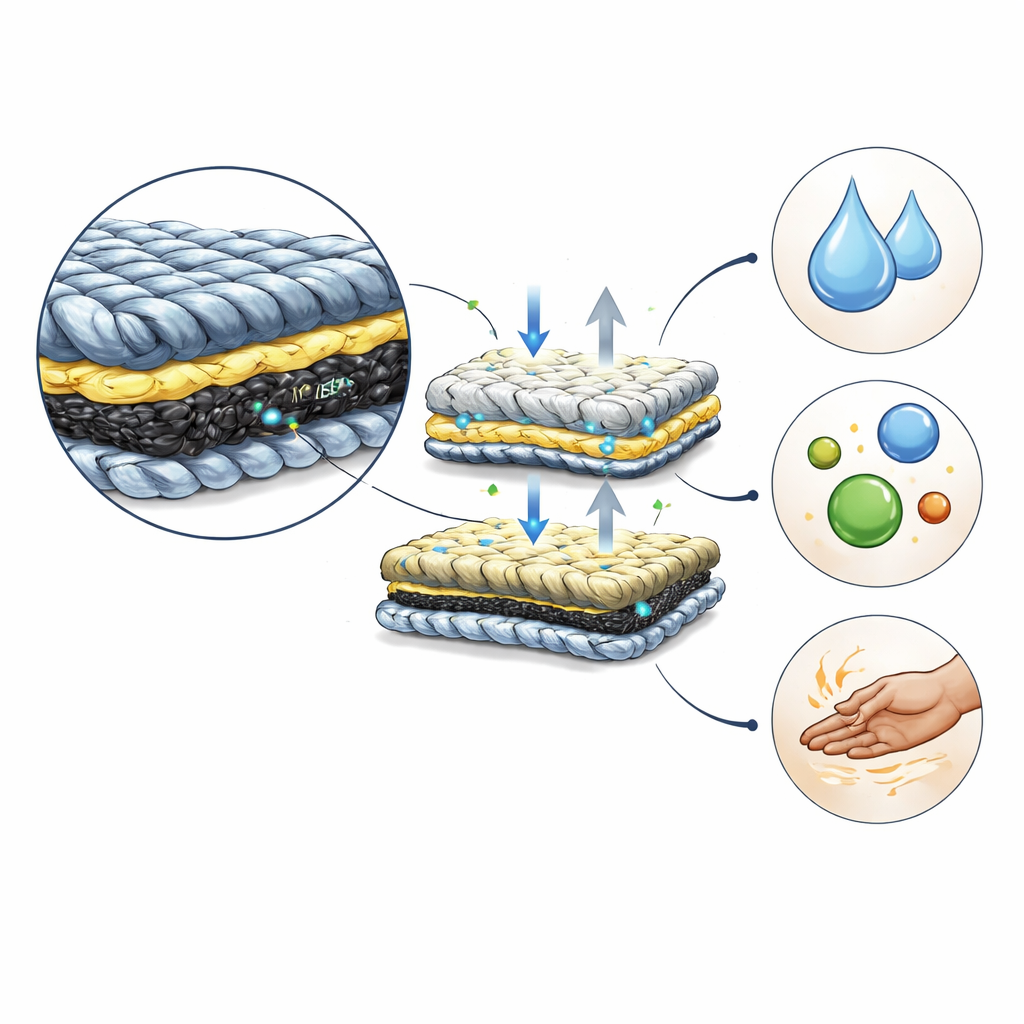
The coated fabric is built into a tiny device called a triboelectric nanogenerator, which produces electricity from contact and separation between two different surfaces. In this design, the sprayed textile layer serves as one side of the pair, and a second textile carrying copper and a plastic film completes the system. When the two pieces tap together and pull apart—as they would during walking, breathing, or gentle tapping—electrical charge moves through the graphene layer. Among several metal compounds tested, the version using molybdenum disulfide stood out, generating voltages of around 60 volts and a record power density for this kind of textile device, all in a package weighing about one gram. The output stays highly stable over months of use and after repeated bending, showing that the fabric can withstand the mechanical stress of everyday wear.
One Fabric, Many Sensing Abilities
Unlike many wearable gadgets that track only a single signal, this fabric is designed to sense several things at once, all using the same basic electrical output from tapping. Changes in humidity around the textile subtly alter how water molecules sit on the molybdenum disulfide surface, which in turn shifts the size and timing of the voltage pulses. The team shows that the fabric can detect small, reversible changes in moisture over a typical indoor range. They then expose the device to different vapors found in human breath and polluted air—including alcohols, acetone, heptane, toluene, and styrene—and find that each chemical leaves its own electrical “fingerprint.” In particular, acetone and styrene, which are linked to conditions such as diabetes and Parkinson’s disease, strongly modulate the output, allowing the fabric to act as a self-powered electronic nose.
Zooming In on Disease-Linked Vapors and Body Heat
The authors pay special attention to styrene, a hazardous industrial compound and a proposed breath biomarker for Parkinson’s disease. By decorating the molybdenum disulfide layer with tiny particles of a plastic called polythiophene—previously shown to light up in the presence of styrene—they greatly amplify the electrical response to this vapor. The resulting fabric achieves an exceptionally high change in current when exposed to styrene, outperforming earlier lab sensors that require external light sources or power-hungry electronics. The same textile platform also responds sensitively to small shifts in temperature around normal skin values. When mounted as a small patch and read out via a simple microcontroller and flexible light strip, a quick tap on warm skin can trigger a visible alert, hinting at future baby or elder-care garments that flag fevers with a touch.
What This Means for Everyday Life
In plain terms, this research shows that it is possible to “weave” power generation and multipurpose sensing directly into common fabrics using scalable, water-based processing. A single lightweight textile patch can harvest energy from ordinary motion and convert subtle changes in moisture, temperature, and specific airborne chemicals into readable electrical signals, all without batteries. While more work is needed to move from laboratory prototypes to washable, mass-produced clothing, the approach opens a realistic path toward smart garments that continuously watch over our health and environment while feeling—and looking—much like the clothes we already wear.
Citation: Kovalska, E., Routledge, J., Cancelliere, R. et al. Multifunctional, energy-autonomous textile sensors enabled by spray-coated two-dimensional heterostructures. npj Flex Electron 10, 49 (2026). https://doi.org/10.1038/s41528-026-00539-3
Keywords: self-powered wearable sensors, smart textiles, triboelectric nanogenerator, graphene and MoS2, breath and temperature monitoring