Clear Sky Science · en
Microgravity-enabled growth of uniform InAsSb bulk single crystal
Crystals Grown in Space
Many of the devices that let us see in the dark, sense tiny magnetic fields, or build future quantum computers rely on extremely pure crystals. But growing large, flawless crystals of advanced semiconductor materials on Earth is surprisingly hard because gravity stirs the molten ingredients in unwanted ways. This study shows that by growing crystals aboard a space station, where microgravity nearly cancels those forces, scientists can make a new kind of infrared-sensitive crystal that is far more uniform and defect-free than anything yet achieved on the ground.
Why This Special Crystal Matters
The material at the heart of this work is an alloy called InAsSb, made from indium, arsenic, and antimony. It belongs to a family of semiconductors prized for detecting mid‑infrared light—the kind used in thermal cameras, gas sensors, and some astronomy instruments—and for hosting fast-moving electrons useful in cutting‑edge electronics and quantum devices. InAsSb’s bandgap, which sets the color of light it responds to, can be tuned by adjusting how much antimony is mixed in. That tunability makes it attractive, but also introduces a problem: under normal gravity, the heavier atoms separate as the crystal freezes, so different parts of a bulk crystal end up with slightly different compositions and properties.
The Challenge of Growing Uniform Crystals on Earth
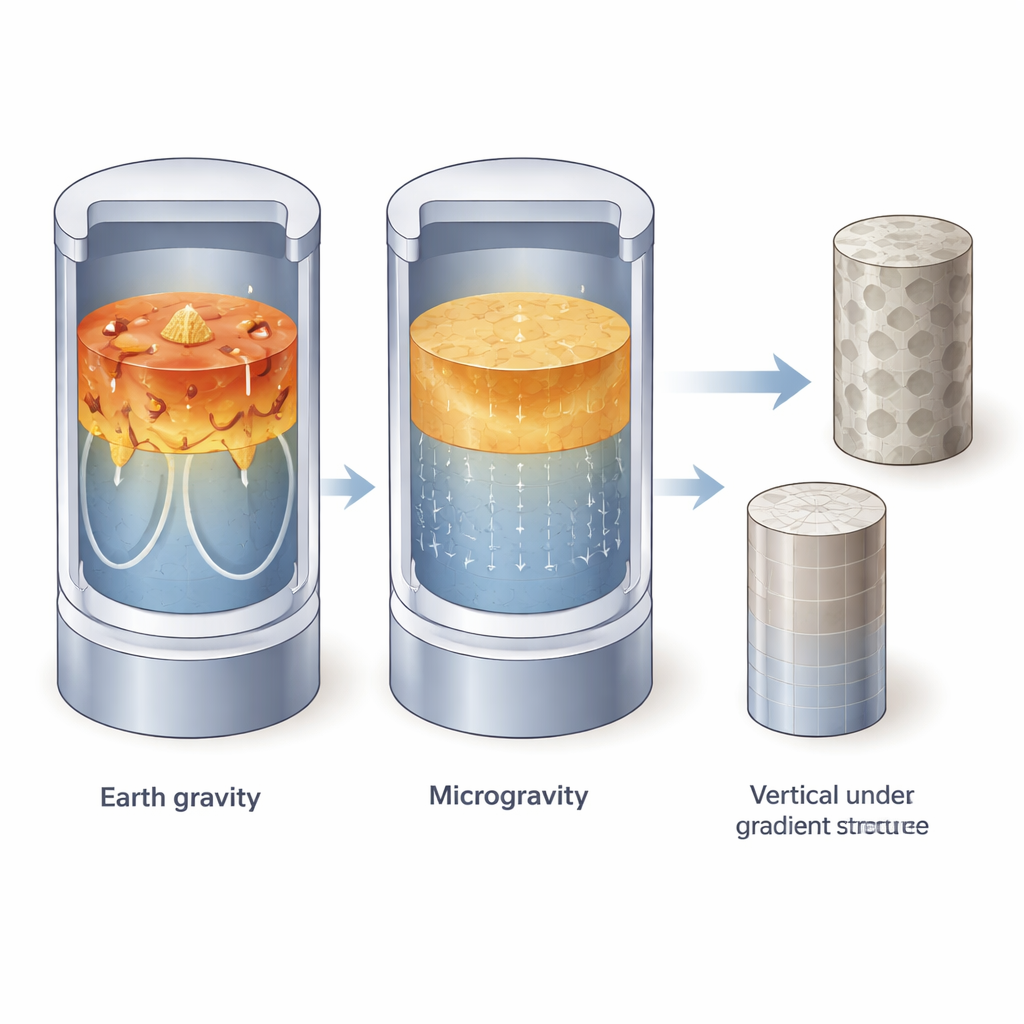
On Earth, when a crystal grows from a melt, gravity drives rolling currents inside the liquid. In alloys like InAsSb, antimony is strongly pushed out of the freezing front and collects in front of it. The combination of stirring, temperature differences, and this “solute pileup” bends and roughens the solid–liquid boundary and encourages defects, microscopic voids, and multiple crystal grains. Even with sophisticated techniques, attempts to grow bulk InAsSb on InAs seed crystals usually hit a practical limit: if the composition is pushed more than about 5% away from pure InAs, the result is often a patchwork of small crystals rather than a single, well‑aligned one.
Growing a Better Crystal in Orbit
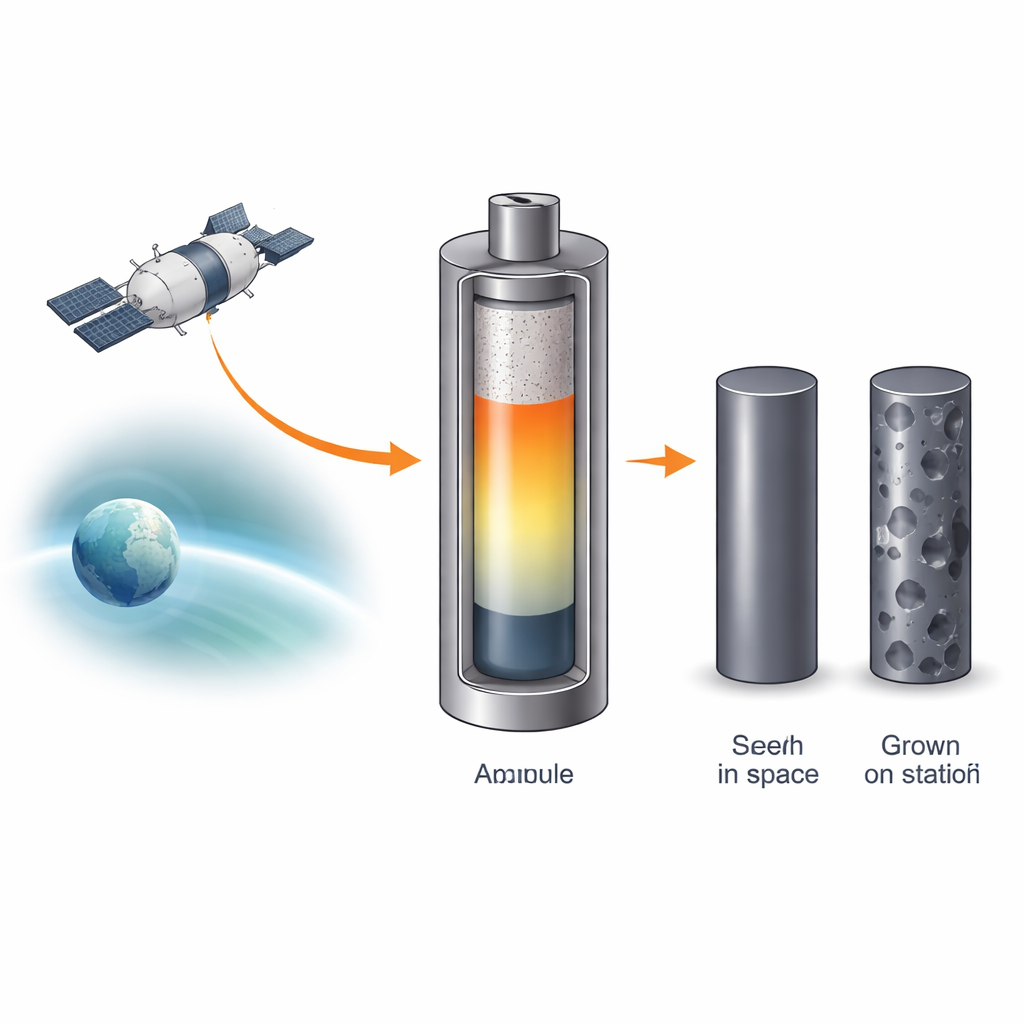
To bypass these gravity‑driven problems, the team sent a crystal growth experiment to the China Space Station. They used a method called vertical gradient freeze, loading a slender stack of InAs and InSb pieces into a sealed quartz crucible. Once heated, the central InSb melted and partially dissolved the InAs above and below, forming a liquid alloy. A carefully controlled temperature gradient was then swept along the ampoule so the crystal could grow slowly—about 0.04 millimeters per hour—onto an InAs seed. In microgravity, the molten alloy could no longer convect vigorously, so solidification was governed mostly by slow diffusion rather than churning flows. The result was an InAsSb crystal cylinder roughly 11 millimeters in diameter and 2.5 millimeters long with an antimony content of about 6.7% that remained uniform to within half a percentage point across its entire volume.
What Makes the Space Crystal Different Inside
Back on Earth, the researchers sliced the space‑grown and ground‑grown ingots and examined them with a suite of microscopes and spectrometers. Electron probe measurements showed that the space crystal had a flat, nearly perfectly planar growth front and remarkably even distributions of arsenic and antimony. The Earth sample, in contrast, contained millimeter‑scale voids and slightly larger composition swings. Structural probes such as Raman scattering, electron backscatter diffraction, X‑ray diffraction, and transmission electron microscopy all pointed to the same conclusion: the microgravity sample was a true single crystal, with sharply aligned atomic layers and no grain boundaries in the examined regions. Its dislocation density—a measure of line‑like defects in the lattice—was about ten times lower than in the terrestrial counterpart.
Sharper Electronic Performance
The authors also asked whether the structural perfection translated into better performance. Using infrared absorption, they found that the bandgap of the space‑grown InAsSb matched both theoretical calculations and known trends for this alloy family, confirming precise control of composition. Electrical tests showed an even more striking improvement: electrons traveled through the space‑grown crystal more than twice as easily as through the ground‑grown one, even though both had similar numbers of charge carriers. This indicates that in the poorer Earth‑grown crystal, electrons are mainly slowed by grain boundaries and dislocations, while in microgravity they move close to the theoretical speed limit for this material.
What This Means for Future Devices
For nonspecialists, the key message is that space offers a fundamentally different way to make materials. By nearly eliminating buoyant stirring in the melt, microgravity allows crystals like InAsSb to freeze in a calmer, more orderly fashion, greatly reducing defects and composition variations that are difficult to avoid on Earth. The study not only demonstrates a high‑quality infrared semiconductor crystal grown in orbit, but also provides guidance on how to improve ground‑based growth—such as shrinking the melt depth or using magnetic fields to tame convection. In the long run, such advances could lead to better infrared cameras, more sensitive sensors, and more reliable building blocks for quantum technologies, some of which may depend on crystals first perfected in space.
Citation: Huang, J., Zheng, H., Yin, Z. et al. Microgravity-enabled growth of uniform InAsSb bulk single crystal. npj Microgravity 12, 31 (2026). https://doi.org/10.1038/s41526-026-00581-5
Keywords: microgravity crystal growth, InAsSb semiconductor, infrared detectors, space materials science, single crystal alloys