Clear Sky Science · en
Simulated microgravity affects neuronal synaptic plasticity by regulating microglial pro-inflammatory activation
Why Space Changes the Brain
As human missions venture farther into space, from long stays on the International Space Station to possible journeys to Mars, scientists are racing to understand how weightlessness affects the brain. Astronauts often report balance problems, slowed thinking, and memory issues after spaceflight. This study explores one hidden player in these changes: the brain’s own immune cells, called microglia, and how simulated weightlessness can push them into a harmful, overactive state that may weaken the connections between nerve cells.
The Brain’s Housekeeping Cells Under Stress
Microglia act as the brain’s resident guardians and housekeepers. In healthy conditions, they quietly patrol the nervous system, trimming excess connections between neurons, clearing debris, and helping maintain a stable environment. When they sense trouble, they can switch into an activated mode and release chemical signals that call in help or fight threats. But if this activation is too strong or lasts too long, the same responses meant to protect the brain can instead damage neurons and their delicate communication points, known as synapses.
Simulating Weightlessness on Cells and Mice
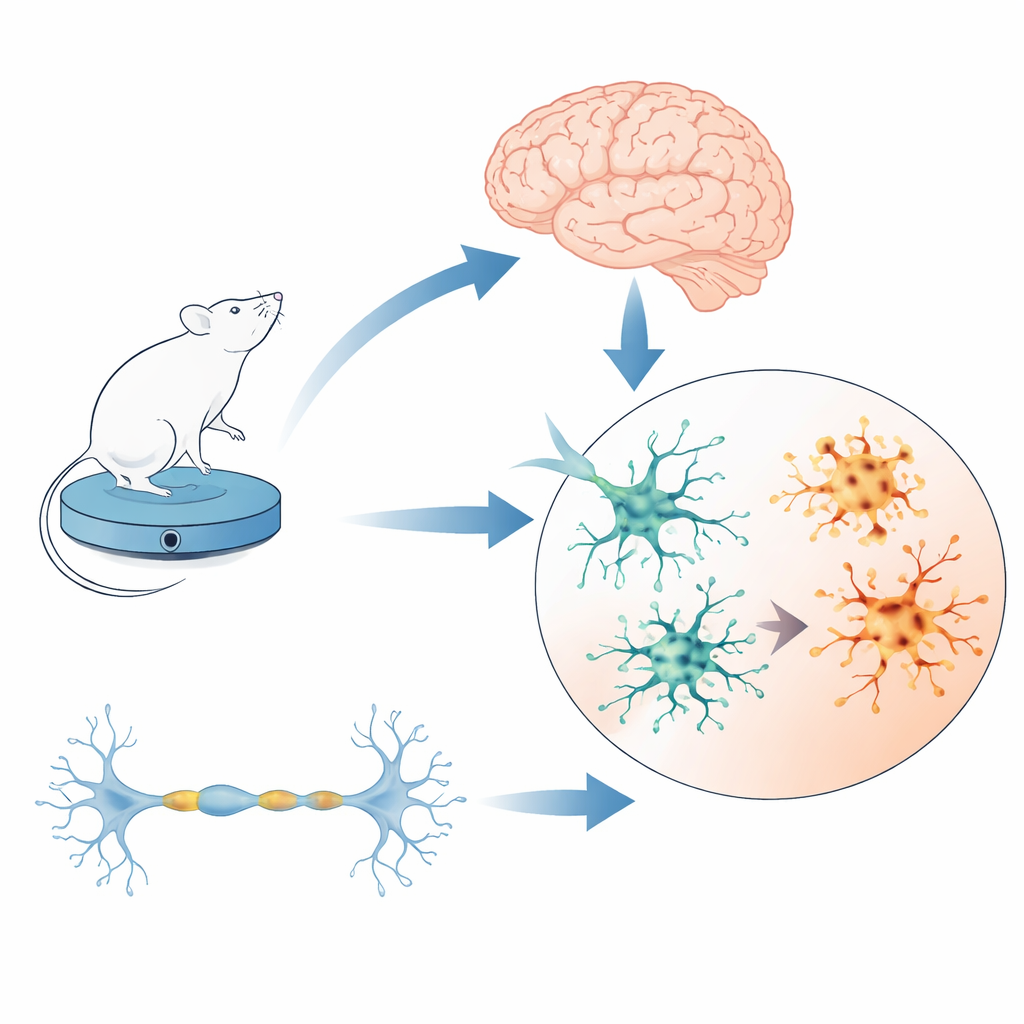
Because running experiments in orbit is difficult and expensive, the researchers used ground-based systems that mimic the effects of microgravity. For cell experiments, they grew mouse microglial cells in flasks mounted on a random positioning machine that constantly changes orientation, blunting the cells’ ability to sense a stable downward pull. For animal experiments, they used a hindlimb unloading setup in which mice are tilted and suspended so that body fluids shift toward the head, imitating a key feature of weightlessness inside spacecraft. Together, these models allowed the team to observe both cell-level and whole-brain responses to simulated microgravity.
From Calm Guardians to Inflammatory Attackers
Under simulated microgravity, microglial cells changed shape from finely branched forms into rounder, amoeboid forms associated with activation. Molecular tests showed that genes and proteins linked to inflammatory behavior increased, while markers of a more soothing, repair-oriented state declined. A detailed analysis of gene activity highlighted one key regulator called Arhgap18, which normally reins in a molecular switch known as RhoA. In microgravity, Arhgap18 levels dropped, while RhoA and its partner ROCK2, along with a signaling relay called ERK1/2, became more active. This chain of events boosted the production of inflammatory molecules. When the team artificially reduced Arhgap18 even without microgravity, the same inflammatory signaling pathway lit up, confirming that this protein acts as a crucial brake on microglial overreaction.
Fragile Connections Between Neurons Weaken
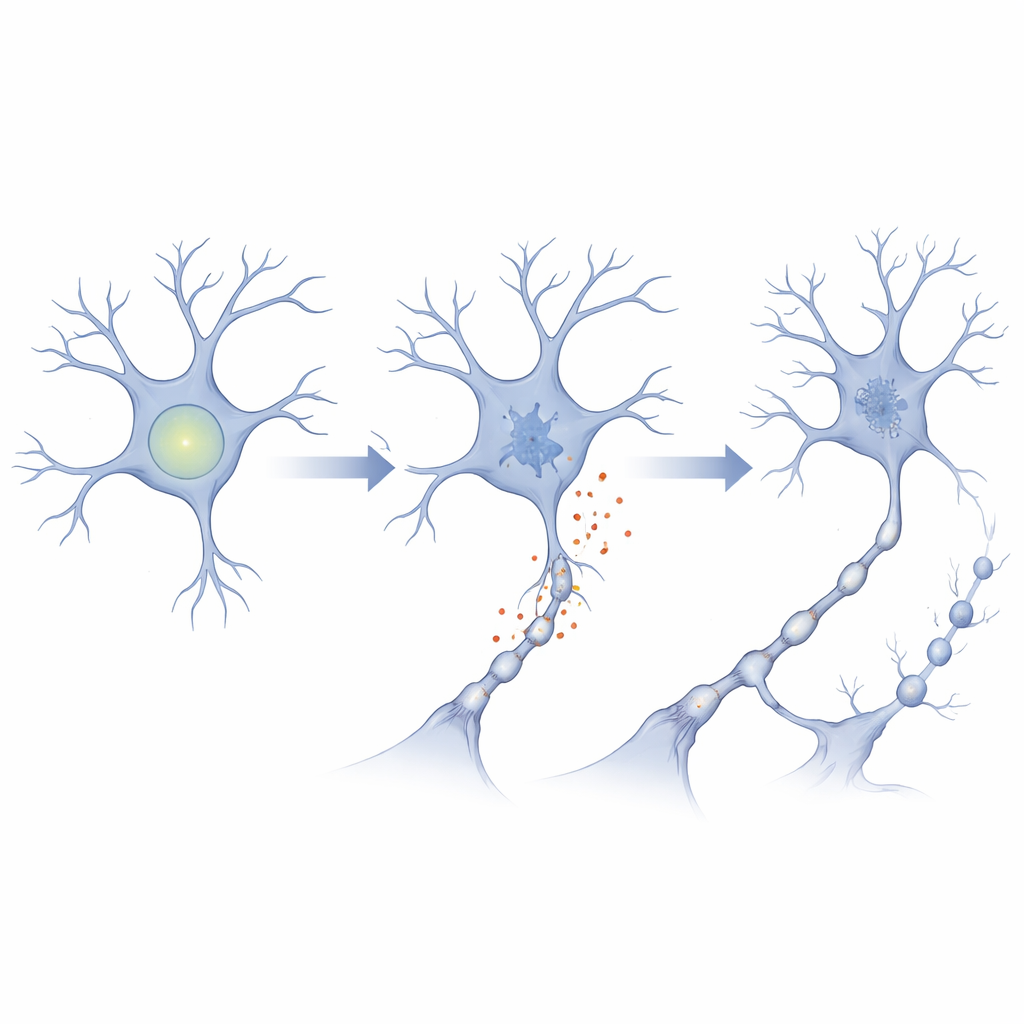
To see how activated microglia affect neurons, the researchers exposed cultured nerve-like cells to fluid taken from microglia that had experienced simulated microgravity. The neurons then showed lower levels of several proteins that support synapses and their ability to adapt—features central to learning and memory. In the hindlimb-unloaded mice, similar losses appeared in the cortex and hippocampus, brain regions important for movement control and memory. Synapse-related proteins declined, and microscopic imaging revealed reduced signals from both sides of excitatory synapses, hinting that these communication points were less numerous or less robust after simulated weightlessness.
What This Means for Future Space Travelers
Taken together, the findings suggest that microgravity can push microglia into a pro-inflammatory mode by dialing down Arhgap18 and unleashing the RhoA–ROCK2–ERK1/2 pathway. Once activated, these cells release factors that erode the molecular underpinnings of synaptic plasticity, potentially undermining learning, memory, and coordination. While more work is needed to prove direct cause-and-effect and to measure behavioral changes, this study points to microglial signaling as a promising target for protecting astronauts’ brains on long missions—and offers fresh clues about how physical forces shape brain health even here on Earth.
Citation: Chen, X., Yuan, C., Li, Z. et al. Simulated microgravity affects neuronal synaptic plasticity by regulating microglial pro-inflammatory activation. npj Microgravity 12, 34 (2026). https://doi.org/10.1038/s41526-026-00580-6
Keywords: microgravity, microglia, neuroinflammation, synaptic plasticity, spaceflight health