Clear Sky Science · en
Spaceflight stressors impact on mitochondrial function and the risk for development of ocular pathology
Why Space Travel Puts Our Eyes to the Test
As humans prepare for longer journeys to the Moon and Mars, scientists are uncovering an unexpected vulnerability: our eyes. Astronauts returning from long missions sometimes show changes in vision, swelling at the back of the eye, or early lens clouding similar to cataracts. This review article brings together evidence that many of these problems may trace back to tiny power plants inside our cells—mitochondria—and explains why protecting them could be key to preserving sight in space and improving eye health on Earth.
The Harsh Light of Space
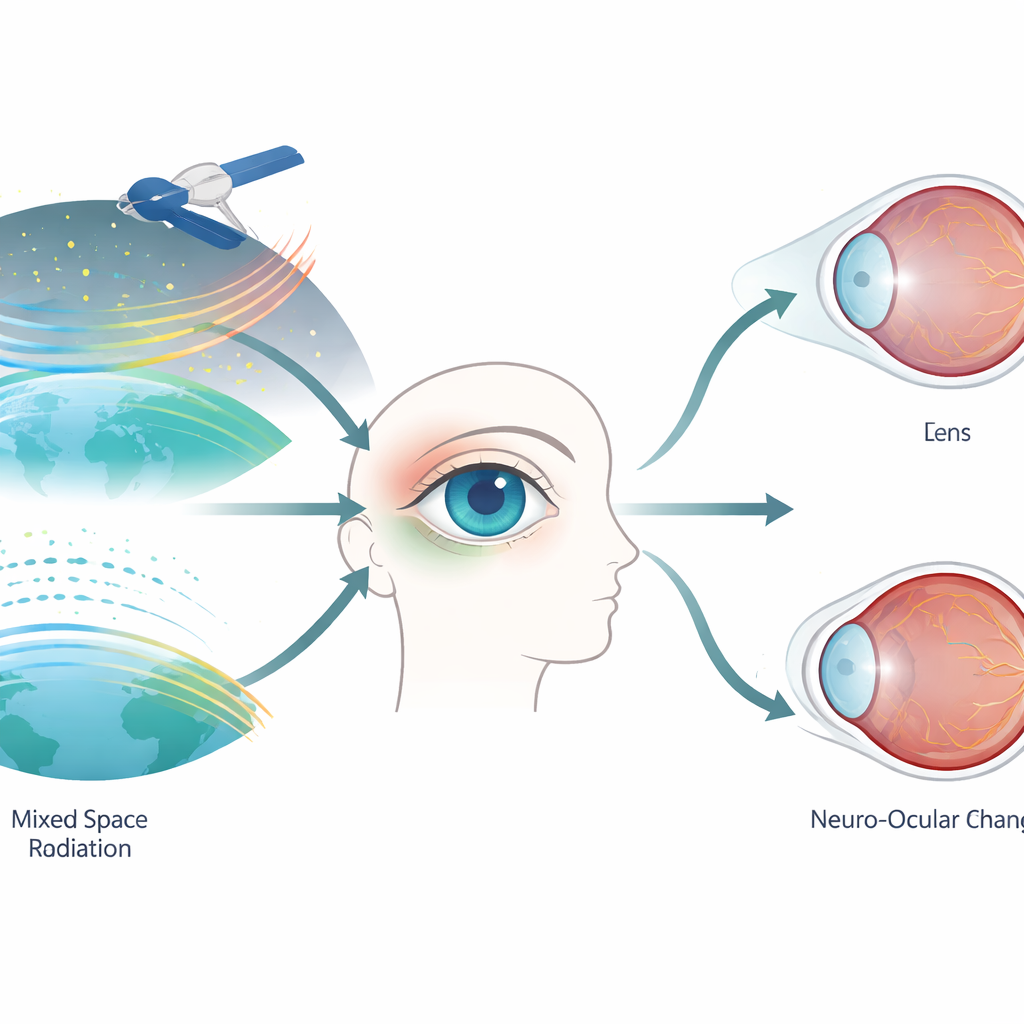
Unlike life on Earth’s surface, astronauts live in an environment filled with high‑energy particles from the Sun, distant galaxies, and Earth’s radiation belts. These forms of ionizing radiation can penetrate spacecraft and human tissue, delivering doses that grow with mission length and distance from Earth. Comparisons with cancer patients receiving radiation therapy to the eye show that even relatively modest doses can increase the risk of cataracts and retinal injury. Although treatment beams and space radiation differ, both can damage delicate eye structures, especially when exposure is chronic or involves heavy charged particles that deliver intense bursts of energy along their paths.
Weightlessness and Fluid Shifts
Spaceflight does not just change radiation exposure; it also removes gravity. In weightlessness, body fluids shift toward the head, increasing pressure around the brain and eyes. Many astronauts on long missions develop a cluster of findings now called Spaceflight Associated Neuro‑Ocular Syndrome (SANS): swelling of the optic nerve head, flattening of the back of the eye, ripples in the light‑sensing layer, and shifts toward farsightedness. Several theories try to explain SANS, including altered cerebrospinal fluid flow and pressure in the tissues behind the eye. The review argues that these mechanical factors likely interact with deeper biological changes, especially those affecting mitochondria.
The Eye’s Energy Factories Under Stress
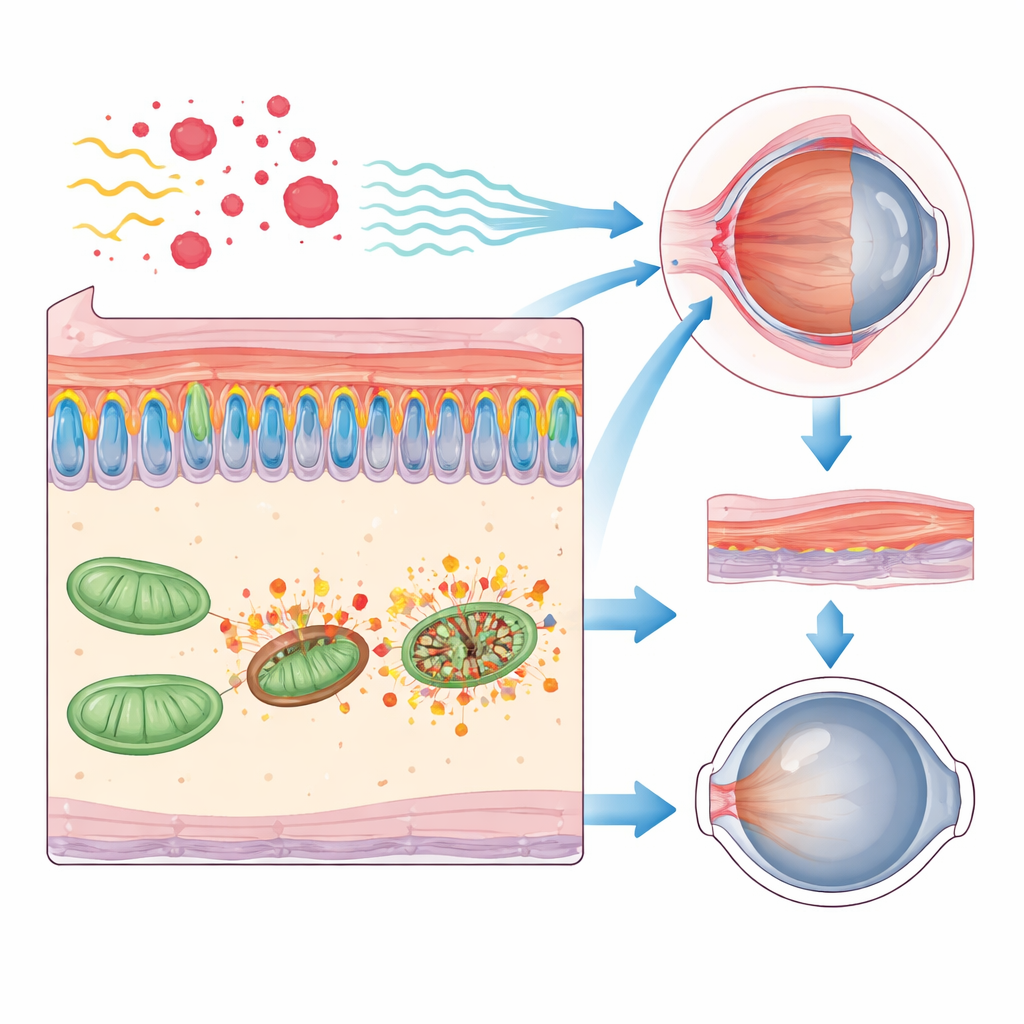
The retina and parts of the lens are among the most energy‑hungry tissues in the body, packed with mitochondria that constantly produce fuel and manage harmful by‑products called reactive oxygen species. Mitochondria in the central retina, where sharp vision resides, and around the edge of the lens are especially dense. Studies in mice flown on the International Space Station, in simulated microgravity experiments, and in astronauts themselves all show a common theme: spaceflight disrupts mitochondrial function across many organs, including the eye. Damaged mitochondrial DNA, poor repair capacity, and excess reactive oxygen species can set off a vicious cycle—less efficient energy production, more oxidative stress, and progressive injury to photoreceptors, supporting cells, and lens proteins.
From Cellular Damage to Cataracts and SANS
By mapping where mitochondria cluster inside the eye and where disease shows up, the authors highlight a striking match. Astronauts most often develop cataracts in the outer, cortical regions of the lens, precisely where mitochondria are concentrated in the lens epithelium and newly forming fibers. Similarly, SANS affects the back of the eye, where the retina and its supporting layer are rich in mitochondria and blood vessels. Radiation and oxidative stress can fragment mitochondria, disrupt their membranes, and alter their number, ultimately promoting clouding of the lens and thinning or swelling of retinal tissues. Nutritional factors may worsen the problem: changes in B‑vitamin status during missions can weaken antioxidant defenses that normally keep mitochondrial stress in check.
Protecting Astronaut Vision and Helping Patients on Earth
The review concludes that spaceflight‑related eye disease is likely a multifactorial process, but mitochondrial dysfunction is a central player that links radiation, microgravity, and nutrition. Understanding exactly how different radiation types, mission profiles, and individual susceptibilities damage mitochondria in the lens and retina will guide new countermeasures, from improved shielding and spacecraft design to targeted antioxidant “cocktails” and mitochondrial‑protective drugs. Insights gained from astronauts’ eyes could also shed light on common conditions such as age‑related macular degeneration and cataracts on Earth, making space a powerful laboratory for understanding—and ultimately preserving—human vision.
Citation: LeBlanc, D.P., Butterfield, B., Jimenez-Chavez, L. et al. Spaceflight stressors impact on mitochondrial function and the risk for development of ocular pathology. npj Microgravity 12, 30 (2026). https://doi.org/10.1038/s41526-026-00565-5
Keywords: spaceflight eye health, mitochondrial dysfunction, radiation and vision, spaceflight associated neuro-ocular syndrome, astronaut cataracts