Clear Sky Science · en
Illumination optimization and low-power trapping of Limnospira indica PCC 8005 using bulk acoustic waves in microgravity
Growing Air and Food for Space Travelers
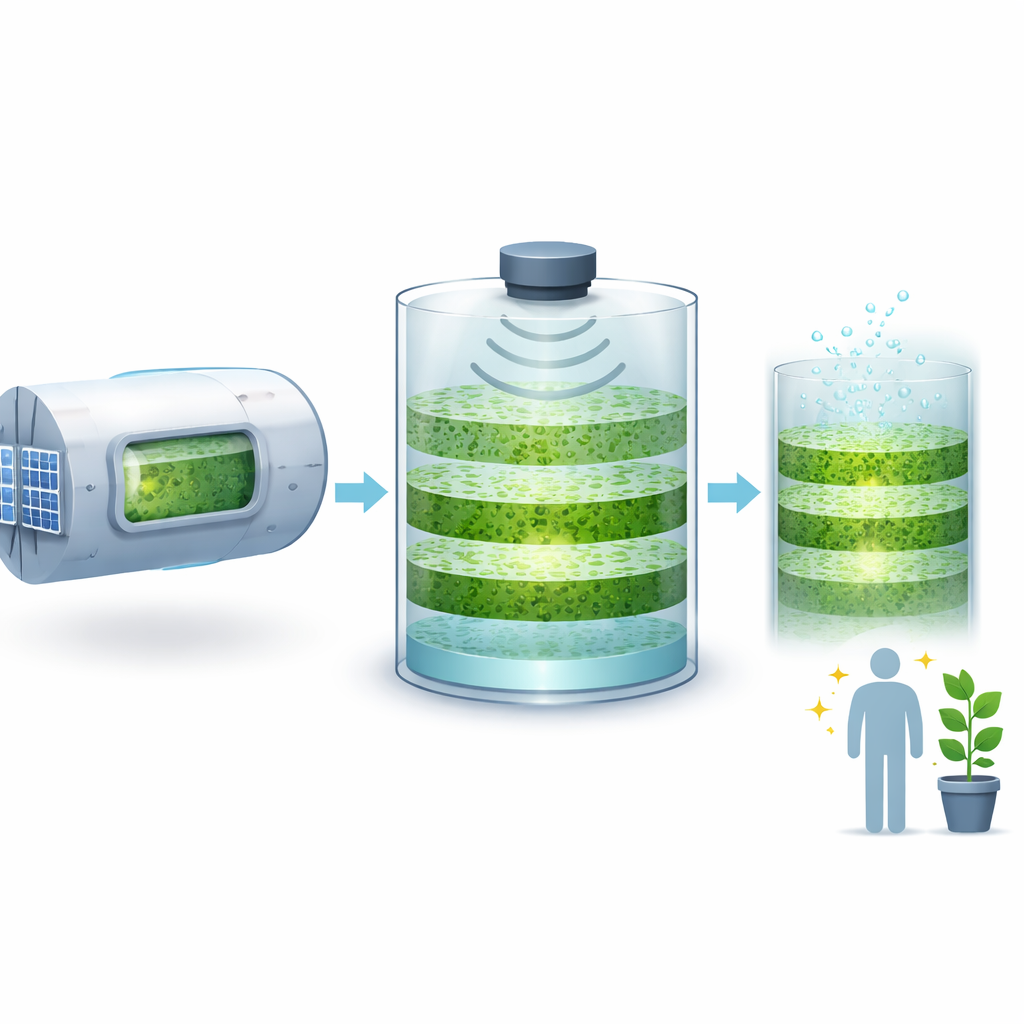
Long missions to the Moon or Mars will need compact, reliable ways to make oxygen and food without constant resupply from Earth. One promising option is to use microscopic, plant-like microbes that turn light and carbon dioxide into oxygen and edible biomass. This study explores a clever way to gently herd these microbes with sound waves in weightlessness so they catch more light, work more efficiently, and use far less power than traditional mixing systems—an important step toward sustainable life support in space.
Why Tiny Spirals Matter in Space
The researchers focus on a filamentous cyanobacterium called Limnospira indica, already a workhorse candidate in European life-support projects. In a closed space habitat, this organism could both refresh the air with oxygen and provide nutritious biomass for astronauts. But there is a basic physical problem: in dense liquid cultures, light is quickly absorbed and scattered in the first few centimeters, leaving the deeper regions too dim for photosynthesis. This depth limit, called the “compensation point,” means a large fraction of the culture contributes little to oxygen production. On Earth, engineers typically stir photobioreactors to move cells in and out of the bright zone, which consumes power and adds mechanical complexity. The authors ask whether, in space, sound waves could passively rearrange the microbes so that more of them sit in well-lit regions without constant stirring.
Shaping Microbes with Invisible Sound
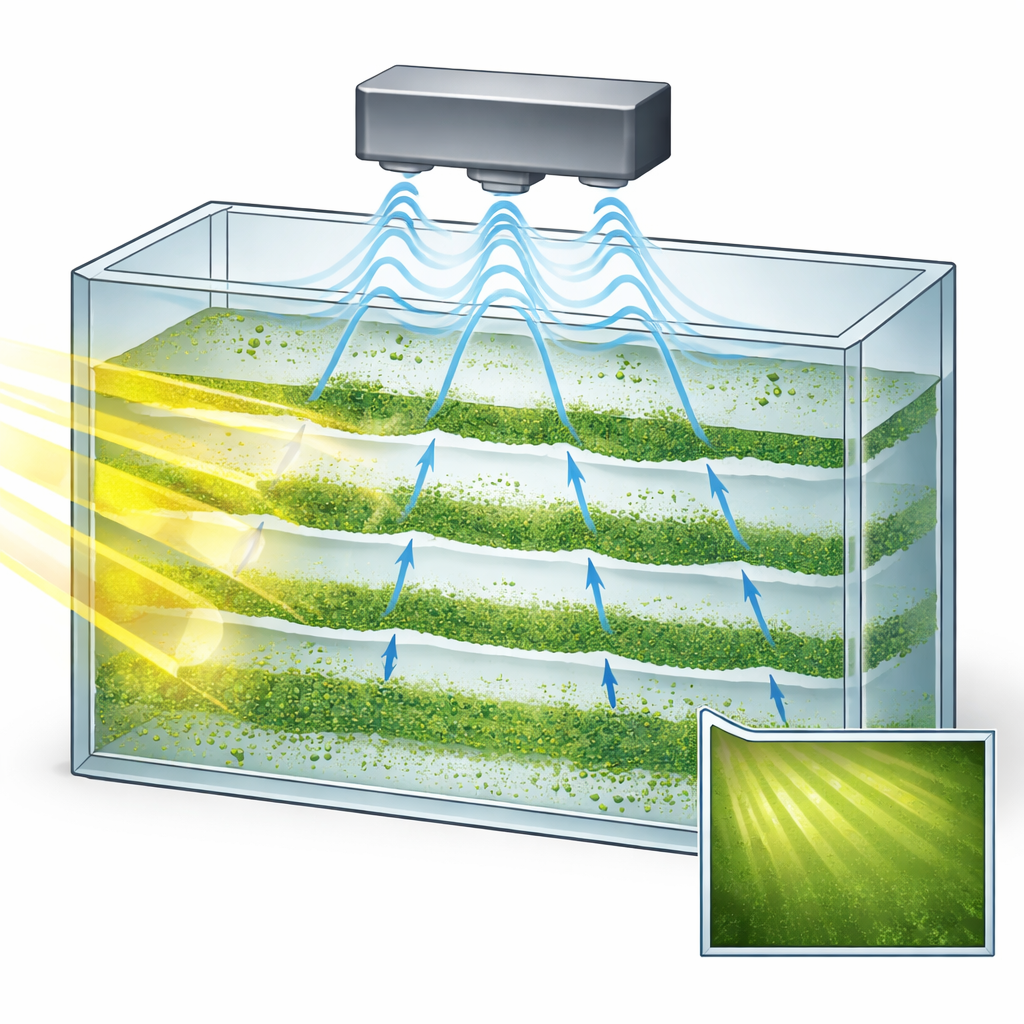
The team uses acoustic levitation, a technique where an ultrasonic transducer and a reflecting wall create a standing sound wave inside a small fluid chamber. Particles whose density and compressibility differ from the surrounding liquid feel a gentle push from the sound field and migrate toward specific planes called pressure nodes. Although theory is best developed for tiny, rigid spheres, the target microbes here are long, flexible, spiral filaments hundreds of micrometers long. In spite of this complexity, when the researchers filled a millimeter-scale chip with a suspension of living Limnospira and switched on the ultrasound, the organisms rapidly collected into multiple thin horizontal layers, each only about 100 micrometers thick and spaced by clear liquid gaps. Over seconds, the layers developed compact, band-like clusters that remained stable without harming cell growth or shape.
Letting Light Reach Deeper Layers
This layered structure is more than a curiosity: the transparent gaps act like light tunnels. To see how much this helps, the researchers ran Monte Carlo simulations of how light travels through two reactors containing the same total amount of biomass. In the “bulk” case, cells are spread evenly throughout the volume, as in a conventional well-mixed culture. In the “leaf” case, cells are concentrated into a few dense layers separated by clear fluid, mimicking the acoustic pattern seen in experiments. The simulations show that in the bulk configuration, light intensity falls nearly to zero within the first six centimeters, recreating the familiar compensation-point bottleneck. In the layered configuration, however, light decays more slowly and maintains a useful level far deeper into the reactor because photons pass through the clear zones and continue to illuminate downstream layers. Despite having locally higher cell density, the layers themselves still receive substantial light, indicating that self-shading is modest and that more cells can remain above the photosynthesis threshold.
Testing Traps in Microgravity
To understand how well acoustic trapping works in space-like conditions, the team flew their chip on parabolic flights that provide about 22 seconds of microgravity at a time. During each weightless phase, they swept the excitation frequency slightly around resonance so that the levitation planes shifted up and down. If the acoustic force was strong enough, the microbial layers followed this motion, and the amplitude of their oscillation served as a measure of trap strength. In microgravity, stable oscillations appeared at much lower voltages than on Earth. The minimum electrical power needed to hold layers in place was about 0.42 milliwatts in weightlessness, compared with 1.4 milliwatts in normal gravity—a factor-of-three saving. Remarkably, when they repeated the experiment in a much taller chamber containing twenty times more culture, the required power barely changed, suggesting that the approach scales favorably with reactor size.
Toward Quiet, Efficient Space Bioreactors
Taken together, the results show that gentle sound fields can safely gather spiral cyanobacteria into self-organized layers that let light penetrate more evenly while consuming only milliwatts of power—far less than typical mechanical stirrers. In microgravity, where sedimentation disappears and layers can remain intact even after the sound is switched off, this method could cut energy use further. With careful control of flow to refresh nutrients and remove oxygen, acoustically structured reactors may offer a low-maintenance way to recycle carbon dioxide into breathable air and biomass on long-duration missions. For future lunar bases or voyages to Mars, such quiet, energy-efficient photobioreactors could become key components of closed life-support systems.
Citation: Dupont, B., Benoit-Gonin, X., Vincent-Bonnieu, S. et al. Illumination optimization and low-power trapping of Limnospira indica PCC 8005 using bulk acoustic waves in microgravity. npj Microgravity 12, 32 (2026). https://doi.org/10.1038/s41526-025-00553-1
Keywords: acoustic levitation, photobioreactor, microgravity, cyanobacteria, life support systems