Clear Sky Science · en
High-entropy solid electrolytes discovery: a dual-stage machine learning framework bridging atomic configurations and ionic transport properties
Why this research matters
Modern electric cars and portable devices increasingly rely on solid batteries that are safer and more compact than today’s liquid-based designs. A key piece of this puzzle is the solid electrolyte, the material that lets lithium ions move between the battery’s electrodes. This article describes a new computer-guided way to search through thousands of complex electrolyte recipes to find those that let ions zip through quickly, which could help engineers design better solid-state batteries far more efficiently.
The challenge of crowded chemical recipes
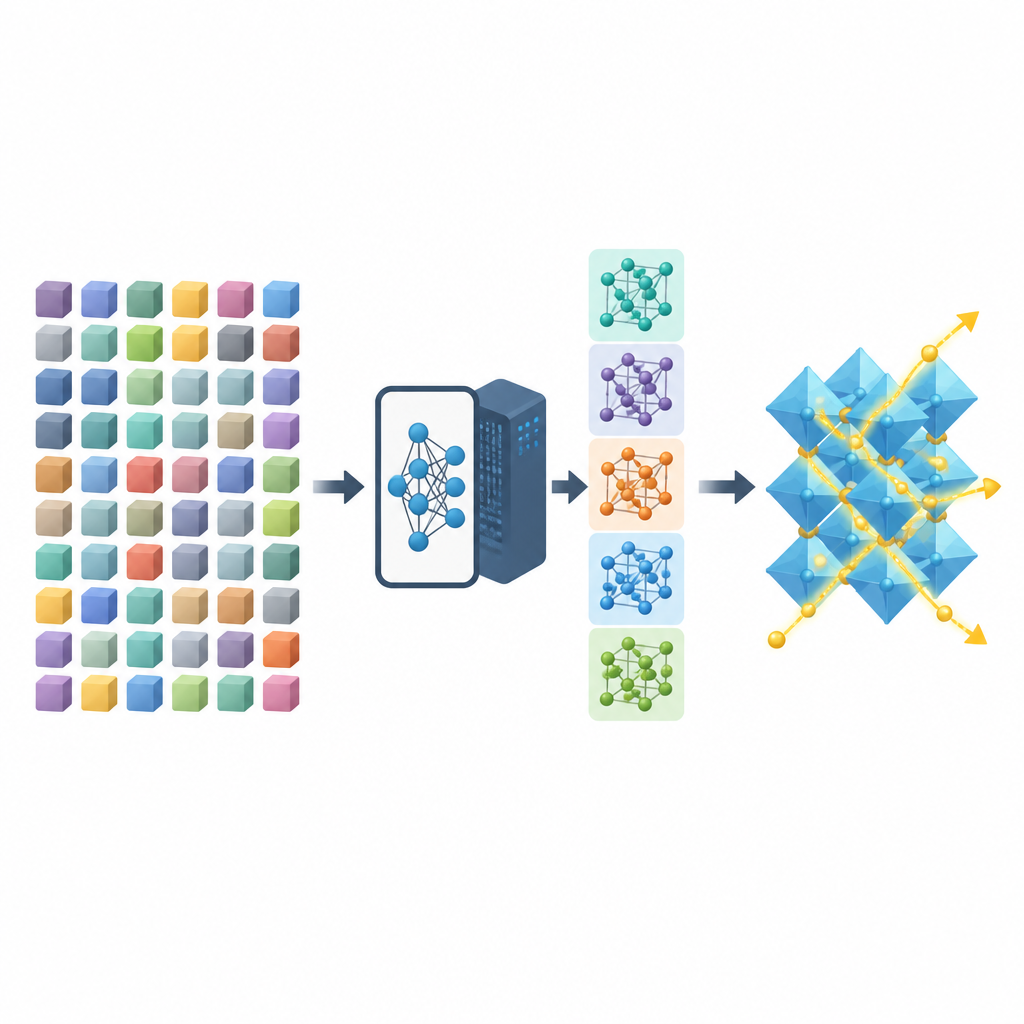
Scientists have discovered that “high-entropy” electrolytes, where many different elements randomly share atomic sites, can sometimes carry lithium ions very well. But this chemical richness comes at a price. The number of possible combinations explodes, and traditional trial-and-error experiments or slow quantum calculations cannot realistically test them all. In these crowded structures, small shifts in atom positions change how easily ions can weave through the material, making it hard to guess winning formulas in advance.
Using smart models as a shortcut
The authors tackle this challenge with a dual-stage machine learning framework built around a well-known solid electrolyte called LZSP. In the first stage, they fine-tune an existing neural network potential, CHGNet, so it can mimic expensive quantum calculations for this family of materials. This tuned model rapidly relaxes atomic structures and runs virtual heating tests that track how lithium ions wander over time. It reaches accuracy close to trusted quantum methods while cutting computing time from days to hours or less.
Connecting structure to ion motion
The second stage turns the problem into something even faster. Instead of simulating every candidate in detail, the researchers train a separate model that links simple structural features to how far lithium ions tend to move. They feed in quantities such as how many lithium atoms are present, how distorted certain atomic cages are, and how stretched the crystal cell is. The model learns which patterns go with sluggish motion and which go with long ion jumps. With this shortcut, the team can quickly estimate ion mobility for thousands of hypothetical materials without running full simulations each time.
Finding stand-out solid electrolytes
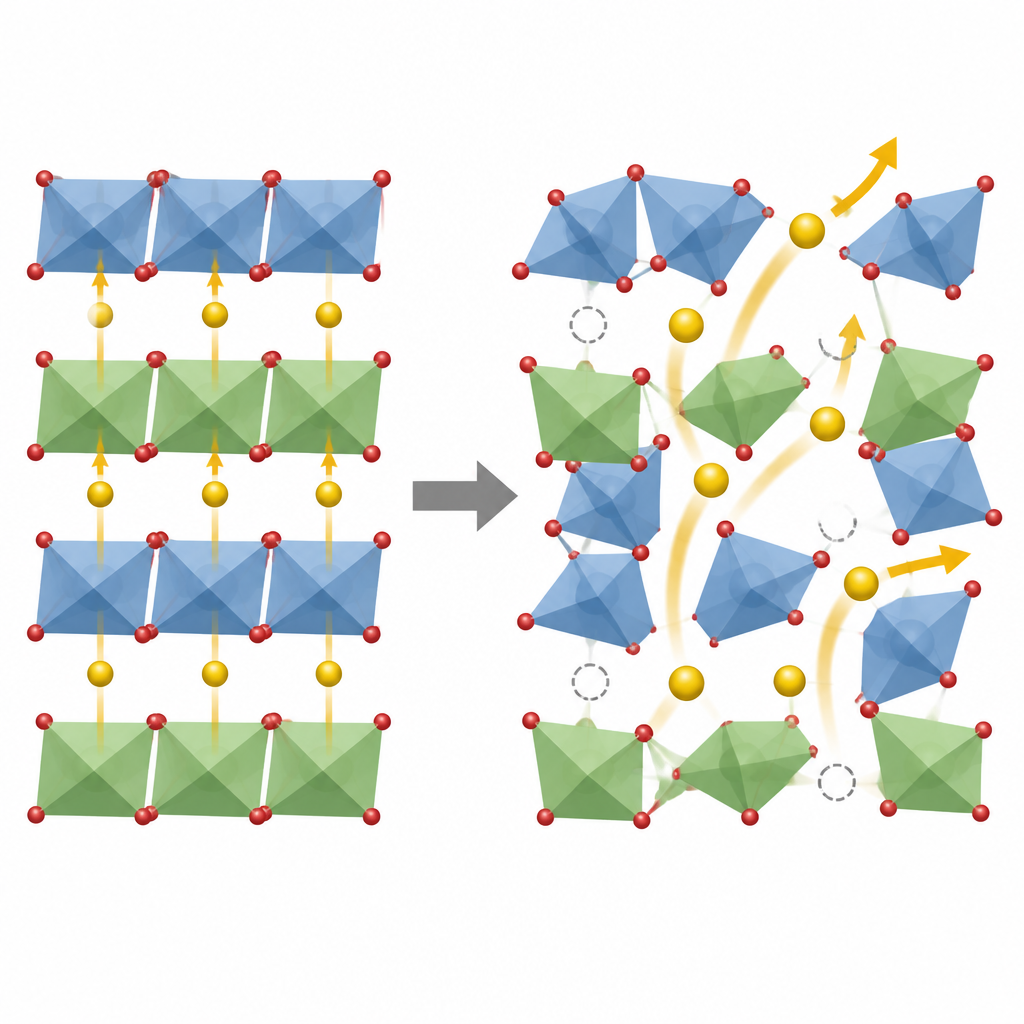
Armed with this two-step strategy, the researchers scan a huge space of five-element versions of LZSP, covering 4575 different compositions. Their feature-based model acts as a filter, ranking candidates by expected ion mobility. They then apply the more detailed simulation only to the top-ranked few. This pipeline uncovers a particular mix of zirconium, hafnium, tin, titanium and niobium that is predicted to carry lithium ions about a thousand times better at room temperature than the original LZSP. The calculations also reveal why: the right mix of elements creates lithium vacancies and gentle distortions in the atomic framework that open up connected, low-resistance pathways for ion flow while keeping the lattice stable.
What the findings mean for future batteries
For non-specialists, the key message is that the authors have built a smart sieve for battery materials. Instead of checking every possible recipe with slow, detailed calculations or lab experiments, they use fast, trained models to rule out poor performers and highlight a small group worth close attention. This approach not only points to a particularly promising solid electrolyte candidate, but also clarifies what structural traits tend to promote fast ion motion. Because the method is general, it can be adapted to other solid electrolytes and even other properties, offering a practical roadmap for exploring enormous chemical spaces in a targeted, time-saving way.
Citation: Fu, X., Xu, J., Yang, Q. et al. High-entropy solid electrolytes discovery: a dual-stage machine learning framework bridging atomic configurations and ionic transport properties. npj Comput Mater 12, 178 (2026). https://doi.org/10.1038/s41524-026-02041-w
Keywords: solid electrolytes, high entropy materials, lithium ion transport, machine learning materials, solid state batteries