Clear Sky Science · en
Database and deep-learning scalability of anharmonic phonon properties by automated brute-force first-principles calculations
Why heat-carrying vibrations matter
Every solid object around us, from smartphone chips to building insulation, moves heat mainly through tiny atomic vibrations called phonons. How easily these vibrations travel determines whether a material is good for cooling electronics, keeping homes warm, or converting waste heat into electricity. Yet accurately predicting this heat flow from a material’s atomic structure has been notoriously difficult and slow. This paper presents a new way to automate such predictions for thousands of crystals and then use deep learning to search vast spaces of possible materials for those with extremely high or low heat conduction.
Building a giant library of vibrating crystals
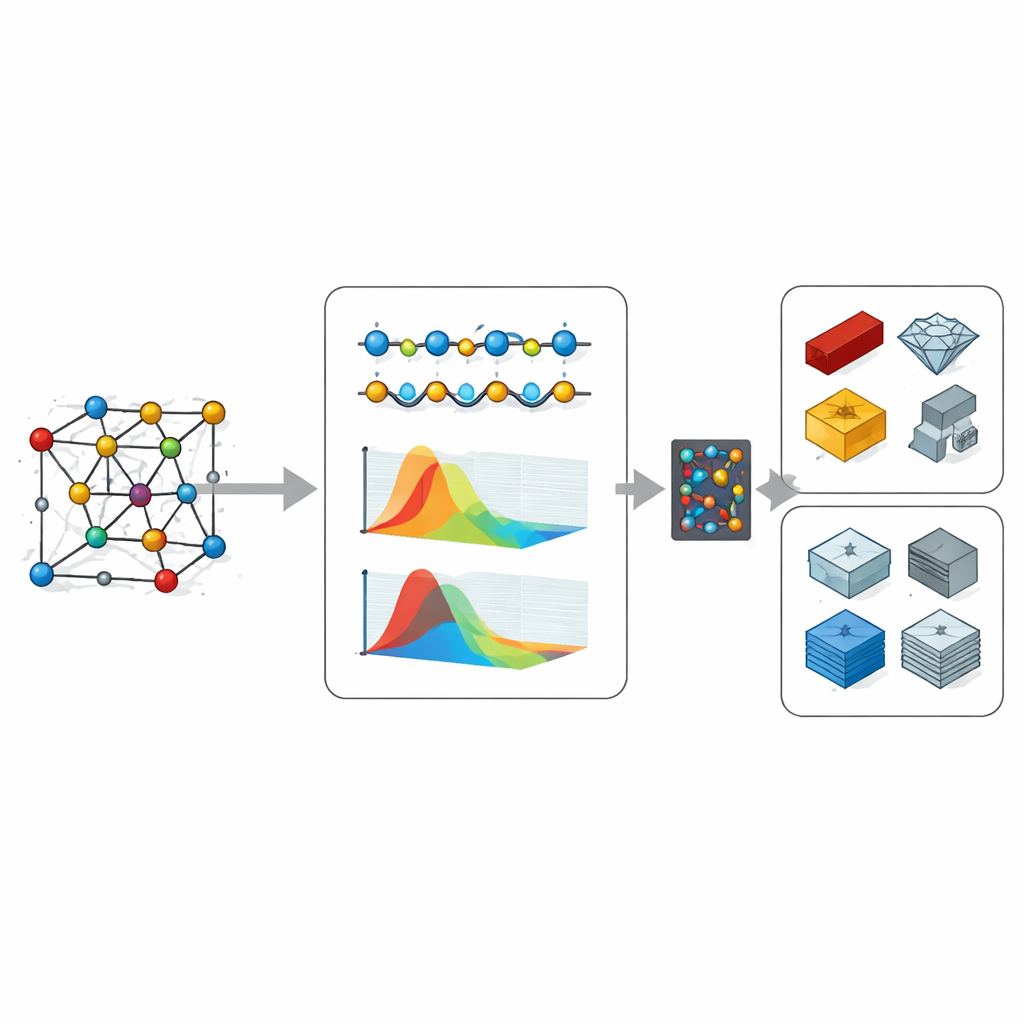
The authors created a software framework called auto-kappa that takes a crystal structure as input and automatically runs a long chain of quantum-mechanical calculations. These calculations resolve not only how atoms vibrate in a perfectly elastic way but also how vibrations collide and scatter in a more realistic, “messy” fashion. From this, the software extracts detailed properties such as phonon lifetimes and how much each vibration contributes to carrying heat. Using this pipeline on supercomputers, the team assembled a new database, named Phonix, covering anharmonic phonon properties for more than 6500 inorganic crystals—ranging from simple salts like sodium chloride to complex structures with over 100 atoms per unit cell.
A diverse map of how solids carry heat
With this database in hand, the researchers examined how heat conduction varies across different materials. They found that lattice thermal conductivity, the part carried by vibrations in the atomic lattice, generally drops as the volume per atom grows—loosely speaking, more open structures tend to conduct heat less well. The database revealed a broad spread: most materials fall between about 0.15 and 40 watts per meter per degree kelvin at room temperature, but a small fraction reach extremely high values above 200, and a tiny subset above 500 or even 1000. Many of the best conductors are forms of carbon and silicon carbide, while large numbers of compounds exhibit quite low thermal conductivity, offering rich possibilities for thermoelectric or insulating applications.
Hidden wave-like contributions to heat flow
Heat in crystals is often pictured as phonons behaving like gas molecules, but at small scales vibrations can also act more like overlapping waves. The Phonix database separates the conventional “particle-like” contribution to heat transport from this more wave-like, or coherent, contribution. For most materials, especially strong heat conductors, the traditional particle channel dominates. Surprisingly, however, the authors found many compounds where the coherent part is sizable and in some cases comparable to the particle part. Certain complex forms of silicon carbide, with many atoms and densely packed vibration branches, show particularly large coherent contributions. This suggests that wave-like heat transport, often neglected in practical modeling, can be important even in otherwise high-conductivity crystals.
Teaching neural networks to read atomic blueprints
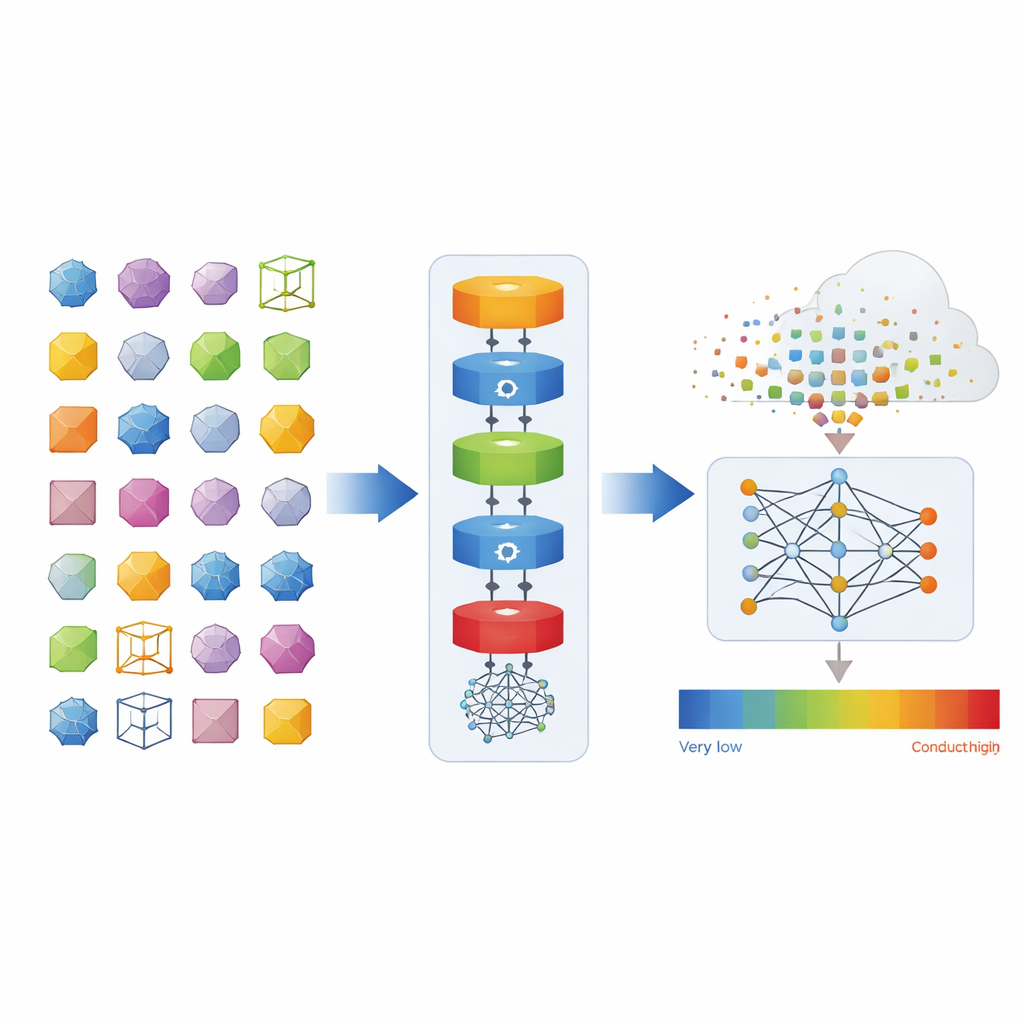
To move beyond costly brute-force calculations, the team trained graph-based neural networks that take the atomic structure of a crystal and predict its thermal conductivity—including how the contribution builds up as vibrations of different mean free paths are included. By varying the size of the training set from a few hundred to several thousand materials, they found a clear scaling law: prediction errors shrink in a predictable way as more data are added, similar to trends seen in large language models. Armed with these trained models, the authors screened hundreds of thousands of hypothetical crystals from the DeepMind GNoME database, then ran full quantum calculations on a subset of the most promising candidates for exceptionally high or low heat conduction.
Finding extremes: super-conductors and super-insulators
The screening uncovered new candidate materials at the extremes of heat conduction. Some hydrogen-rich compounds containing very heavy atoms exhibited high thermal conductivity because their vibrations separate cleanly into low-frequency modes from heavy atoms and high-frequency modes from light atoms, reducing disruptive scattering. On the opposite side, complex cesium-based structures showed very low thermal conductivity, with highly mixed vibrations spread across many atoms and frequencies, which favors strong scattering and poor heat flow. While some of these crystals may be difficult to synthesize, their shared structural motifs provide valuable clues for designing both highly conductive “thermal highways” and highly resistive “thermal walls.”
What this means for future materials
In everyday terms, this work delivers two key advances: a large, openly accessible library that captures how atoms in thousands of crystals actually jiggle and collide, and a set of machine learning models that can read those atomic blueprints to forecast how well a material will carry heat. Together, they offer a powerful shortcut for discovering better heat spreaders for electronics, improved thermoelectrics for energy harvesting, and advanced materials for technologies where controlling heat is as important as controlling electricity. As the database grows and includes even more subtle vibration effects, these tools are poised to make the search for new thermal materials faster, cheaper, and far more systematic than trial-and-error experimentation.
Citation: Ohnishi, M., Deng, T., Torres, P. et al. Database and deep-learning scalability of anharmonic phonon properties by automated brute-force first-principles calculations. npj Comput Mater 12, 150 (2026). https://doi.org/10.1038/s41524-026-02033-w
Keywords: lattice thermal conductivity, phonon database, anharmonic vibrations, materials informatics, graph neural networks