Clear Sky Science · en
The dual role of 90° domain walls in ferroelectric switching of Hf0.5Zr0.5O2 thin films: Insights from phase-field simulations
Why tiny walls inside future memory chips matter
Modern phones, laptops, and data centers all hunger for faster, denser, and more energy‑efficient memory. A promising class of materials based on hafnium oxide—already common in today’s chips—can store information using tiny electric dipoles that flip like microscopic compass needles. This paper uses advanced computer simulations to look inside one such material, a hafnium–zirconium oxide thin film, and asks a deceptively simple question: how do the invisible internal boundaries between regions of opposite polarization help or hurt the switching that underpins digital memory?
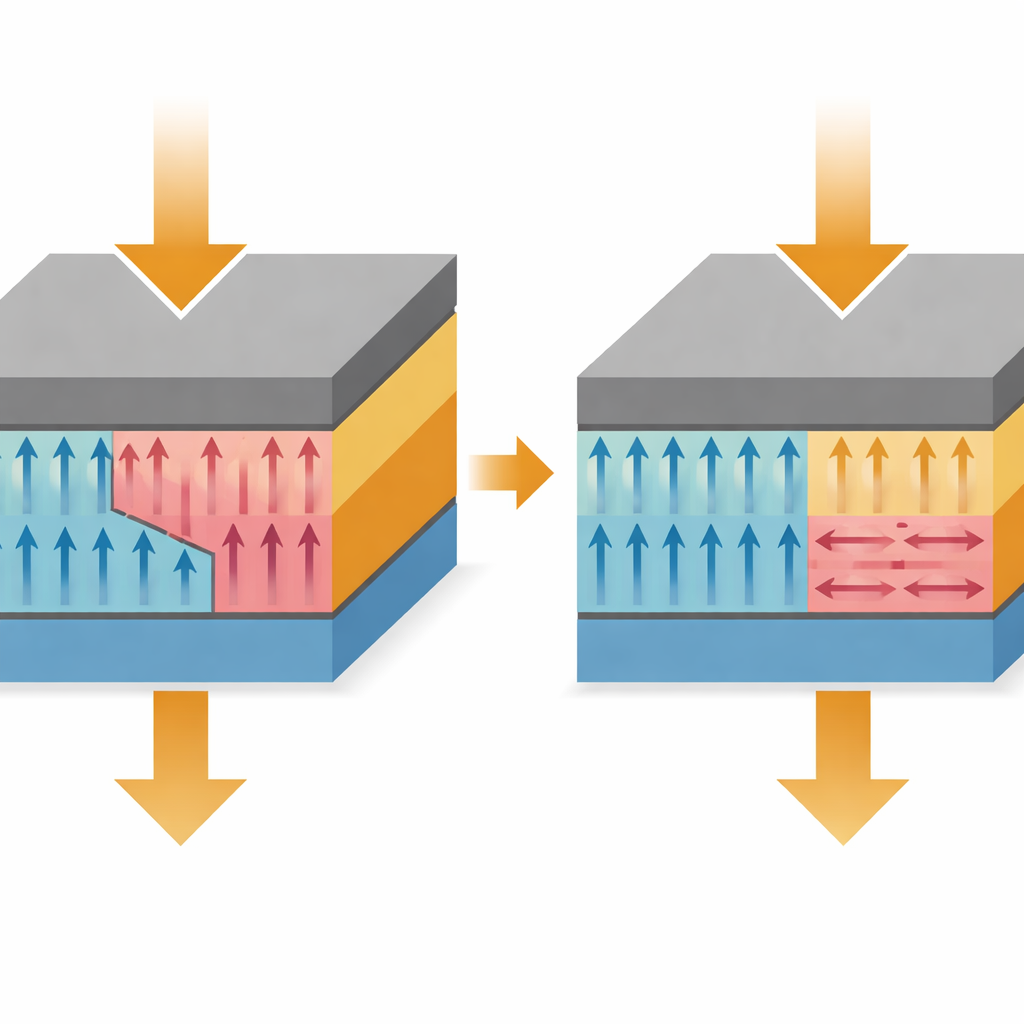
Tiny regions that store digital bits
In these ferroelectric films, the electric polarization does not point the same way everywhere. Instead, the material splits into small regions, or domains, where many atoms tilt together in one preferred direction. Neighboring domains can point in opposite directions (a 180‑degree change) or at right angles (a 90‑degree change), and the thin interfaces between them are called domain walls. When a voltage is applied across the film, domains can grow, shrink, or flip, and this collective motion of domain walls is what turns an electrical “0” into a “1” and back again. Because hafnium‑based ferroelectrics are compatible with standard chip manufacturing and can be made extremely thin, understanding how these walls move is crucial for designing future non‑volatile memories.
Simulating a crowded landscape of domains
The authors focus on a realistic hafnium–zirconium oxide film in which both 180‑degree and 90‑degree walls coexist. Instead of tracking every atom, they use a mesoscale phase‑field model that follows how polarization changes smoothly across the film over time. First they validate the model by reproducing known material behavior, such as the characteristic loop that relates electric field to polarization and the typical size and mix of domains seen in experiments. Then they apply different voltages to a simulated film that already contains a mix of domains, watching how the 180‑degree and 90‑degree walls respond as the voltage is ramped up.
Helpers and roadblocks in the same material
The simulations reveal that not all walls are created equal. The softer type of 180‑degree wall begins to move at relatively low voltage, allowing stripe‑shaped domains to extend across the film. A stiffer 180‑degree wall activates only near the coercive voltage—the point where the overall polarization flips. In stark contrast, 90‑degree walls remain almost frozen until the voltage is pushed much higher. From the energy landscape, the team shows that 90‑degree walls have a significantly larger barrier to motion, making them kinetic bottlenecks. Yet these same 90‑degree walls also raise the local energy in their neighborhood, which makes them favored birthplaces for new reversed domains. As a result, they lower the voltage needed to start switching even while they later slow the complete reversal.
Guiding safe switching paths
To mimic the action of a sharp probe or a tiny memory cell, the authors also simulate a localized voltage applied near a 90‑degree wall. A new switched domain forms under the high‑field region and first grows vertically, like a needle, to avoid building up excess electrical charge at its sides. When it reaches a nearby 90‑degree wall, its forward growth is blocked; instead, the domain turns and spreads sideways along the film. In doing so, the switching pathway skirts energetically costly head‑to‑head or tail‑to‑tail arrangements of polarization. The 90‑degree walls therefore act like traffic guides, steering the growth of new domains along safer, lower‑energy routes while still resisting their own motion.
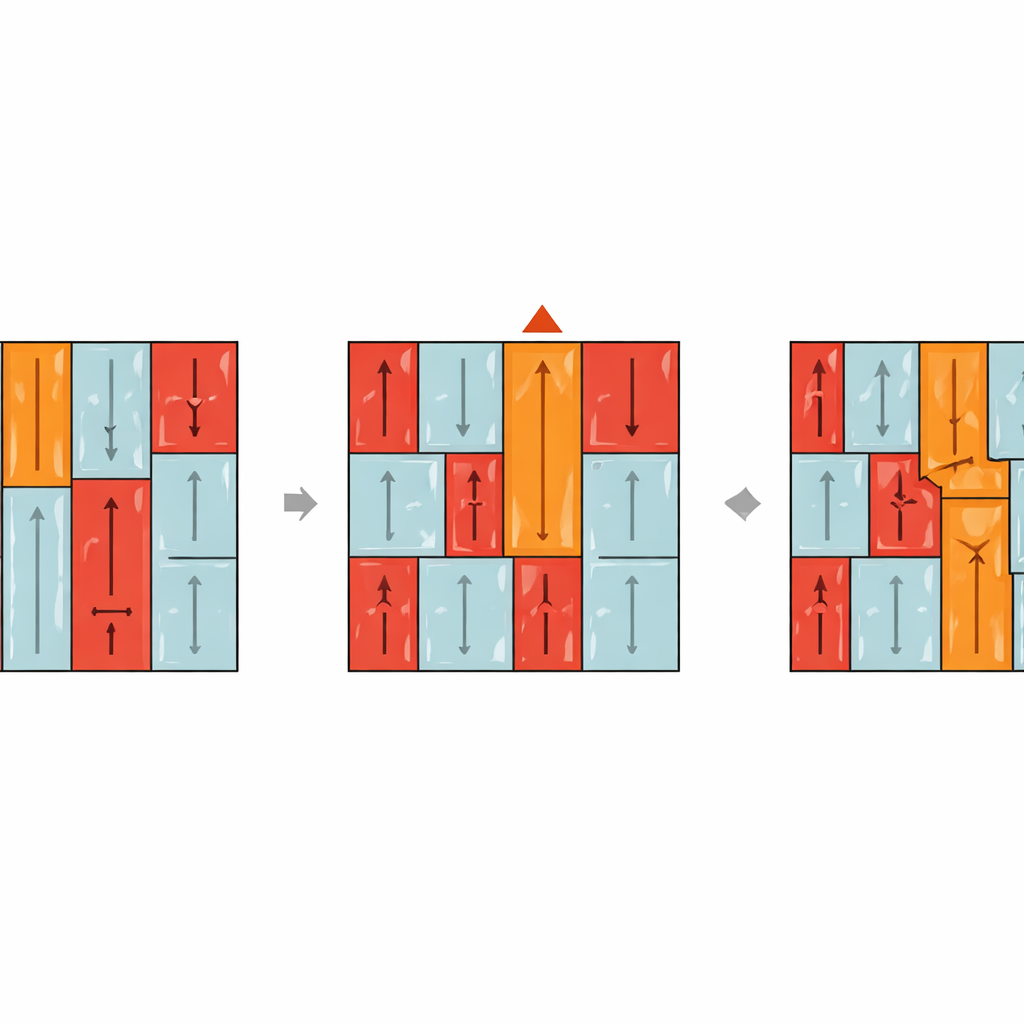
What this means for future memory devices
To a non‑specialist, the message of this work is that the same internal features that help a ferroelectric memory cell switch on can also prevent it from switching completely off. Ninety‑degree domain walls serve a dual role: they seed new switched regions at relatively low voltages, but because they are hard to move, they can trap leftover domains and contribute to gradual performance changes known as wake‑up and fatigue. By quantifying these effects and mapping how energy flows during switching, the study offers a roadmap for engineers to tune domain‑wall configurations—through film strain, geometry, or processing—so that future hafnium‑based memories switch reliably, efficiently, and with many more cycles before wearing out.
Citation: Wen, S., Peng, RC., Cheng, X. et al. The dual role of 90° domain walls in ferroelectric switching of Hf0.5Zr0.5O2 thin films: Insights from phase-field simulations. npj Comput Mater 12, 158 (2026). https://doi.org/10.1038/s41524-026-02028-7
Keywords: ferroelectric memory, hafnium oxide, domain walls, thin films, phase-field simulation