Clear Sky Science · en
Fully data-driven inverse characterization of heterogeneous materials with hyper-network neural ODEs
Why learning from how things stretch matters
From aircraft wings to artificial heart valves, many important materials are not uniform on the inside. They may hide stiff fibers, soft pockets, or smooth gradients in strength that strongly influence how they behave in use. Traditionally, engineers have had to guess a mathematical model for such materials and then tweak a few parameters so computer simulations match laboratory tests. This works only when the material is fairly simple and uniform. The paper summarized here introduces a new way: it lets the data speak directly, using modern neural networks to infer how every tiny region of a complex material responds to being stretched, squeezed, or sheared—without assuming a specific formula in advance.
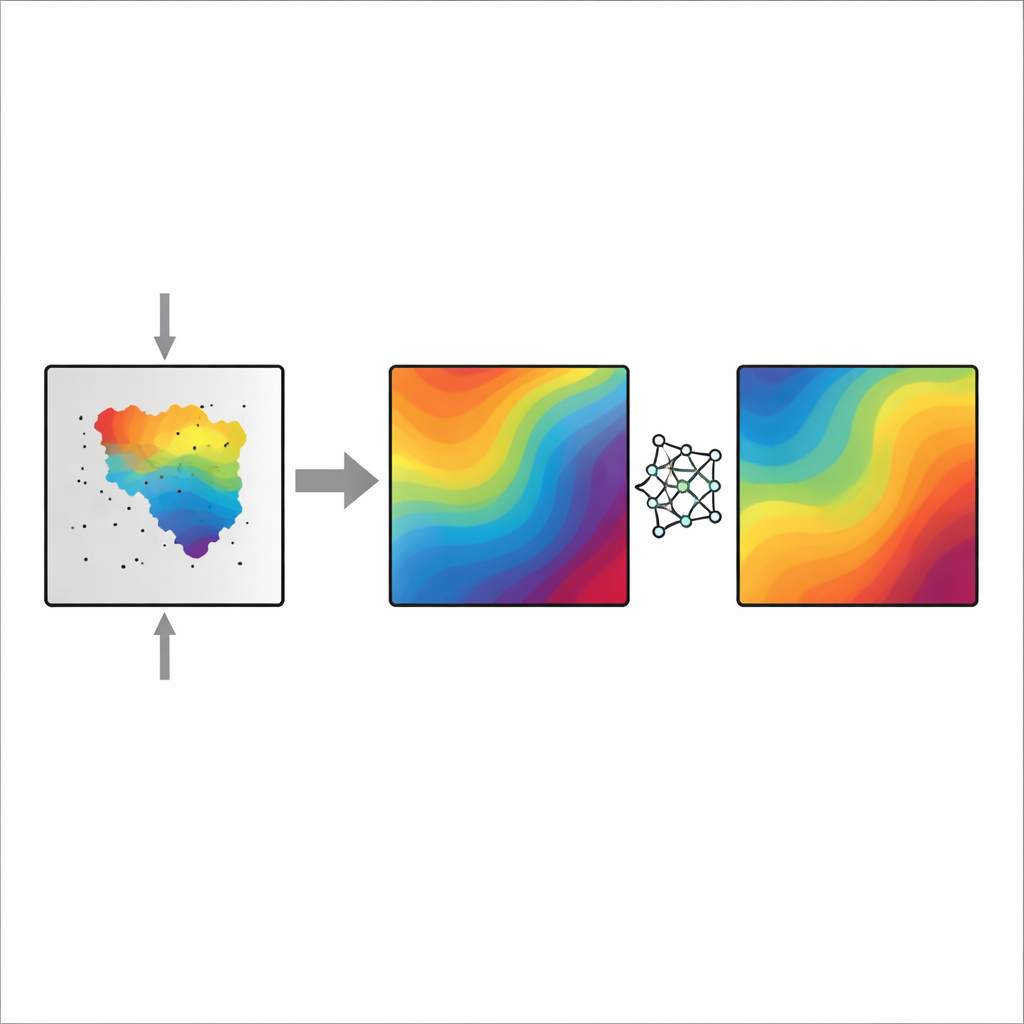
Seeing the whole picture instead of single pokes
Existing tools for probing hidden stiffness often rely on very local tests, like pressing a sharp tip into one spot of a sample. While these methods can resolve small details, they rarely mimic the real loading conditions that materials experience, such as large stretches in several directions at once. A complementary approach uses full-field techniques like digital image correlation, which track how thousands of points on a specimen move as it is loaded. From these rich motion maps one can compute how much each region deforms. The challenge is to invert this information: given deformations and boundary forces, what underlying material behavior produced them, especially when that behavior varies from place to place?
Letting neural differential equations describe the material
The authors tackle this inverse problem by representing the material’s behavior with a special class of neural networks known as neural ordinary differential equations. Instead of prescribing a fixed stress–strain formula, they train these networks so that the energy stored in the material, and thus the stresses it produces under deformation, emerge directly from data. These networks are designed so that they automatically obey key physical requirements: they produce no stress in an undeformed state, store non-negative energy, and lead to mathematically well-behaved responses under large strains. This ensures that the learned model is not just a good fit to the data, but is also consistent with basic mechanical principles.
Giving every point its own material model
To handle heterogeneity, the method adds a second neural network, called a hyper-network, that assigns a unique set of material parameters to each point within the specimen. In effect, this network turns spatial coordinates into the internal settings of the neural differential equation at that location. When combined, the two networks define a continuous field of local material laws over the entire domain. Training is driven by a loss function that directly enforces mechanical balance: the predicted stress field must satisfy equilibrium throughout the interior and match the known tractions on the boundaries. The full-field deformation gradient, either computed from measured displacements or taken directly from simulations, is interpolated smoothly so that spatial derivatives needed for these checks can be evaluated accurately.
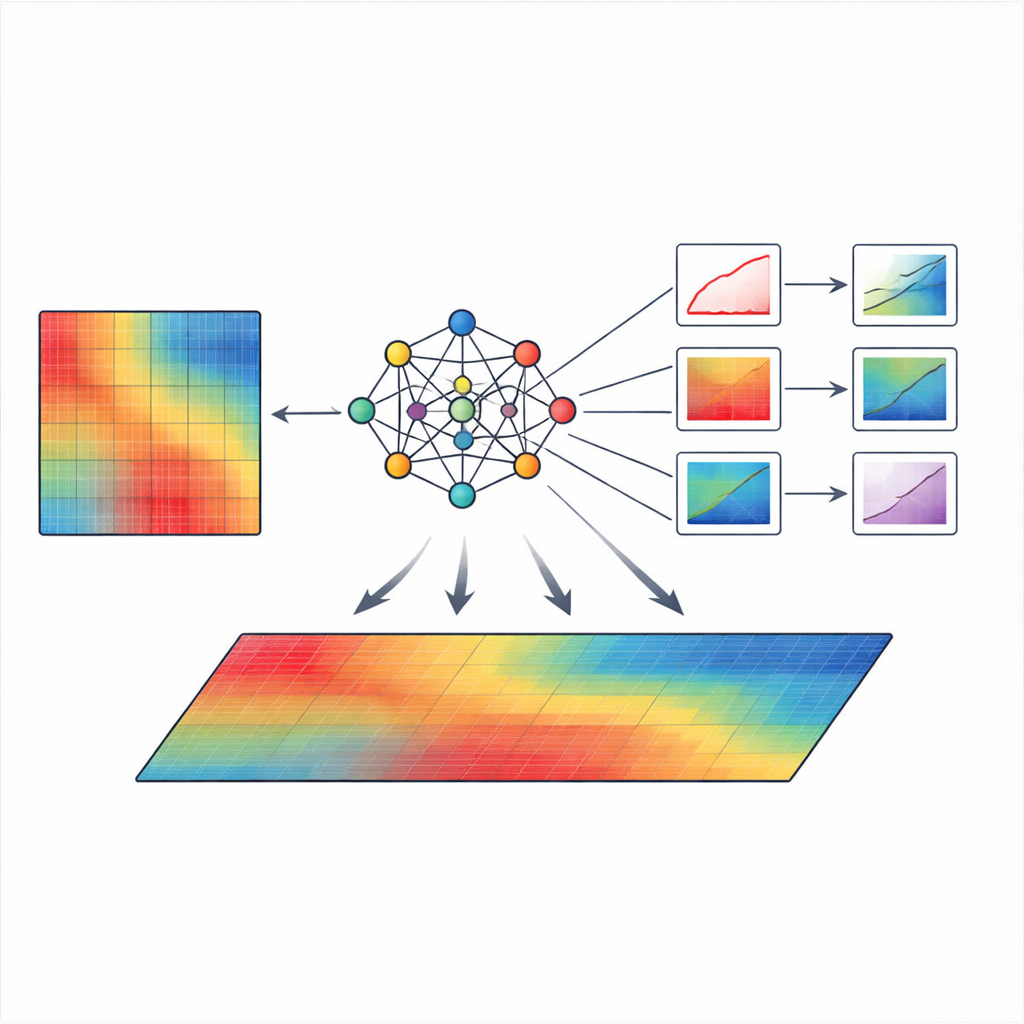
Testing on synthetic shapes and real printed samples
The team validates their framework on a wide range of computer-generated examples: simple two-phase plates with P- or X-shaped inclusions, more nonlinear materials, mixtures of isotropic and anisotropic regions, ring-shaped structures with added measurement noise, and even smoothly varying “Gaussian field” stiffness patterns. In these tests, the method reliably recovers both the spatial pattern of stiffness and the detailed local stress–strain curves, often with only a few percent error. It can even detect the orientation of fiber-like reinforcement without being told in advance that the material is directional. Finally, the authors apply the approach to real experiments on 3D-printed elastomers whose internal geometry mimics a handwritten digit. Using image-based deformation measurements alone, their model reconstructs where the stiffer inclusion lies and how both phases respond under stretch, in good agreement with separate tests on uniform samples.
Dealing with noisy measurements and practical limits
Because the method relies on derivatives of displacement fields, measurement noise can degrade its performance. The authors explore this systematically by adding controlled noise to synthetic data. They find that the approach remains accurate up to moderate strain errors, and that increasing the number of experiments—either by repeating the same loading several times or by mixing different loading types—helps to average out noise and sharpen the recovered material map. They also compare their strong-form enforcement of mechanical balance, which avoids mesh generation and numerical integration, to a more traditional weak-form version described in the supplementary material, and show that both are feasible within the same general framework.
What this means for real-world materials
In simple terms, this work offers a way to turn rich images of how a complex object deforms into a detailed map of how stiff or soft every point inside it is, and how it reacts to being loaded in different ways. Instead of guessing a small set of material parameters up front, the method learns an entire field of local behaviors that obey the laws of mechanics by design. This opens the door to more faithful digital twins of composite structures, architected materials, and biological tissues, where internal variations matter greatly. With further development and careful handling of experimental noise, such data-driven characterization could become a powerful companion to traditional testing, helping engineers and scientists design, diagnose, and optimize heterogeneous materials based directly on how they move under load.
Citation: Taç, V., Amiri-Hezaveh, A., Bechtel, G.N. et al. Fully data-driven inverse characterization of heterogeneous materials with hyper-network neural ODEs. npj Comput Mater 12, 165 (2026). https://doi.org/10.1038/s41524-026-02027-8
Keywords: data-driven materials, heterogeneous stiffness mapping, neural constitutive modeling, digital image correlation, inverse mechanics