Clear Sky Science · en
Origin of suppressed ferroelectricity in κ-Ga2O3: interplay between polarization and lattice domain walls
Why tiny crystal shifts matter for future electronics
Modern gadgets increasingly rely on special materials that can remember an electric state without constant power. These “ferroelectric” materials promise low-energy memory, sensors, and energy harvesters. Yet in many promising compounds, theory predicts strong, robust behavior while real devices deliver much weaker performance. This paper digs into that mystery for a material called κ-Ga2O3 and uncovers a hidden, very practical reason why experiment and theory disagree—one that could help engineers deliberately tune ferroelectric materials for speed, stability, and low power.
Electric memory inside a crystal
Ferroelectric materials carry an internal electric polarization that can be flipped by an external voltage, much like reversing the north and south poles of a magnet. Two key figures of merit are the remanent polarization (how much “memory” remains after the field is turned off) and the coercive field (how strong a field is needed to switch the material). For κ-Ga2O3, standard quantum-mechanical calculations on perfect, tiny crystals predict a large remanent polarization and a very high coercive field, suggesting tough-but-powerful switching. Experiments, however, repeatedly measure much smaller values—less than half the predicted polarization and about ten times lower switching fields—mirroring puzzling gaps seen in other emerging ferroelectrics.
A sideways route to flipping polarization
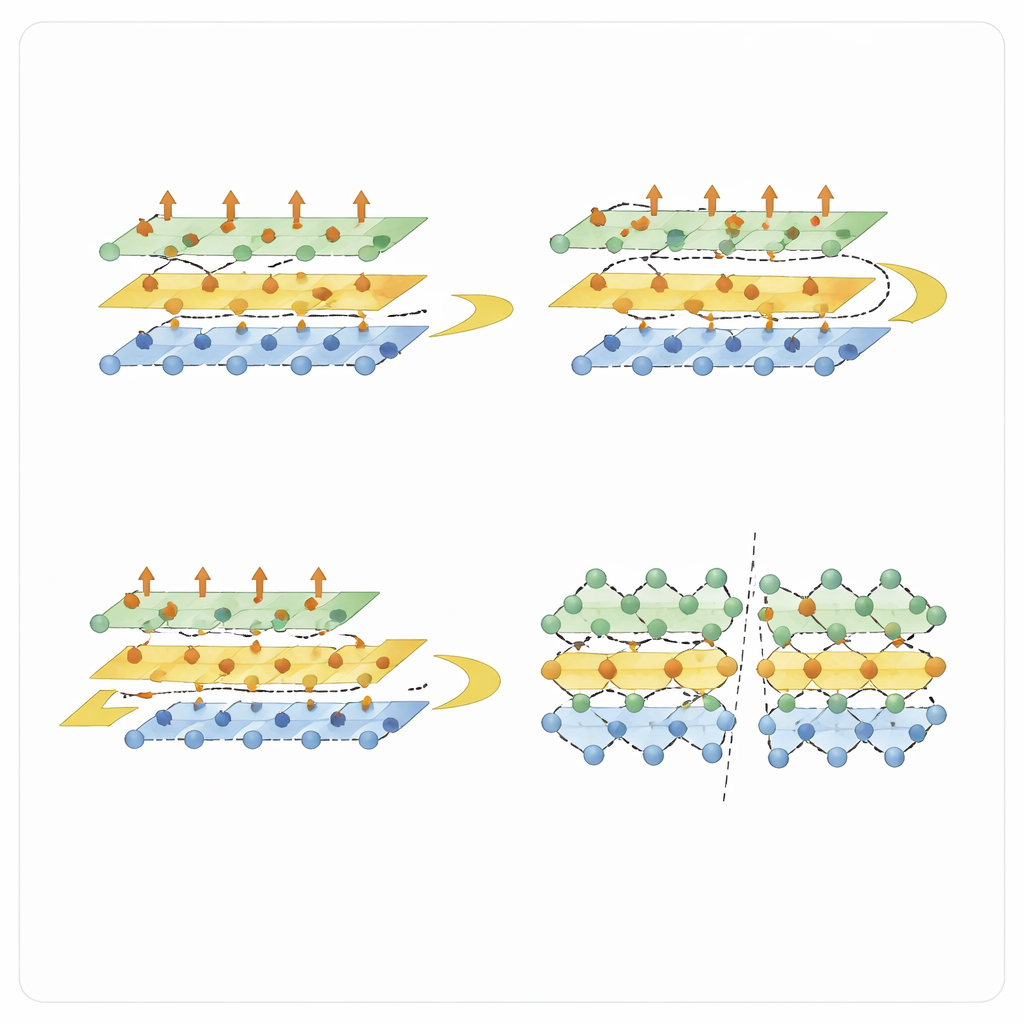
The authors first revisit how κ-Ga2O3 actually switches its internal polarization on the atomic scale. Instead of ions simply moving straight up and down in the crystal, they find that the key motion is a sideways sliding and shearing of stacked gallium–oxygen layers. During switching, certain layers glide laterally while neighboring layers deform, effectively twisting the orientation of tiny building blocks called tetrahedra. This sideways shift reverses the direction of the overall polarization. Using quantum calculations, the team maps out this sliding pathway and finds that, in an ideal crystal cell, it has a modest energy barrier and produces a large intrinsic polarization—still too large compared to experiment, hinting that something important is missing from this small-cell picture.
Teaching a computer to watch billions of atoms move
To capture the missing physics, the researchers turn to machine learning. They train a “deep learning” interatomic model on more than twenty thousand atomic snapshots from high-accuracy quantum simulations at different temperatures and electric fields. This model faithfully reproduces energies, forces, and even subtle electronic properties, but runs fast enough to simulate crystals containing tens of thousands of atoms over realistic times. With this tool, they can watch how polarization regions, known as domains, appear, grow, and move under an applied field—processes that are too large and slow for conventional quantum methods to handle directly.
When walls inside the crystal get in the way
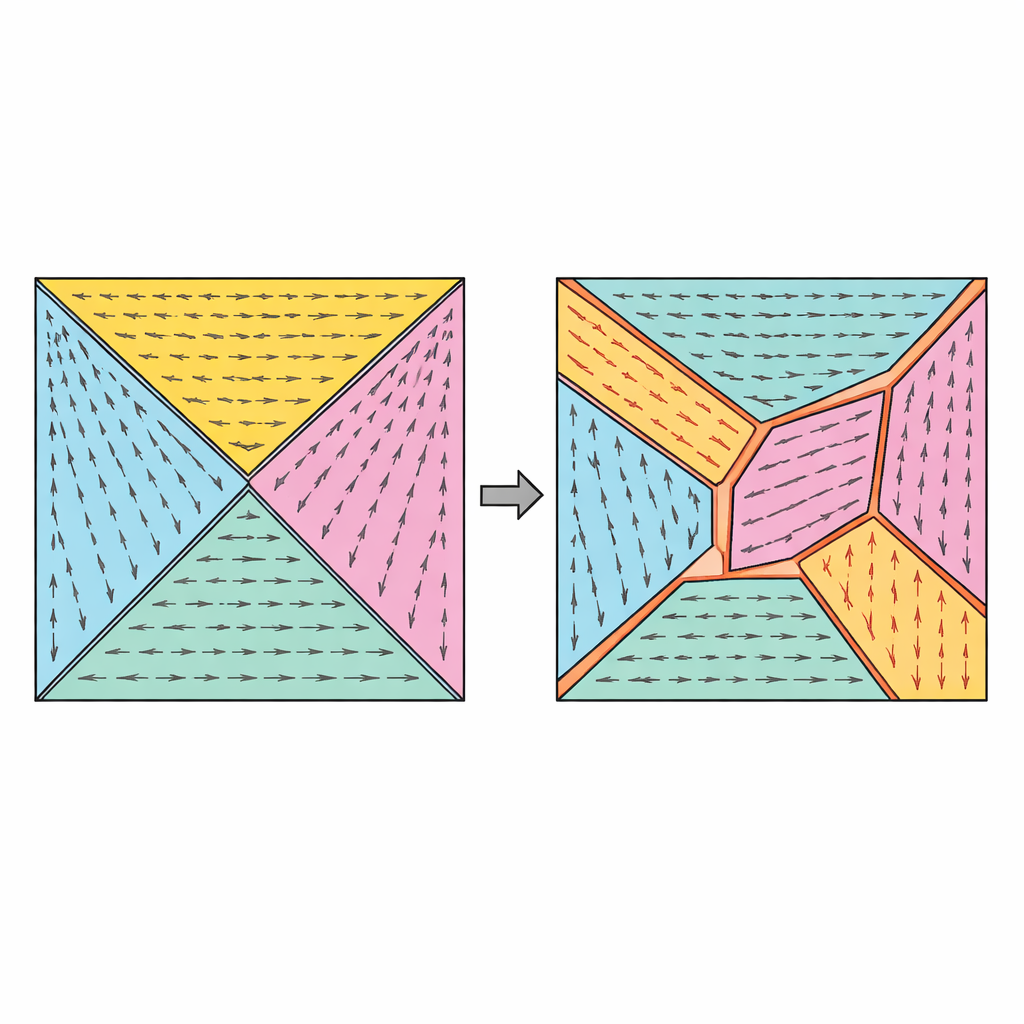
Large simulations reveal that polarization does not switch all at once. Instead, new reversed regions nucleate and expand, separated by mobile boundaries called polarization domain walls. In a perfect single crystal, creating those first reversed regions requires a very strong electric field, but once present, the domain walls move quickly, especially along certain directions favored by the sliding motion. Real κ-Ga2O3 samples, however, are not single crystals—they contain multiple lattice domains rotated by 120 degrees in the plane. At the boundaries between these differently oriented regions, the authors show that the sideways sliding needed for switching cannot continue smoothly. These lattice domain walls act as topological barriers that can stop polarization walls in their tracks, leaving behind a stable network of partially switched regions woven through the crystal.
Trading memory strength for easy switching
This built‑in web of pinned domain walls has two major consequences. First, because some portions of the material remain unswitched, the overall remanent polarization is reduced, bringing theoretical values down to the experimentally observed range. Second, the pre‑existing domain walls sitting at lattice boundaries serve as ready‑made seeds for future switching. Instead of repeatedly paying the energetic cost to nucleate new reversed regions, the material can flip quickly and at low fields simply by moving existing walls over short distances before they hit the next barrier. The calculations show that as lattice domains get smaller, blocking becomes stronger: memory strength drops, but the ease and speed of switching improve. This trade‑off suggests a powerful design knob—engineering the pattern and size of lattice domains—to optimize ferroelectric materials like κ-Ga2O3, and other “sliding” ferroelectrics, for fast, low‑power electronic devices.
Citation: Zhu, Y., Liu, WH., Long, R. et al. Origin of suppressed ferroelectricity in κ-Ga2O3: interplay between polarization and lattice domain walls. npj Comput Mater 12, 155 (2026). https://doi.org/10.1038/s41524-026-02022-z
Keywords: ferroelectric domains, sliding ferroelectrics, kappa gallium oxide, machine learning potentials, domain wall engineering