Clear Sky Science · en
Approaching lower bound of lattice thermal conductivity by simultaneously suppressing diagonal and off-diagonal phonon contributions
Why stopping heat can power future tech
Many clean-energy and high-performance technologies, from thermoelectric generators that turn waste heat into electricity to heat shields on hypersonic aircraft, depend on solids that are very bad at conducting heat. This paper explores how to push crystalline materials down to an extreme “almost glass-like” lower limit of heat flow through their atomic vibrations, revealing design rules and new candidates for ultralow thermal conductivity.
How vibrating atoms move heat
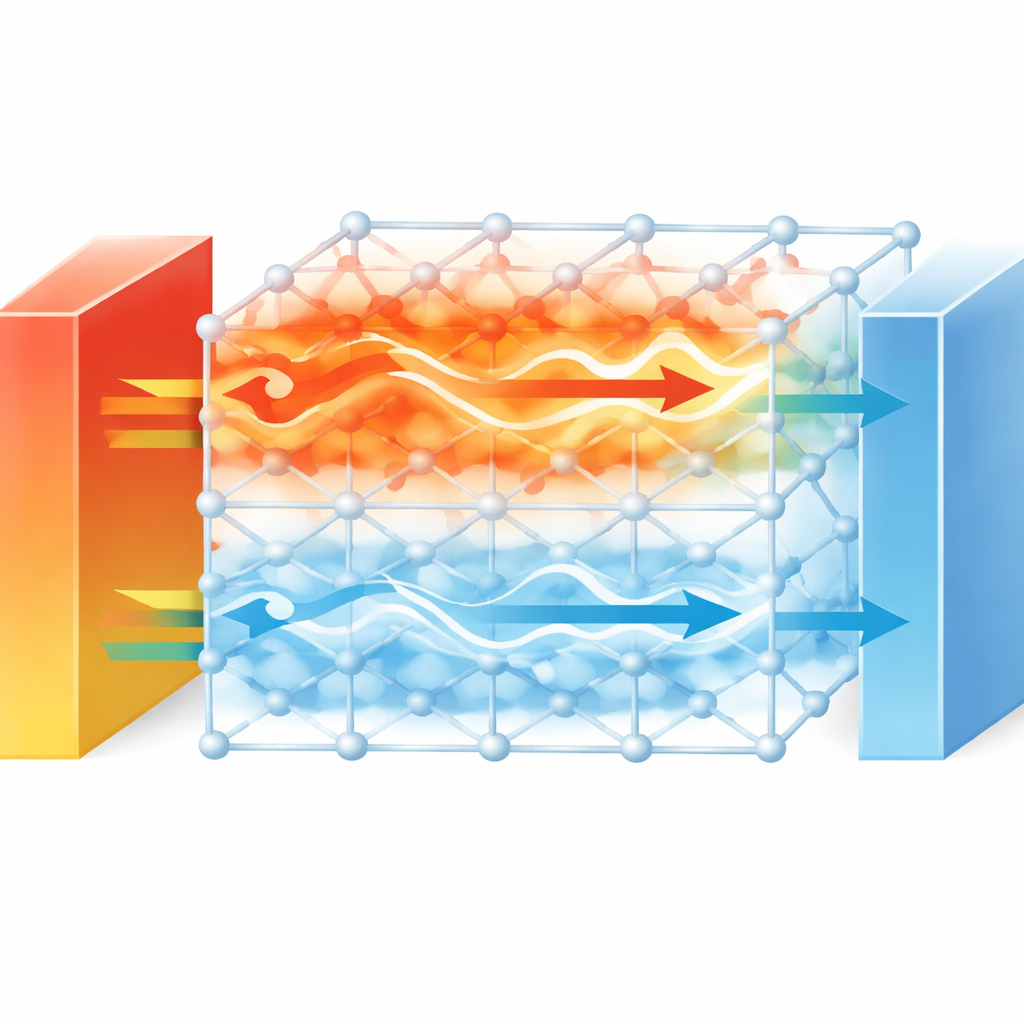
In most semiconductors and insulators, heat is carried by phonons—tiny packets of atomic vibration. In simple, stiff crystals these vibrations travel like gas particles, zipping across the lattice and giving high thermal conductivity. In disordered solids, however, vibrations lose their neat, wave-like character, and heat meanders diffusively, more like in a glass. A recent “two-channel” theory unifies these pictures by treating heat flow as a combination of a diagonal, particle-like channel and an off-diagonal, more wave-like coherence channel. Understanding how these two channels add up is essential if we want to deliberately slow both down and make crystals that insulate as well as the best glasses.
Two ways heat sneaks through a crystal
In this framework, the usual particle-like phonons form the diagonal channel, while the off-diagonal channel comes from quantum-like mixing between different vibration modes at the same wavelength. The authors analyze 4,700 crystals using quantum-mechanical calculations to map out, in detail, how each frequency of vibration contributes to each channel. They find that complex crystals with many atoms per unit cell tend to suppress the particle-like channel but enhance the wave-like, off-diagonal one. Across materials, a common pattern emerges: off-diagonal heat carriers have high speeds but extremely short lifetimes, acting as fast yet very fragile messengers of heat.
Finding the sweet spot for blocking heat
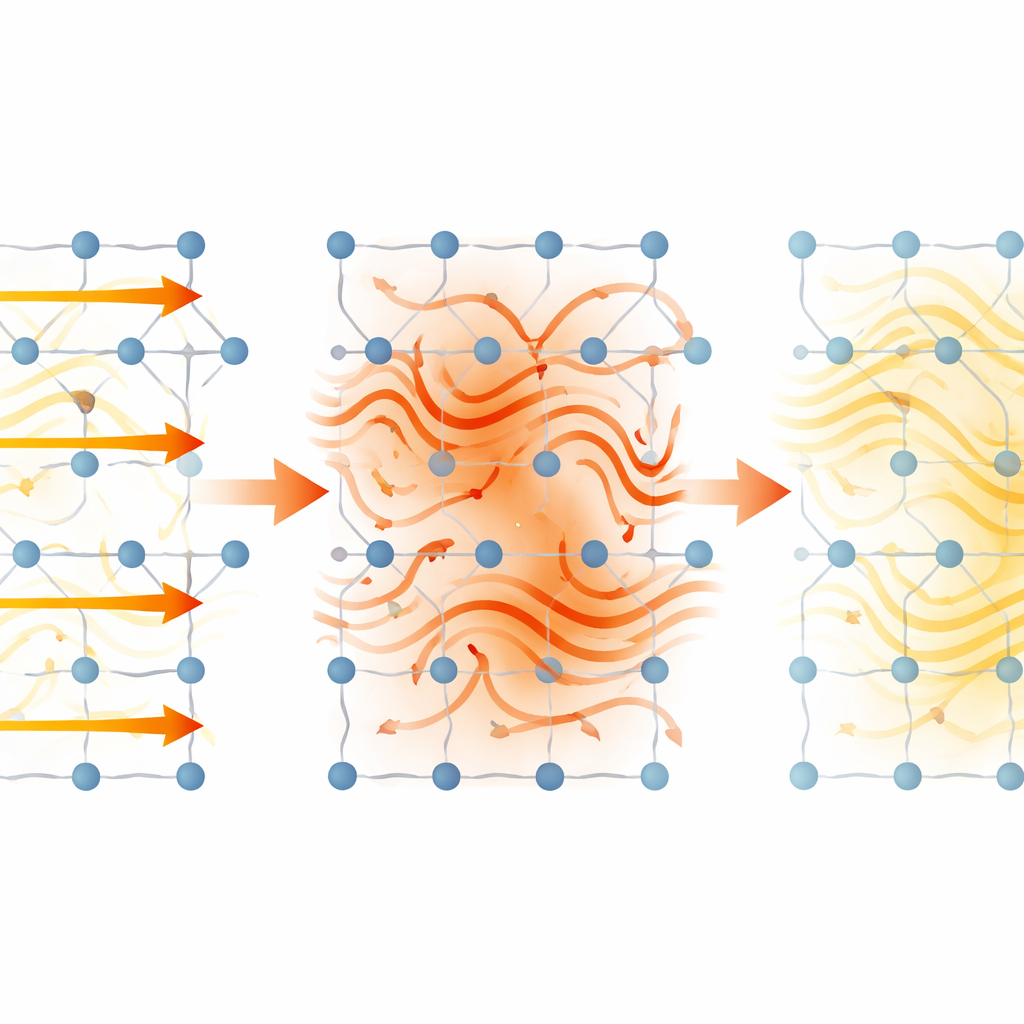
A key discovery is that simply making phonons very short-lived does not always minimize heat flow. If lifetimes are too long, particle-like phonons travel far and carry heat efficiently. If they are too short, vibrations behave diffusively and the off-diagonal channel becomes strong. The materials with the lowest total thermal conductivity cluster around an intermediate lifetime of roughly one picosecond, combined with relatively slow phonon speeds and large atomic displacements, which signal soft bonding and strong anharmonicity. In this regime, both channels are simultaneously weakened: phonons do not travel far enough to act like clean particles, yet also are not so overdamped that diffusive wave-like transport takes over.
Teaching machines to hunt for ultra-insulators
To turn these physical insights into a discovery tool, the team trains an advanced graph neural network, ALIGNN, on their 4,700 high-accuracy simulations. The model learns to predict not only overall thermal conductivity but also detailed phonon properties—lifetimes, speeds, mean free paths, and more—directly from crystal structure and chemistry. They then apply these models to over 30,000 additional materials and use a second layer of traditional machine-learning models to confirm which combinations of phonon descriptors best signal ultralow heat transport. This multi-step approach captures the same trends seen in the full quantum calculations, showing that data-driven models can reliably navigate the complex two-channel landscape.
New record-setting materials emerge
Armed with these models, the researchers screen about 26,000 real and hypothetical crystals drawn from major databases. They flag a small set of promising candidates and then return to full quantum calculations for confirmation. Twelve materials are validated to have ultralow room-temperature lattice thermal conductivity, several near 0.2 watts per meter-kelvin and one, cubic thallium iodide, reaching about 0.13—among the lowest reported for a crystalline solid. Many of these compounds share features like heavy, weakly bound atoms (such as cesium, thallium, and lead) and complex structures that naturally favor the desired intermediate lifetimes and slow phonon speeds.
What this means for future energy materials
By showing that the lowest heat conduction in crystals occurs where neither particle-like nor wave-like phonons can dominate, this work offers a practical recipe for designing extreme thermal insulators. Instead of just “softening” a lattice or complicating its structure, materials scientists can now target a specific balance of phonon lifetime, speed, and atomic motion, aided by powerful machine-learning models. This dual-channel perspective is expected to accelerate the discovery of new thermoelectric materials, thermal barrier coatings, and phononic crystals that manage heat with unprecedented precision.
Citation: Rodriguez, A., Rurali, R., Lin, C. et al. Approaching lower bound of lattice thermal conductivity by simultaneously suppressing diagonal and off-diagonal phonon contributions. npj Comput Mater 12, 137 (2026). https://doi.org/10.1038/s41524-026-02018-9
Keywords: lattice thermal conductivity, phonons, thermoelectric materials, machine learning materials discovery, phononic crystals