Clear Sky Science · en
Phase retrieval of highly strained Bragg coherent diffraction patterns using supervised convolutional neural network
Sharper Views of Tiny Crystals
Many of today’s most promising technologies—from better catalysts for cleaner cars to more efficient batteries—depend on how atoms shift and strain inside tiny crystals. Scientists can probe these invisible distortions with a powerful X‑ray technique called Bragg Coherent Diffraction Imaging (BCDI), but a key computational step often fails precisely when the crystals are most strained and scientifically interesting. This paper shows how a deep‑learning approach can rescue those difficult measurements, turning previously unusable data into clear three‑dimensional pictures of working nanomaterials. 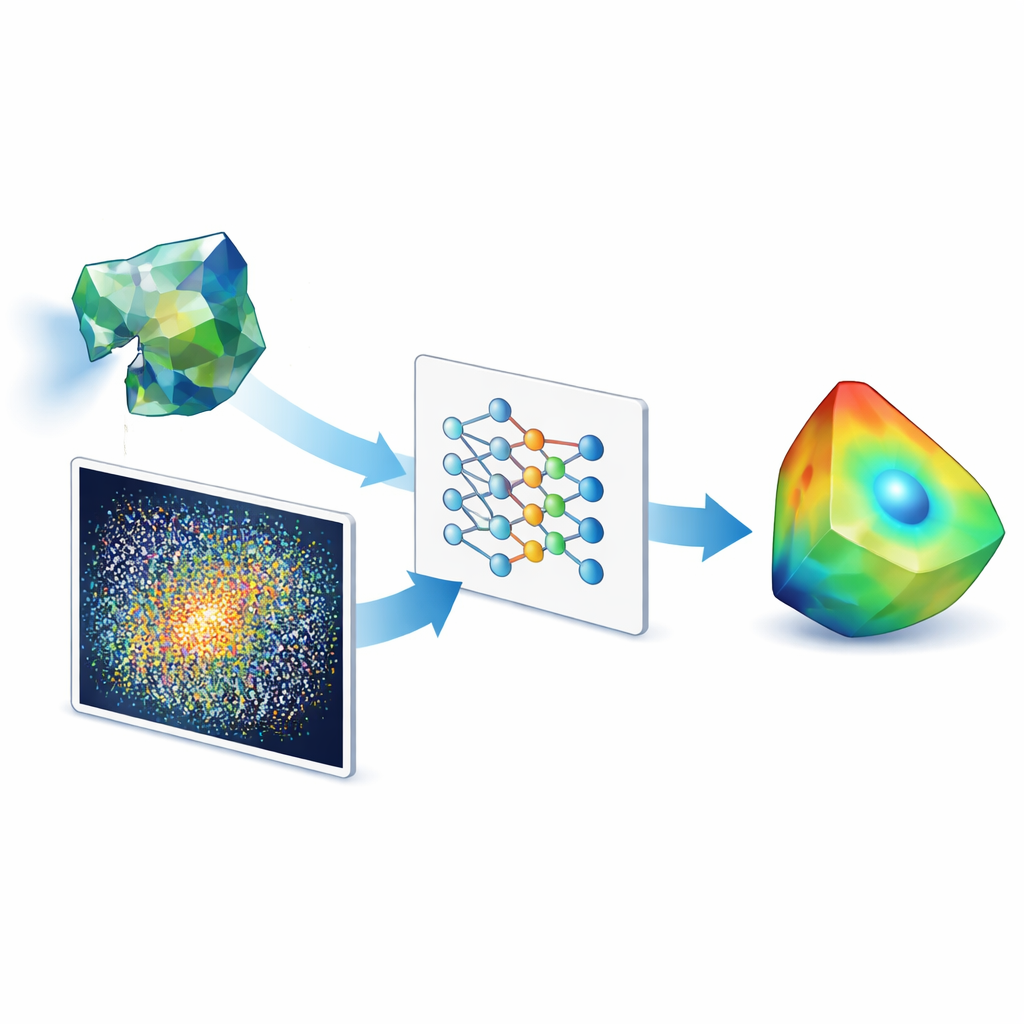
How X‑rays Reveal Hidden Distortions
In a BCDI experiment, a nanocrystal is illuminated by a tightly focused, highly coherent X‑ray beam. The crystal scatters the X‑rays into a complex speckle pattern recorded by a distant detector. That pattern is linked to the crystal’s internal structure by a mathematical operation called a Fourier transform. Unfortunately, the detector only measures the intensity of the scattered waves, not their phase—the part of the wave that encodes how atoms are displaced inside the crystal. Reconstructing a 3D picture of both the electron density and the strain field therefore requires “phase retrieval” algorithms that must infer the missing phase from the measured intensity alone.
Why Conventional Methods Break Down
Standard phase retrieval relies on iterative algorithms that bounce back and forth between the measured diffraction pattern and a guess of the real‑space object, gradually enforcing physical constraints in each space. This approach works well when the crystal is only mildly strained. But when the internal distortions are strong, they warp the diffraction pattern so severely that the algorithms struggle to converge. The recovered phase can wrap around by many times 2π, the apparent size and shape of the crystal can be misestimated, and dozens of random starts may still fail to find a usable solution. As a result, many BCDI measurements of highly strained, and often most interesting, particles end up being discarded.
A Neural Network That Thinks in Diffraction Space
To tackle this bottleneck, the authors train a three‑dimensional convolutional neural network, based on a UNet‑like architecture, to predict the missing phase directly in the same reciprocal (diffraction) space where the data are collected. They generate tens of thousands of realistic simulated diffraction patterns from model nanocrystals with varied shapes and strong, complex strain fields, adding experimental‑like noise. Each simulated pattern is paired with its known reciprocal‑space phase, which the network learns to reproduce. A specially designed loss function called the Weighted Coherent Average lets the network account for inherent symmetries in phase data—such as global offsets, sign changes, and wrapping—without being misled by them, while focusing learning effort on the most intense, informative parts of the pattern.
From Simulation Benchmarks to Real‑World Data
Once trained, the network is fed only the measured diffraction intensity, scaled into a logarithmic form, and outputs a full three‑dimensional phase map. Combining this predicted phase with the measured intensity and applying an inverse Fourier transform immediately yields a first 3D image of the crystal and its strain. On simulated test data, the network reliably recovers complex phase structures for different particle shapes and strain profiles, producing reconstructions that closely match the ground truth, even when the signal is noisy. Crucially, when applied to challenging experimental datasets from platinum and platinum–palladium nanoparticles under strong interfacial strain, the neural‑network‑based reconstructions succeed where conventional iterative phase retrieval alone fails. 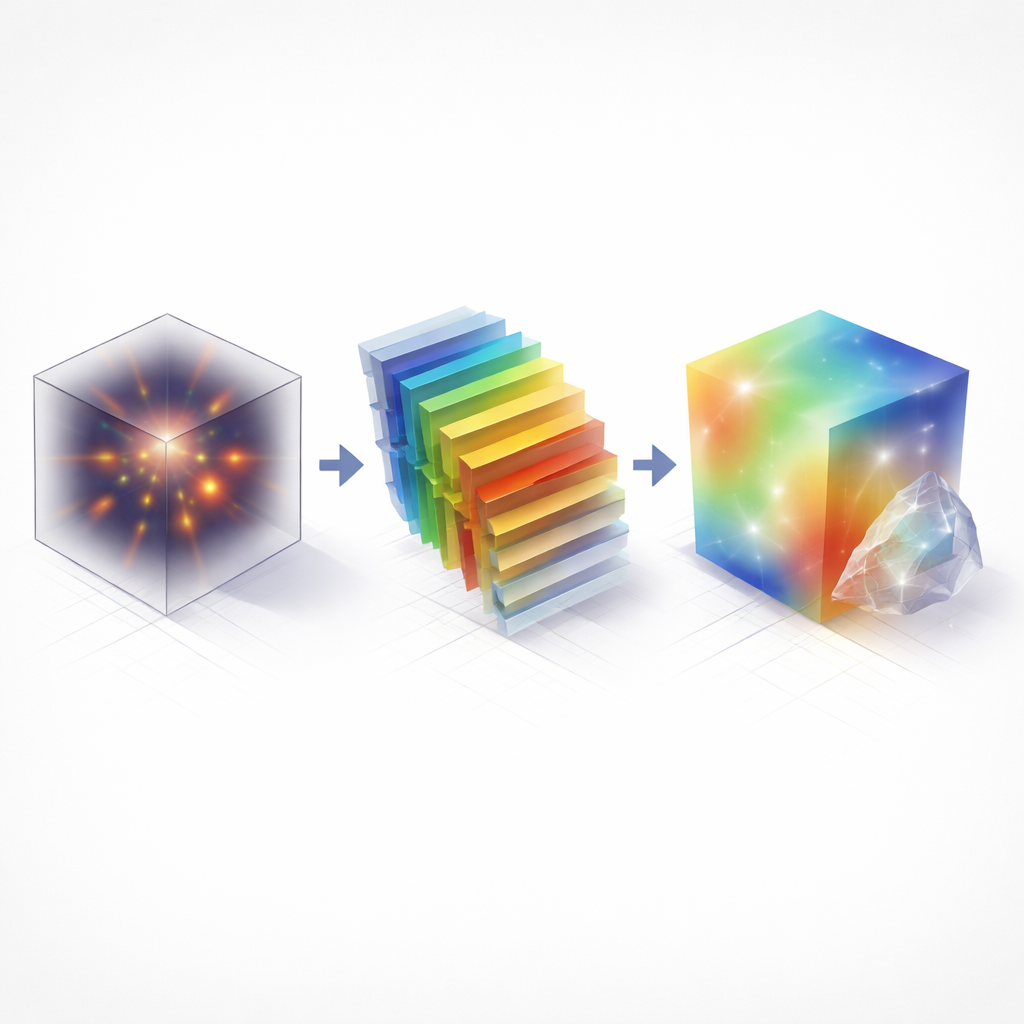
Faster and Clearer Pictures of Working Nanomaterials
The authors do not abandon traditional algorithms; instead, they use the neural network’s output as a high‑quality starting point. A relatively short refinement stage with standard error‑reduction iterations tidies up the reconstruction without undoing the good initial guess. This hybrid approach cuts computation time by two to three orders of magnitude compared with running many long conventional reconstructions, and unlocks reliable imaging of highly strained particles that were previously out of reach. In practical terms, the work turns difficult BCDI experiments into a more routine tool: scientists can now more quickly and robustly visualize how strain evolves inside single nanocrystals during reactions, electrochemical cycling, or extreme conditions, opening the door to better‑designed materials and devices.
Citation: Masto, M., Favre-Nicolin, V., Leake, S. et al. Phase retrieval of highly strained Bragg coherent diffraction patterns using supervised convolutional neural network. npj Comput Mater 12, 164 (2026). https://doi.org/10.1038/s41524-026-02017-w
Keywords: Bragg coherent diffraction imaging, phase retrieval, deep learning, nanostructure strain, X-ray microscopy