Clear Sky Science · en
Dislocation-induced ordering as a source of strengthening in refractory multi-principal element alloys
Why these tough alloys matter
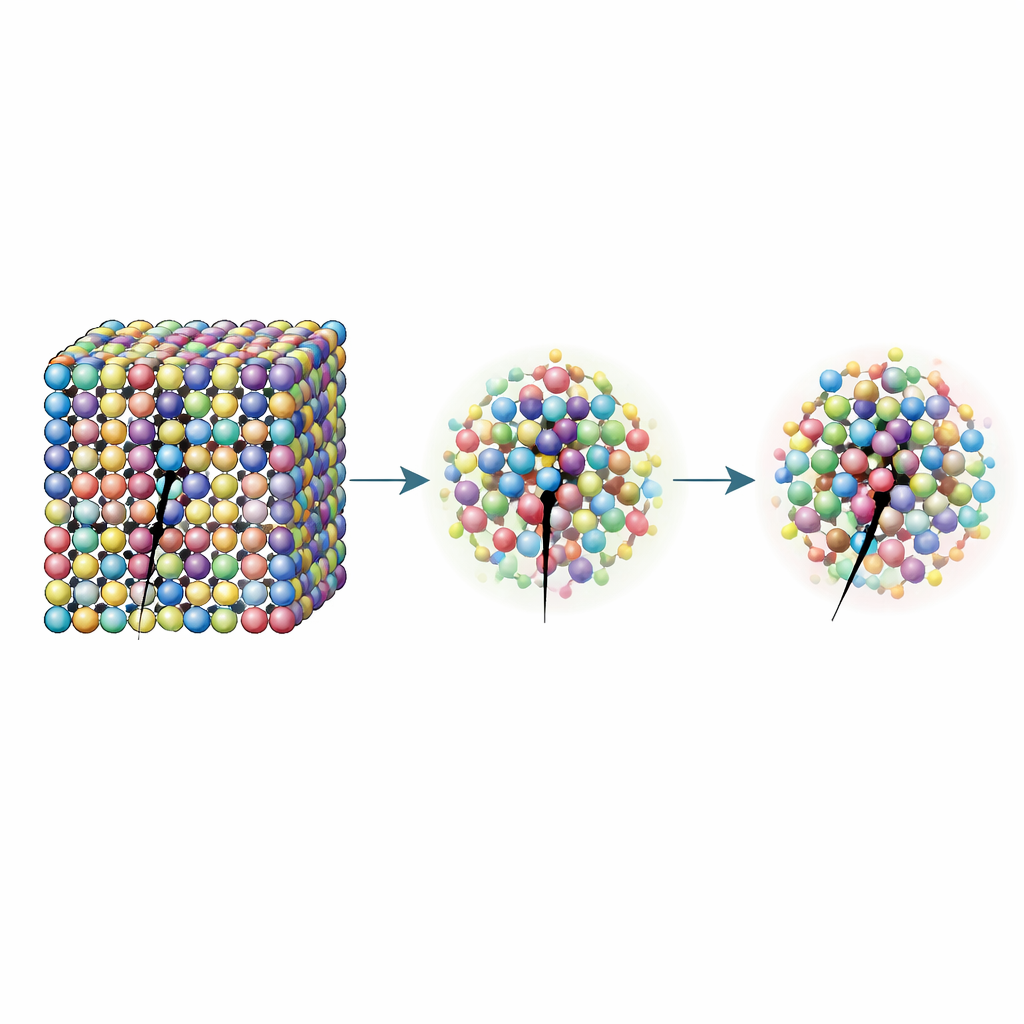
Engines, rockets, and chemical plants all need metals that stay strong even when they are scorching hot. A new class of metals called refractory multi-principal element alloys (RMPEAs) has shown remarkable strength at extreme temperatures, but the reasons behind this toughness have remained murky. This paper uses advanced computer simulations to peer inside these complex alloys, revealing how tiny defects in the crystal—called dislocations—can actually organize nearby atoms into special patterns that lock the defects in place and make the material stronger.
Metals made from many equal partners
Traditional alloys rely on one main element, like iron in steel, with small additions of others. RMPEAs break this rule: they mix several heavy, heat-resistant metals such as chromium, molybdenum, niobium, tantalum, vanadium, and tungsten in nearly equal amounts. At high temperatures, many of these alloys keep their strength far better than conventional metals, making them appealing for demanding applications. Yet even after years of study, scientists still do not fully understand why these mixtures, built on a simple body-centered-cubic crystal lattice, can resist softening so well when they are hot.
Hidden patterns around crystal defects
In a perfect crystal, atoms form an orderly three-dimensional grid. Real metals, however, are full of defects, and line-like defects called dislocations are the main carriers of plastic deformation. As a dislocation glides through the crystal, the metal bends or stretches. This study focuses on how the jumble of different atoms in RMPEAs rearranges around dislocations during heat treatment. Near a dislocation, atoms can diffuse more quickly and settle into preferred local neighborhoods, forming short-range order—subtle patterns in which certain atom pairs are more or less likely to sit next to each other. The authors show that when dislocations are present during annealing, they do not just move through existing patterns; they actively create their own highly distinctive atomic environments that in turn hold them back.
Teaching a computer to feel atomic forces
Because these alloys contain six different elements and complex dislocation structures, fully quantum-mechanical calculations would be far too slow to track their behavior over realistic distances. The researchers instead built a machine-learning interatomic potential—a mathematical model that mimics quantum accuracy while remaining fast enough for large-scale simulations. Trained on thousands of reference calculations, this potential can predict energies and forces for any arrangement of chromium, molybdenum, niobium, tantalum, vanadium, and tungsten atoms in a body-centered-cubic lattice. Using a hybrid Monte Carlo and molecular dynamics approach, they simulated annealing of crystals that already contained either edge or screw dislocations, then studied how atoms segregated and ordered around these defects.
How dislocations become trapped
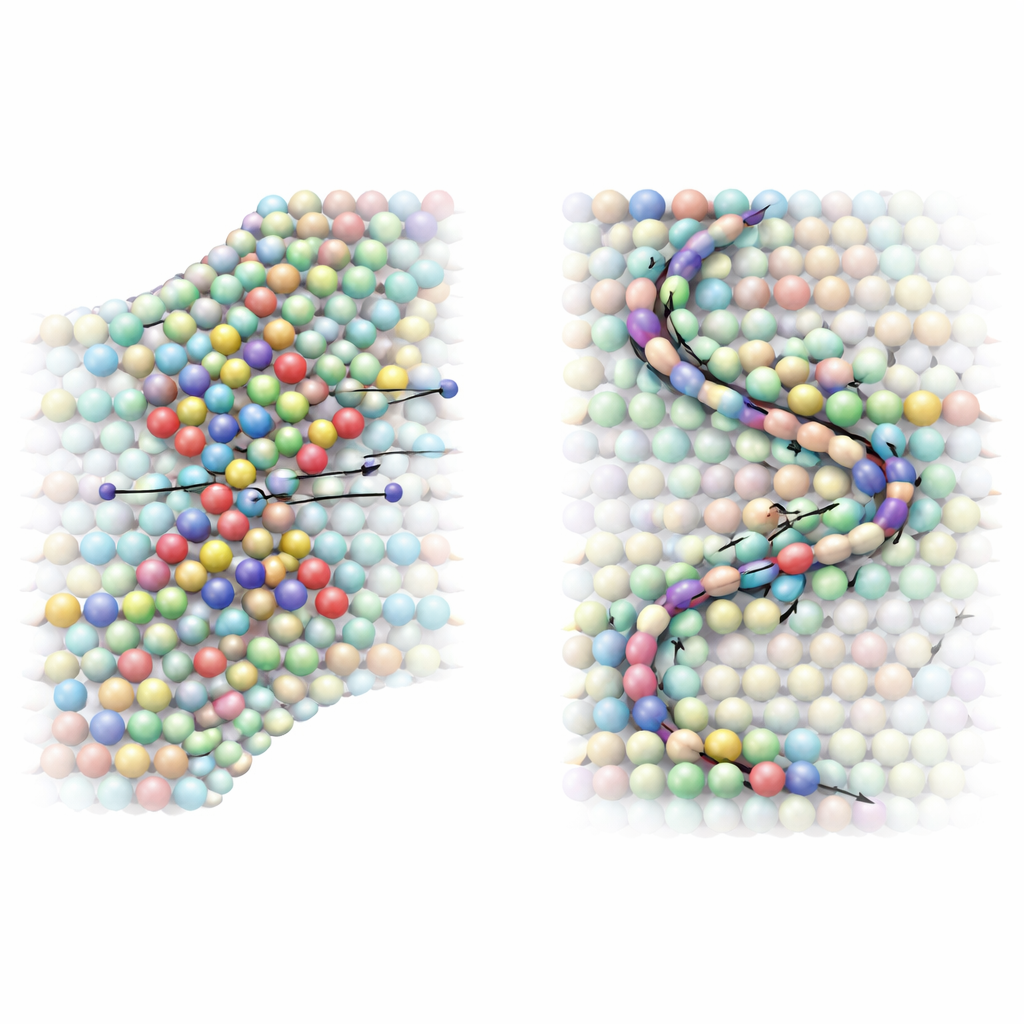
The simulations reveal that three ingredients shape the special environments around dislocations: the energy cost of putting each element into the dislocation core, how strongly different elements like or dislike each other, and the stress field created by the dislocation itself. Together, these factors drive some atoms toward the core and push others away, building up distinctive local patterns. For edge dislocations, this rearrangement narrows the dislocation core, which sharply increases the stress needed to make it move. For screw dislocations, the surrounding atomic landscape encourages the line to kink and bend; the more wavy it becomes, the more it is trapped in low-energy pathways and the harder it is to push along. In both cases, the overall strengthening is controlled by only a few dozen atoms in the immediate core region.
Why edge defects matter more than expected
A long-standing view in body-centered-cubic metals is that screw dislocations largely control strength, especially at high temperatures. Experiments on RMPEAs, however, have hinted that edge dislocations may play an even bigger role. The new simulations provide an explanation: when dislocations are present during annealing, edge dislocations generate much stronger ordering and lattice distortion around their cores than screw dislocations do. This raises the critical resolved shear stress for edge motion to levels even higher than for screws. The work also shows that these effects appear quickly during simulated annealing and then saturate, consistent with ideas that fast atomic rearrangements near dislocations underlie puzzling phenomena like dynamic strain aging and jerky flow.
What this means for future superalloys
In simple terms, the study shows that in these complex high-temperature alloys, dislocations dig their own traps: as atoms shuffle and sort themselves around a defect during heat treatment, they build tiny, ordered cages that hold the defect in place. This self-induced pinning dramatically increases the force required to move dislocations and thus boosts the strength of the material. By linking these atomic-scale patterns to measurable strength, the work offers a roadmap for designing next-generation RMPEAs: choose element combinations and heat treatments that promote strong ordering and core narrowing around edge dislocations, while controlling how screw dislocations kink, to engineer metals that stay hard and strong under extreme conditions.
Citation: Luo, Y., Wang, T., Huang, Z. et al. Dislocation-induced ordering as a source of strengthening in refractory multi-principal element alloys. npj Comput Mater 12, 134 (2026). https://doi.org/10.1038/s41524-026-02008-x
Keywords: refractory high-entropy alloys, dislocations, short-range order, atomic-scale strengthening, machine-learning interatomic potentials