Clear Sky Science · en
Analysing heat transport in crystalline polymers in real and reciprocal space
Why heat in plastics can travel like it does in metals
Most of us think of plastics as good thermal insulators, but when their chains line up perfectly, some plastics can carry heat almost as well as metals. This article explores how heat moves through highly ordered forms of two common polymers—polyethylene (used in everyday plastics) and polythiophene (a model semiconducting plastic)—and asks a deceptively simple question: can very different simulation methods agree on how well these materials conduct heat?
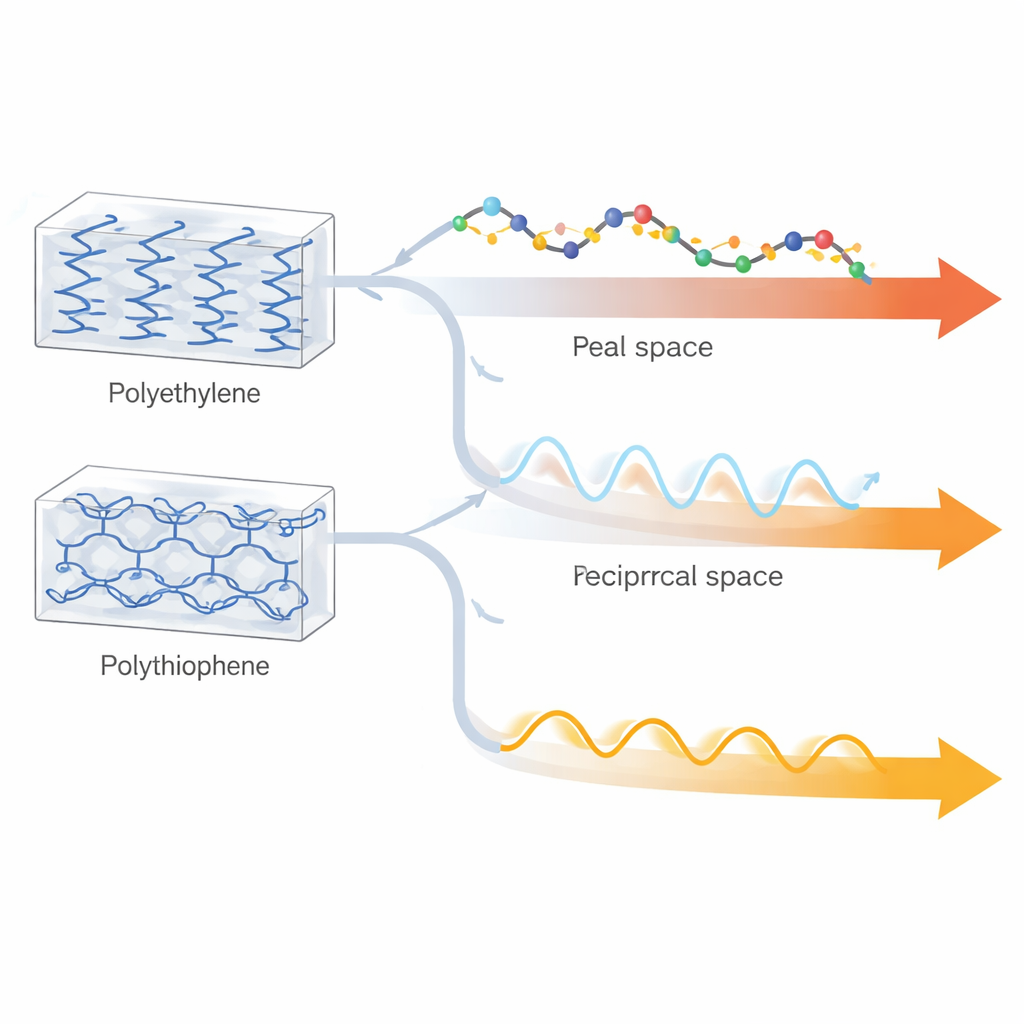
Two tidy plastics with very different personalities
The study focuses on crystalline polyethylene and polythiophene, where long molecular chains are packed in neat, repeating arrangements. In their usual, tangled, amorphous state these polymers barely conduct heat, but when chains are stretched and aligned, measurements on polyethylene fibers and films show thermal conductivities rivaling some metals along the chain direction. For polythiophene, only theoretical data existed. Knowing the true upper limit of heat flow in a perfectly ordered crystal is crucial for designing lightweight heat spreaders and advanced flexible electronics, yet past calculations for polyethylene disagreed by factors of several, depending on the method and the interaction models used.
Two ways to watch heat move
The authors compare two broad families of approaches. In “real space” simulations, molecular dynamics tracks the motion of individual atoms over time: add a temperature difference, watch energy flow, and extract the thermal conductivity. In “reciprocal space” approaches, the same process is described in terms of phonons—quantized vibrational waves—whose speeds, lifetimes, and populations together determine heat flow via the Boltzmann transport equation. Each approach has built-in compromises: phonon-based calculations usually include only the simplest scattering events between three phonons, but treat quantum statistics correctly; molecular dynamics naturally includes all levels of anharmonicity (complex scattering), yet relies on classical statistics that become questionable for high-frequency vibrations at room temperature.
Machine learning as the common language
A central step in making these methods comparable is how atomic forces are calculated. Instead of relying on traditional, often inaccurate force fields or prohibitively expensive quantum calculations for every step, the researchers use machine-learned “moment tensor” potentials. These are trained on a limited set of high-accuracy quantum-mechanical data and then used to run very long and very large simulations at near–first-principles fidelity. The team deliberately builds slightly different versions of these potentials optimized either for precise vibrational properties or for stable long-time molecular dynamics, and cross-checks that the spread in the results stays small compared with the physical trends they want to resolve.
When everything works smoothly: the case of polythiophene
For crystalline polythiophene, all roads lead to nearly the same answer. Phonon-based calculations that include only three-phonon scattering predict chain-direction thermal conductivities of roughly 80–100 W m−1 K−1, depending on whether a standard simplification is used or a more complete equation is solved. Molecular-dynamics-based routes—both those that extract phonon lifetimes from trajectories and fully real-space methods that drive or relax temperature gradients—land in essentially the same range once small, well-understood corrections are applied. A closer look reveals why: the main heat carriers are relatively low-frequency vibrations, for which classical and quantum statistics are quite similar at room temperature, and three-phonon processes already provide ample ways for energy to scatter. In this polymer, then, the different methods are consistent and the approximations on each side do little harm.
When simplicity makes life hard: the case of polyethylene
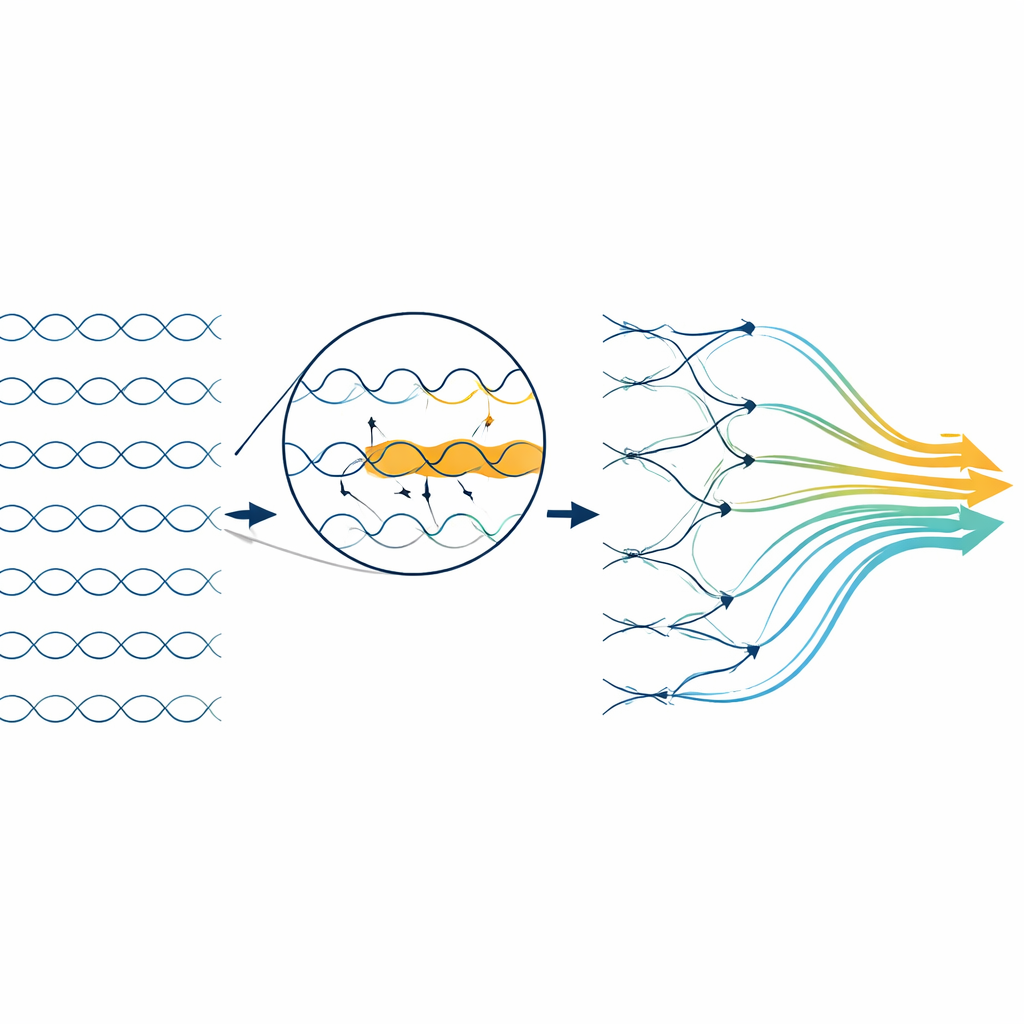
Polyethylene behaves very differently. Its simple, repeating backbone leaves fewer vibrational branches, and energy and momentum conservation rules suppress many three-phonon scattering channels in a band of higher-frequency modes between about 11 and 16 terahertz. In standard phonon calculations that include only three-phonon processes, these modes acquire extraordinarily long lifetimes and dominate heat transport, yielding strikingly high predicted conductivities above 300 W m−1 K−1. When the authors instead infer phonon lifetimes from molecular dynamics—where all higher-order scattering is present—these same modes still matter but their lifetimes shrink dramatically, cutting the conductivity by more than a factor of two. Because these important modes sit at high frequencies, classical statistics also begin to break down, and using a classical versus quantum description of their populations changes the answer by nearly 50 percent.
What this means for designing heat-carrying plastics
By combining accurate machine-learned forces with a battery of complementary methods, the study shows that consistent descriptions of heat transport in crystalline polymers are achievable—but only if the subtle physics of each material is respected. For polythiophene, three-phonon scattering plus any of the common simulation strategies already gives a trustworthy picture. For polyethylene, however, the same shortcuts badly overestimate how well a perfect crystal can conduct heat, because they miss or mis-treat both higher-order scattering and the quantum nature of high-frequency vibrational modes. The authors conclude that future attempts to design ultra–high-conductivity polymer fibers and films must account for these effects if they want realistic targets, and that cross-checking real- and reciprocal-space approaches is an effective way to expose hidden assumptions in thermal transport models.
Citation: Reicht, L., Legenstein, L., Wieser, S. et al. Analysing heat transport in crystalline polymers in real and reciprocal space. npj Comput Mater 12, 129 (2026). https://doi.org/10.1038/s41524-026-01988-0
Keywords: crystalline polymers, thermal conductivity, phonons, molecular dynamics, machine learning potentials