Clear Sky Science · en
The landscape of B and plasma cells in breast cancer: insights from single-cell and spatial transcriptomics
Why the Body’s Own Defenders Matter in Breast Cancer
When we think about the immune system fighting cancer, T cells usually steal the spotlight. This study shows that another family of immune cells—B cells and their antibody-making cousins, plasma cells—are just as important in breast cancer. By zooming in on these cells one by one inside tumors, the researchers uncovered a hidden cast of B cell characters, including a special group linked to better survival and stronger responses to modern immunotherapy drugs.
Looking Closely at Immune Cells One Cell at a Time
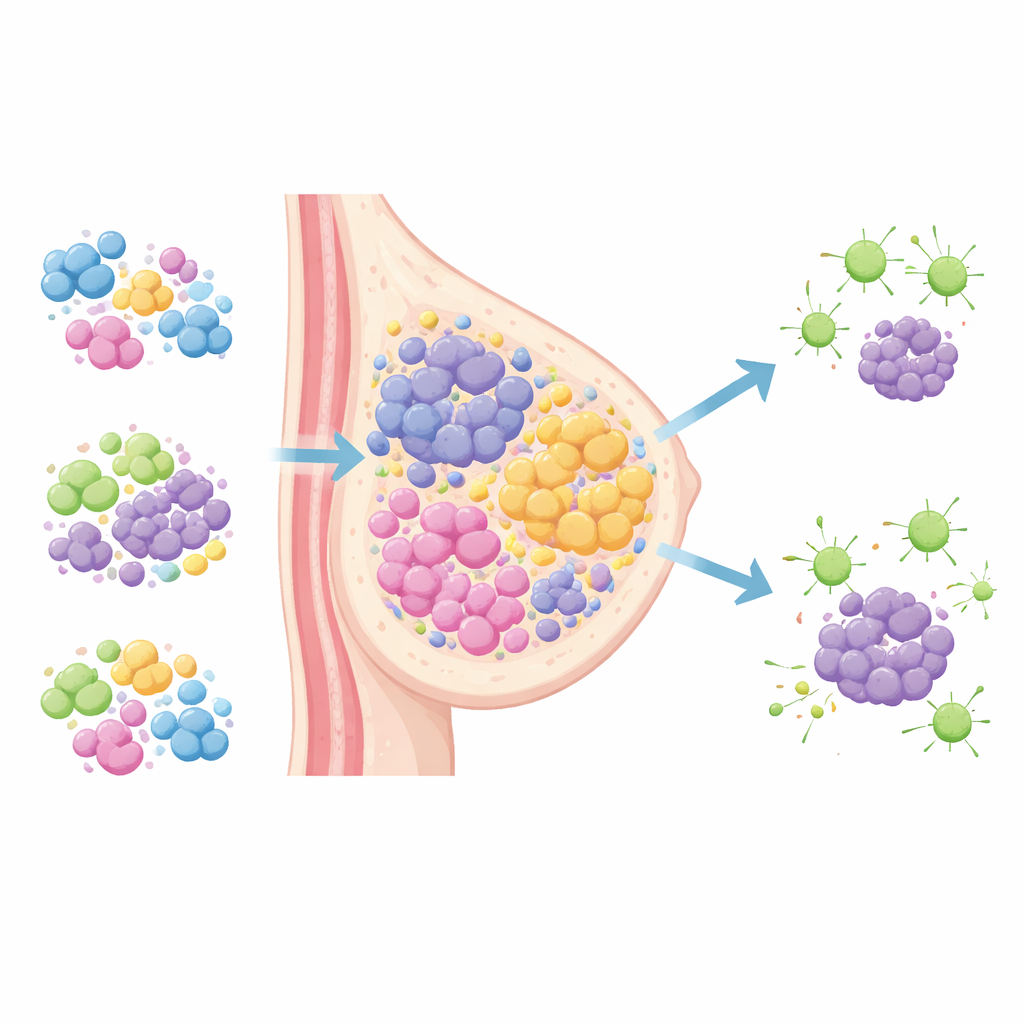
To map these cells in detail, the team combined many existing datasets with new measurements from 79 samples taken from 35 breast cancer patients. These samples came from tumors, nearby healthy tissue, lymph node metastases, and blood. Using single-cell RNA sequencing and B cell receptor sequencing, they built a high-resolution atlas of more than 100,000 B and plasma cells. This allowed them to group the cells into 21 distinct subtypes based on their gene activity, maturity, and antibody features, rather than treating all B cells as a single, uniform group.
Many Faces of B Cells Inside Breast Tumors
The map revealed that B cells in breast tumors are highly diverse. The researchers found classic naïve B cells that have not yet fully learned to recognize threats, memory B cells that carry past experience, germinal center-like cells that are in the process of refining antibodies, and plasma cells that secrete large amounts of antibodies. Tumor tissue contained more plasma cells and fewer naïve cells than nearby normal tissue or blood, reflecting an active immune response. By examining mutation patterns and antibody types, the team could also trace how B cells matured from early to late stages as they encountered tumor signals.
Spotlighting a Helpful B Cell Subset
Among all these groups, two stood out as especially important in tumors: a naïve-like subset marked by a molecule called CD200, and an atypical memory subset marked by the gene ISG15. Both showed signs of clonal expansion and strong activation, suggesting they were reacting to tumor material rather than just passing through. The CD200-positive naïve B cells were often found in structures called tertiary lymphoid structures—small, lymph node–like hubs that can form inside or near tumors—and tended to cluster with T cells. Patients whose tumors had more of the CD200-positive B cell signature generally lived longer, and across several cancer cohorts they were more likely to respond to checkpoint-blocking immunotherapies.
How B Cells Shape Antibodies and Therapy Response
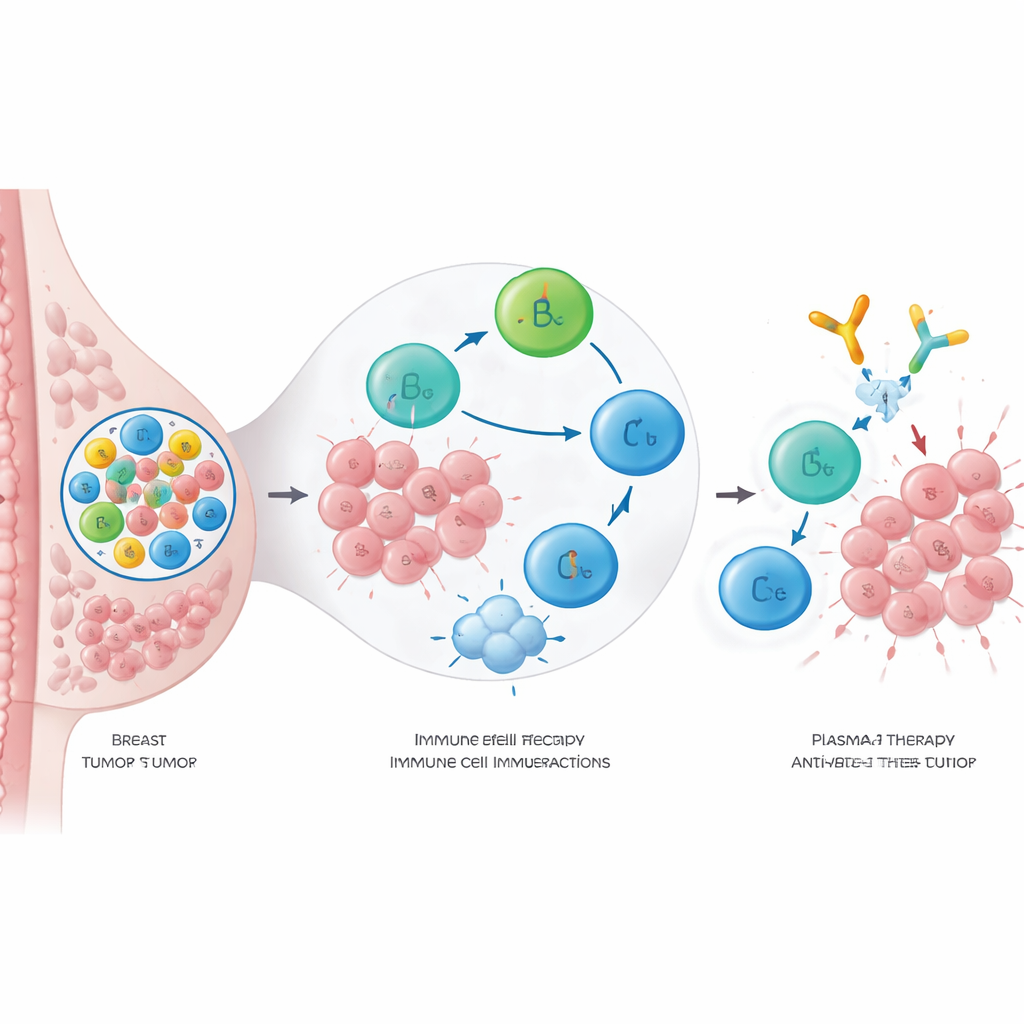
The study also dissected plasma cells, which are the antibody factories that arise from B cells. Different plasma cell subgroups were found in normal tissue, lymph nodes, and tumors, and some tumor-enriched groups produced antibodies that had switched from an IgA type common in normal tissues to an IgG type more prevalent in tumors. These IgG antibodies are better suited to engage immune cells such as natural killer cells and certain macrophages. The authors suggest that, in breast cancer, the balance of antibody types and plasma cell states may tilt the tumor environment toward either attack or tolerance.
Testing B Cells in Animal Models
To move beyond correlations, the researchers tested the function of these cells in mouse models of breast cancer. They isolated CD200-positive B cells and CD200-negative B cells from mouse spleens and transferred them into tumor-bearing mice whose own B cells had been removed. Mice receiving CD200-positive B cells had slower tumor growth and more active killer T cells than those receiving CD200-negative cells. When the team combined CD200-positive B cell transfer with anti–PD-1 treatment—a widely used checkpoint inhibitor—the tumors shrank more, and the proportion of potent, effector CD8 T cells rose. In contrast, using an antibody to broadly deplete CD200-positive cells, which also reduced some T cells, did not help and could blunt the beneficial effects.
What This Means for Patients
Overall, the work shows that not all B cells in breast cancer are alike: some appear to undermine the immune response, while others, especially CD200-positive B cells, help rally T cells and improve the impact of immunotherapy. By creating a detailed atlas of B and plasma cells and linking certain B cell signatures to patient outcomes, this study points to CD200-positive tumor-associated B cells as promising biomarkers and potential partners for future treatments. In plain terms, carefully harnessing the “good” B cells in tumors may make existing cancer drugs work better and open new paths for more precise, effective breast cancer care.
Citation: Cai, X., Yang, J., Wang, W. et al. The landscape of B and plasma cells in breast cancer: insights from single-cell and spatial transcriptomics. npj Breast Cancer 12, 61 (2026). https://doi.org/10.1038/s41523-026-00917-0
Keywords: breast cancer immunology, B cells, plasma cells, immunotherapy response, single-cell analysis