Clear Sky Science · en
Socioeconomic disparities in long-term heart failure risk of trastuzumab with or without anthracyclines in early-stage breast cancer: a SEER-Medicare database analysis
Why this matters beyond the clinic
As more women survive breast cancer, what happens to their hearts years after treatment becomes a crucial question. This study looks at how cancer drugs and the neighborhoods women live in combine to shape their chances of developing congestive heart failure, and how those risks differ across racial and ethnic groups. Understanding these patterns can help doctors target heart-protective care to the women who need it most and highlight where social inequality shows up in long‑term health.
Who was studied and what was measured
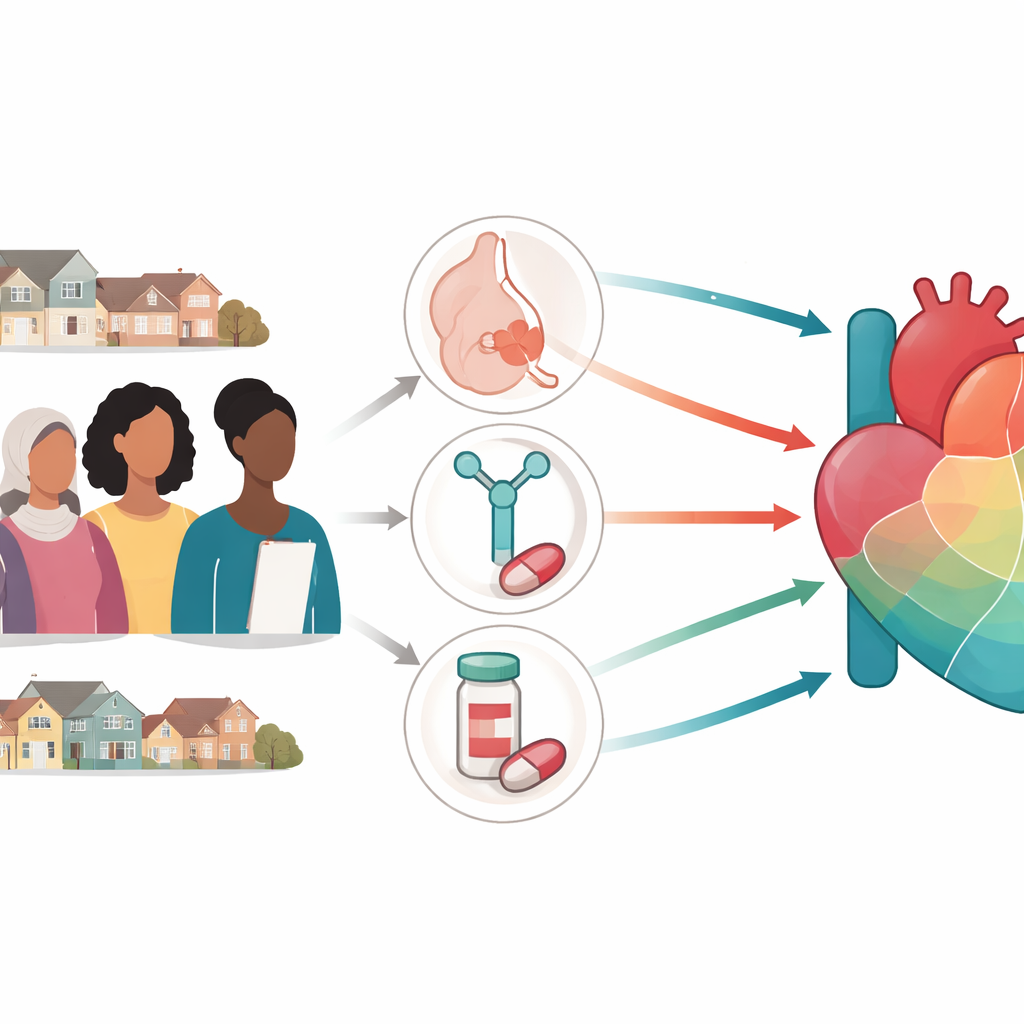
The researchers used a large U.S. database that links cancer registry records with Medicare insurance claims, capturing over 200,000 women aged mostly 65 and older who were diagnosed with early-stage breast cancer between 2005 and 2016. They focused on two common breast cancer drug types: anthracyclines, an older chemotherapy class known to stress the heart, and trastuzumab, a targeted drug used in HER2‑positive disease that can also affect heart function. Using billing codes, they tracked who later developed congestive heart failure. They then linked each woman’s record to census information from her ZIP code, capturing average income, education level, poverty rates, and how often English was spoken at home, as well as recorded race and ethnicity.
How cancer stage and neighborhood are linked
The team found that cancer at diagnosis looked very different depending on race, ethnicity, and local socioeconomic conditions. Black, Hispanic, and American Indian/Alaska Native women were more likely than White and Asian American/Pacific Islander women to have large, high‑grade tumors and cancer that had already spread to nearby lymph nodes—features that signal more aggressive disease and a need for stronger treatment. Similar patterns appeared when they examined neighborhood characteristics. Women living in areas with lower income, more poverty, less education, or a higher share of households not speaking English at home had higher rates of large, high‑grade, and lymph‑node‑positive cancers. As income and education rose and poverty fell across ZIP codes, the proportion of women with these high‑risk cancer features dropped in a near‑linear fashion.
Heart disease risk beyond traditional factors
Heart problems such as coronary artery disease, high blood pressure, and diabetes were also unevenly distributed. Black women, in particular, had higher rates of these conditions, and diabetes was more common across several minority groups and in poorer neighborhoods. When the researchers followed women over time, nearly all the socioeconomic measures were linked to differences in heart failure risk in simple, one‑factor analyses. To dig deeper, they built multivariable models that adjusted for age, existing heart conditions, and which cancer drugs each woman received. After this adjustment, race, ethnicity, and per‑person income still mattered. Black women had a 23 percent higher risk of developing heart failure than White women, while Asian American/Pacific Islander women had a 12 percent lower risk. Independently of race and medical history, women living in ZIP codes with the lowest per‑capita income had an 18 percent higher risk of heart failure than those in the wealthiest areas.
How cancer drugs and social conditions combine
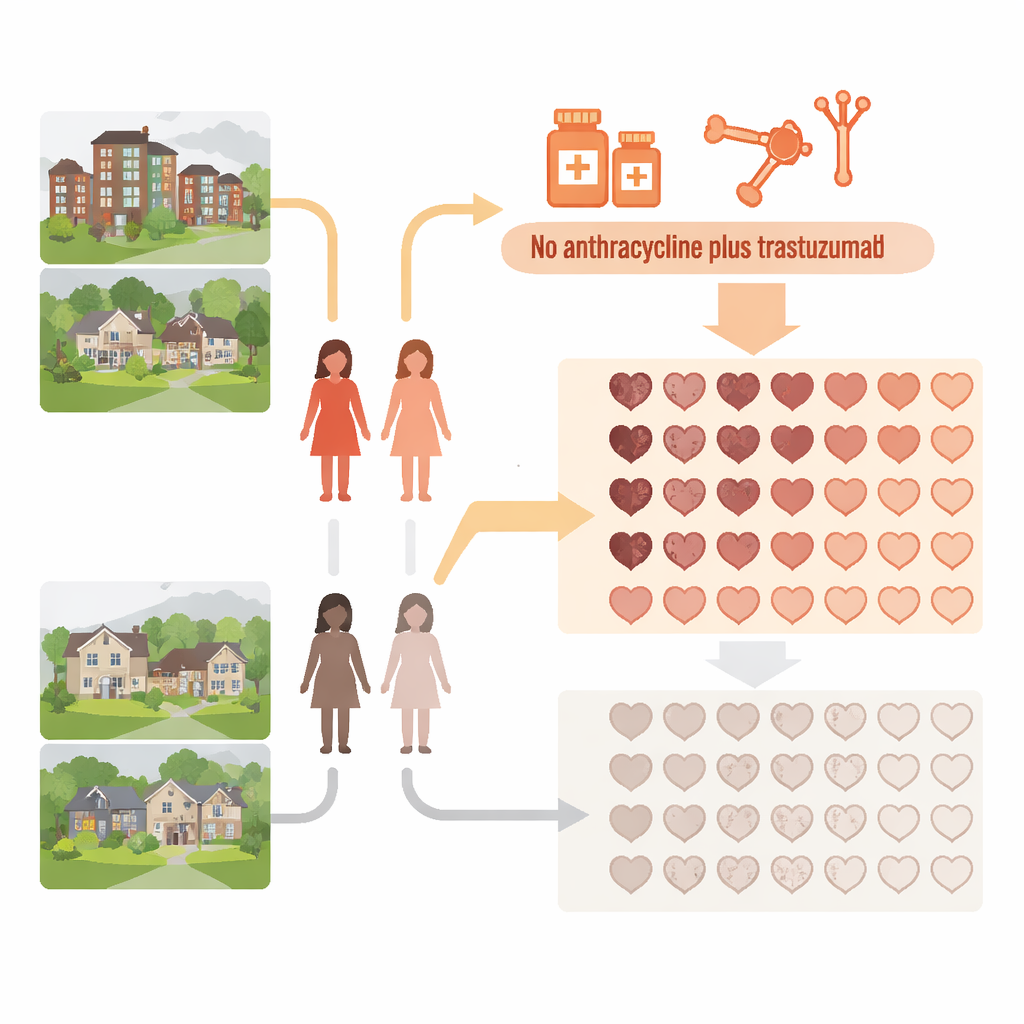
When the team compared treatment groups, the pattern of drug‑related risk was consistent even after accounting for socioeconomic factors. Women who received both anthracyclines and trastuzumab had the highest risk of later heart failure, followed by those who received anthracyclines alone and then trastuzumab alone, compared with women who received neither drug. Adding income, education, or race and ethnicity to the statistical models did not erase or reverse these treatment effects. Instead, the study suggests that social conditions and race or ethnicity layer on top of known drug risks, rather than explaining them away. This points to a complex web of influences that may include lifestyle factors, access to high‑quality care and follow‑up, chronic stress, and underlying differences in biology.
What this means for patients and care
For women who have been treated for early-stage breast cancer, this work underscores that long‑term heart health does not depend only on which drugs they received or whether they already had high blood pressure or diabetes. Where they live and the social and economic pressures surrounding them also play a measurable role, and those pressures are not felt equally across racial and ethnic groups. The authors suggest that Black women and women living in low‑income neighborhoods should be considered for closer heart monitoring and more aggressive risk‑reduction strategies after breast cancer treatment, especially when they have been given heart‑stressful drugs like anthracyclines and trastuzumab. In practical terms, the study argues that protecting survivors’ hearts will require not just better medicines, but also attention to the social environment in which recovery takes place.
Citation: Britten, K., Lipsyc-Sharf, M., Yang, E.H. et al. Socioeconomic disparities in long-term heart failure risk of trastuzumab with or without anthracyclines in early-stage breast cancer: a SEER-Medicare database analysis. npj Breast Cancer 12, 51 (2026). https://doi.org/10.1038/s41523-025-00883-z
Keywords: breast cancer survivorship, heart failure risk, socioeconomic disparities, cardio-oncology, trastuzumab and anthracyclines