Clear Sky Science · en
DeepStrataAge: an interpretable deep-learning clock that reveals stage- and sex-divergent DNA methylation aging dynamics
Why Your Birth Certificate Doesn’t Tell the Whole Story
Two people can both be 60 years old, yet one runs marathons while the other struggles with everyday tasks. This gap reflects not just years lived, but how their bodies have aged on the inside. Scientists are increasingly turning to tiny chemical marks on our DNA—known as DNA methylation—to read this hidden "biological age." The study behind DeepStrataAge introduces a new, more precise way to read these marks, revealing not only how fast we age but also when our bodies go through major aging "phases," and how these phases differ between men and women.

Reading Age in the Blood
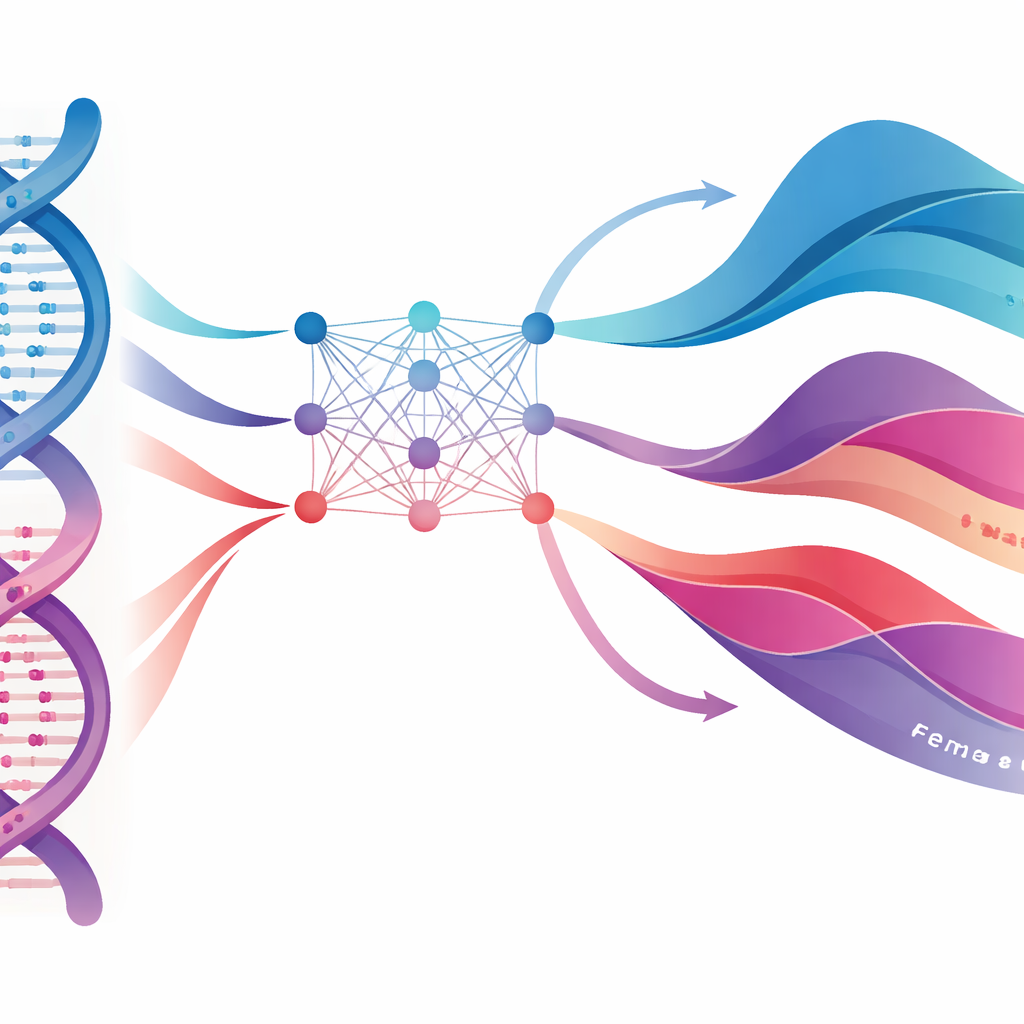
DNA methylation clocks work like forensic tools for biology: they scan hundreds of thousands of positions along our DNA for chemical tags that change in predictable ways across life. Earlier generations of these clocks relied on simple statistical recipes that assumed each DNA site nudged age up or down independently and in a straight-line fashion. Those methods were surprisingly accurate, but they often missed more complex patterns and gave little insight into what was happening biologically. DeepStrataAge takes a different approach. The researchers trained a deep neural network—a machine-learning model inspired by how neurons connect—to read methylation patterns from more than 29,000 blood samples and estimate a person’s age with an average error of just under two years, outperforming many popular existing clocks.
Finding Aging Phases, Not Just a Slope
Instead of treating aging as a smooth, linear decline, the team asked whether there are distinct stages where the body’s molecular systems reconfigure in waves. Using a method called SHAP, which explains which DNA sites matter most to each prediction, they grouped ages that shared similar influence patterns. This revealed four broad phases when everyone was analyzed together: early life (up to the mid-30s), an early-midlife transition, a late-midlife phase, and a late-life remodeling phase from about 65 onward. These phases resembled “aging waves” seen in previous multi-omics studies, where proteins and other molecules crest and shift around the 40s and 60s, suggesting that aging is punctuated by coordinated biological transitions rather than a steady slide.
Men and Women Age on Different Timetables
When the researchers separated the data by sex, the patterns became more nuanced. In men, early-life methylation patterns up to about age 40 were tightly coordinated and linked to brain development, cellular structure, and muscle function. Then, around ages 45–49, the model picked up an abrupt transition, coinciding with declining testosterone and shifts in metabolism and immunity. Late-life male patterns were dominated by changes in immune and inflammatory genes, echoing the phenomenon of “inflammaging,” where chronic low-level inflammation becomes more common. In women, by contrast, the transition was earlier and smoother. Subtle shifts began around 35–39, aligned with perimenopause, and unfolded into a midlife phase marked by changing immune signals and stress responses. By late life, women showed strong changes in gene regulation and neuroendocrine pathways, suggesting a progressive reshaping of brain–hormone communication.
What the Molecular Changes Are Actually Doing
Looking more closely at which genes were affected at different ages, the study painted a moving picture of what the body is working on as it ages. In early life, the most age-sensitive DNA sites in both sexes were tied to the cell’s internal scaffolding, nerve growth, and structural maintenance—systems that help build and stabilize tissues. Many immune and hormone-related genes remained relatively stable then, implying a kind of developmental priority: build first, remodel later. In midlife and late life, the balance flipped. Highly influential sites clustered in genes that regulate immunity, inflammation, and how DNA is switched on or off, while core structural genes changed less. These shifts suggest that as we get older, aging is driven less by the erosion of basic architecture and more by rewiring of control systems that manage repair, defense, and communication between organs.
Why This Matters for Health and Longevity
Because DeepStrataAge is both accurate and interpretable, it can do more than simply tell you how old your body "looks." The difference between its predicted age and your actual age—called delta-age—tracked with risks of stroke, chronic kidney disease, cardiovascular problems, and cognitive decline, even after adjusting for chronological age. The work also highlights sex-specific windows when molecular aging accelerates: a compressed midlife shift in men and a longer, hormonally guided transition in women. In practical terms, this opens the door to timing interventions—whether lifestyle changes, drugs, or hormone-based therapies—around the years when our internal clocks are turning most rapidly, and to designing treatments that respect the distinct aging trajectories of men and women.
Citation: Lin, A., Giosan, I., Aparicio, A. et al. DeepStrataAge: an interpretable deep-learning clock that reveals stage- and sex-divergent DNA methylation aging dynamics. npj Aging 12, 62 (2026). https://doi.org/10.1038/s41514-026-00358-w
Keywords: biological age, DNA methylation, deep learning, sex differences, epigenetic clock