Clear Sky Science · en
AFM imaging reveals the unreconstructed α‑Al2O3(0001) surface to be inhomogeneous and rough
Why tiny surface details matter
Aluminum oxide, often called alumina, is a workhorse material found in everything from protective coatings to catalysts and electronic devices. Many technologies rely on growing ultra thin films on top of perfectly prepared alumina crystals. For decades, scientists assumed that one common crystal face of alumina was atomically flat and neatly ordered, providing an ideal base layer. This study uses cutting edge microscopy and computer simulations to show that this assumption is wrong, with important consequences for how we design and interpret experiments that use alumina surfaces.
The old picture of a smooth surface
The crystal face examined here is known as the (0001) surface of alpha alumina, the most stable form of aluminum oxide. Textbooks and many theoretical studies have treated its unreconstructed form as a simple, flat grid of aluminum atoms sitting on oxygen atoms below. This model satisfied basic electrical balance rules and was convenient for calculations of how gases and thin films interact with alumina. It also suggested that the exposed aluminum atoms should be highly reactive, readily grabbing onto water molecules and helping them split apart.
A puzzling mismatch with experiments
Over the years, measurements of how water sticks to this alumina face painted a confusing picture. Some experiments saw the strong chemical bonding and water splitting predicted by theory, while others reported that the surface stayed mostly dry and unreactive unless water pressures were high. Different techniques even disagreed on whether water remained intact or broke apart. These contradictions hinted that the real surface might be more complicated than the neat, flat model used in many simulations and interpretations.
Looking closer with atomic force microscopy
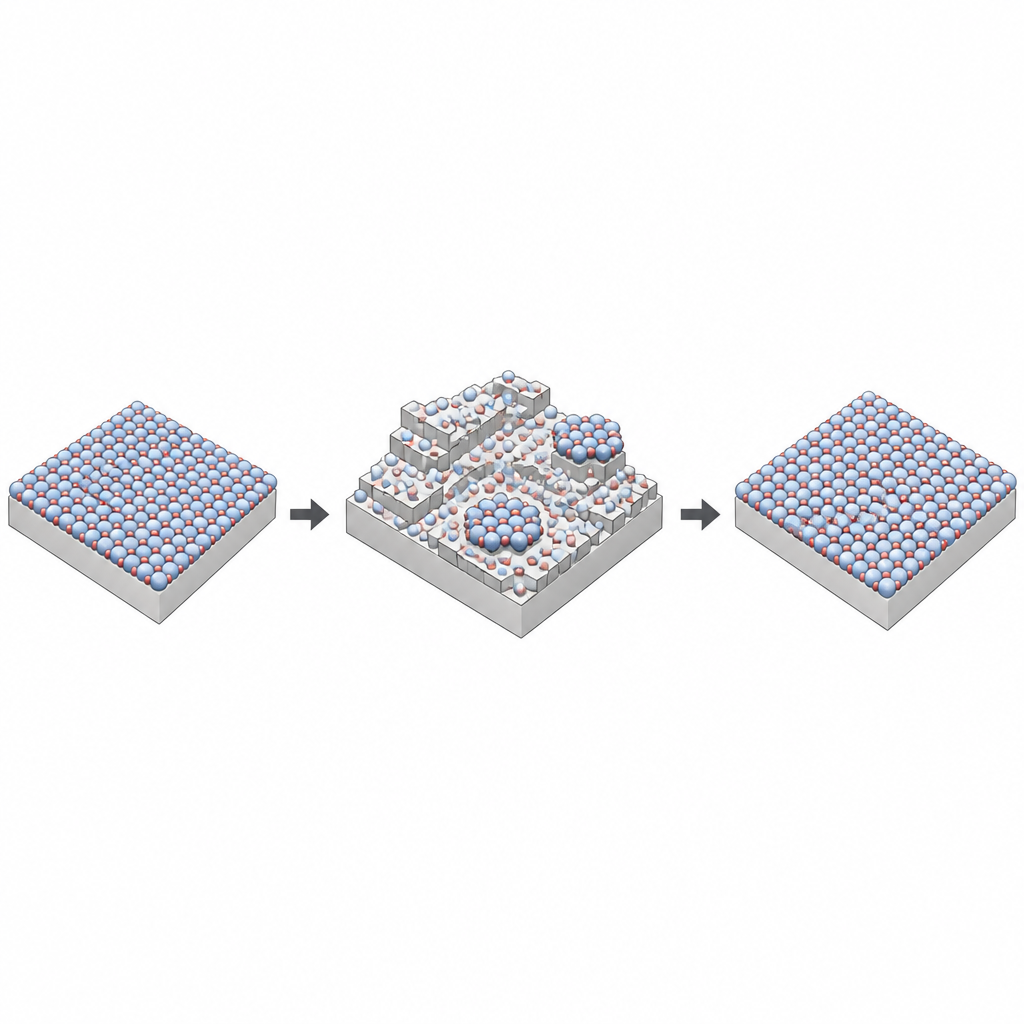
The authors tackled this puzzle using noncontact atomic force microscopy, a method that feels the surface with an ultra sharp tip without touching it, as well as detailed quantum mechanical calculations. Under conditions where the surface should remain unreconstructed, the images revealed that it is not flat at all. Instead, it is rough on the nanoscale, with steps and height variations spanning several atomic layers. Only tiny islands a few nanometers wide show the orderly aluminum pattern expected from the traditional model. By chemically tuning the tip and comparing the images to simulations, the team confirmed that these bright islands really are aluminum rich patches. The vast majority of the surface, however, appears disordered and is likely richer in oxygen.
How heat reshapes the surface
When the crystals were heated above about 1000 degrees Celsius, the surface changed its structure. It reorganized into a different, more complex but highly ordered pattern that earlier work had identified as the thermodynamically stable state. This reconstructed surface is much flatter, with only small height variations inside each repeating unit. Theory shows that this reconstruction greatly lowers the surface energy by letting aluminum atoms bond more fully to oxygen underneath, removing the highly exposed sites that made the unreconstructed model unstable. Once formed, this reconstructed state stayed in place, even when samples were cooled down or exposed to water, indicating that it is not easily reversed.
Why this new view matters
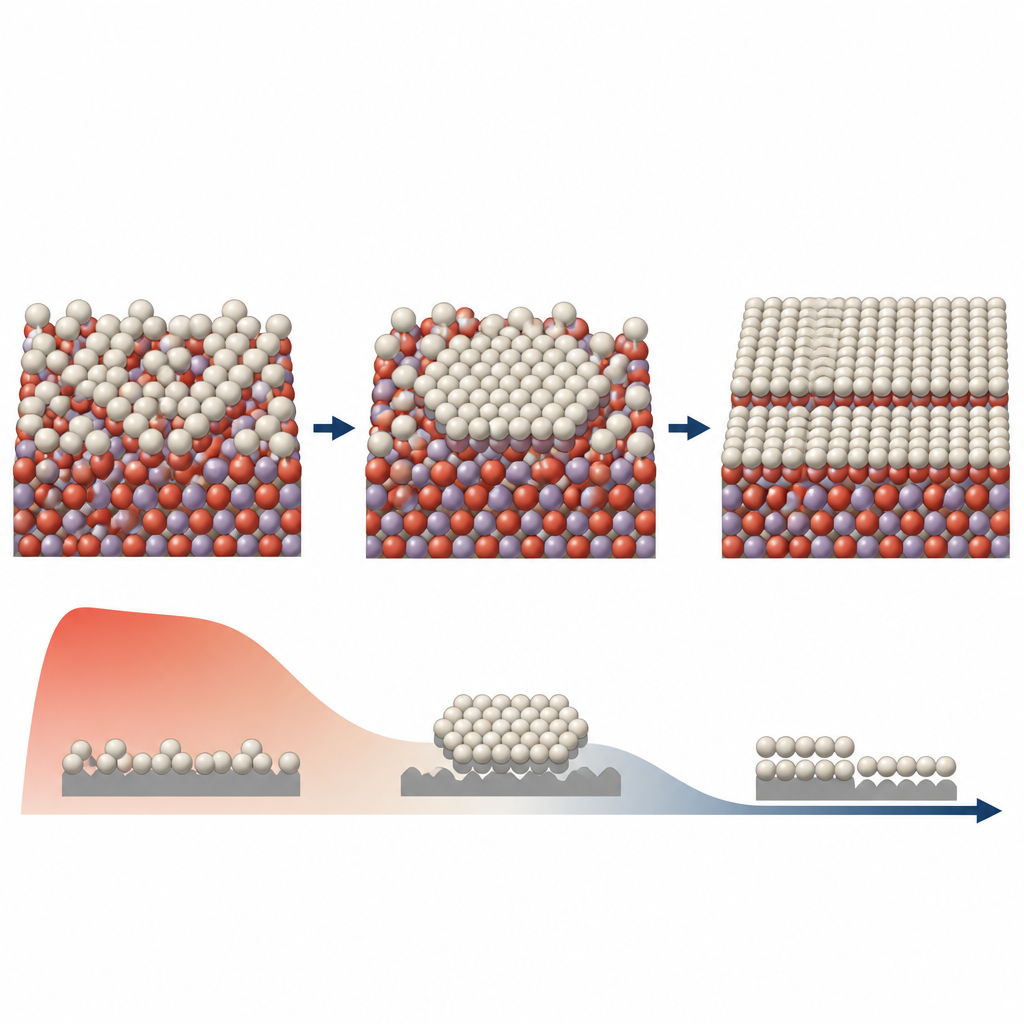
The finding that the common unreconstructed alumina surface is intrinsically rough and patchy has wide reaching implications. It helps explain why water sometimes reacts strongly and sometimes barely interacts, since only the small aluminum rich islands offer the reactive sites that favor water splitting. For technologies that grow two dimensional materials or other thin films on sapphire, it means that the starting template is far from uniform, which can influence how new layers nucleate and spread. The work shows that widely used simple surface models can be misleading and that a more realistic, inhomogeneous picture is needed to understand and control alumina based interfaces.
Citation: Hütner-Reisch, J.I., Conti, A., Kugler, D. et al. AFM imaging reveals the unreconstructed α‑Al2O3(0001) surface to be inhomogeneous and rough. Nat Commun 17, 4692 (2026). https://doi.org/10.1038/s41467-026-73690-0
Keywords: alumina surface, atomic force microscopy, sapphire substrate, surface reconstruction, thin film growth