Clear Sky Science · en
Chemical bonding concepts emerge naturally from maximally entangled atomic orbitals
Why this new view of chemical bonds matters
Chemistry textbooks teach us to picture bonds as simple lines between atoms, but real molecules behave according to the strange rules of quantum physics. This article shows how ideas from quantum information, especially how strongly different parts of a system are linked, can give a clear and quantitative picture of chemical bonds. The work connects familiar classroom drawings of molecules with the deeper quantum structure of electrons and offers a unified way to think about ordinary bonds, multicenter bonds, and aromatic rings.
A new way to look at how atoms hold together
Chemical bonds are usually described with two classic pictures. Valence bond theory focuses on electron pairs shared between atoms, while molecular orbital theory spreads electrons over the whole molecule. Modern computer methods can predict energies very accurately, but they often hide the simple bonding story behind layers of mathematical detail. The authors propose a different route. They start from localized atomic orbitals, use tools from quantum information to measure how strongly these orbitals are linked, and from this recover the familiar bonding patterns that chemists draw by hand.
Maximally entangled atomic orbitals in plain terms
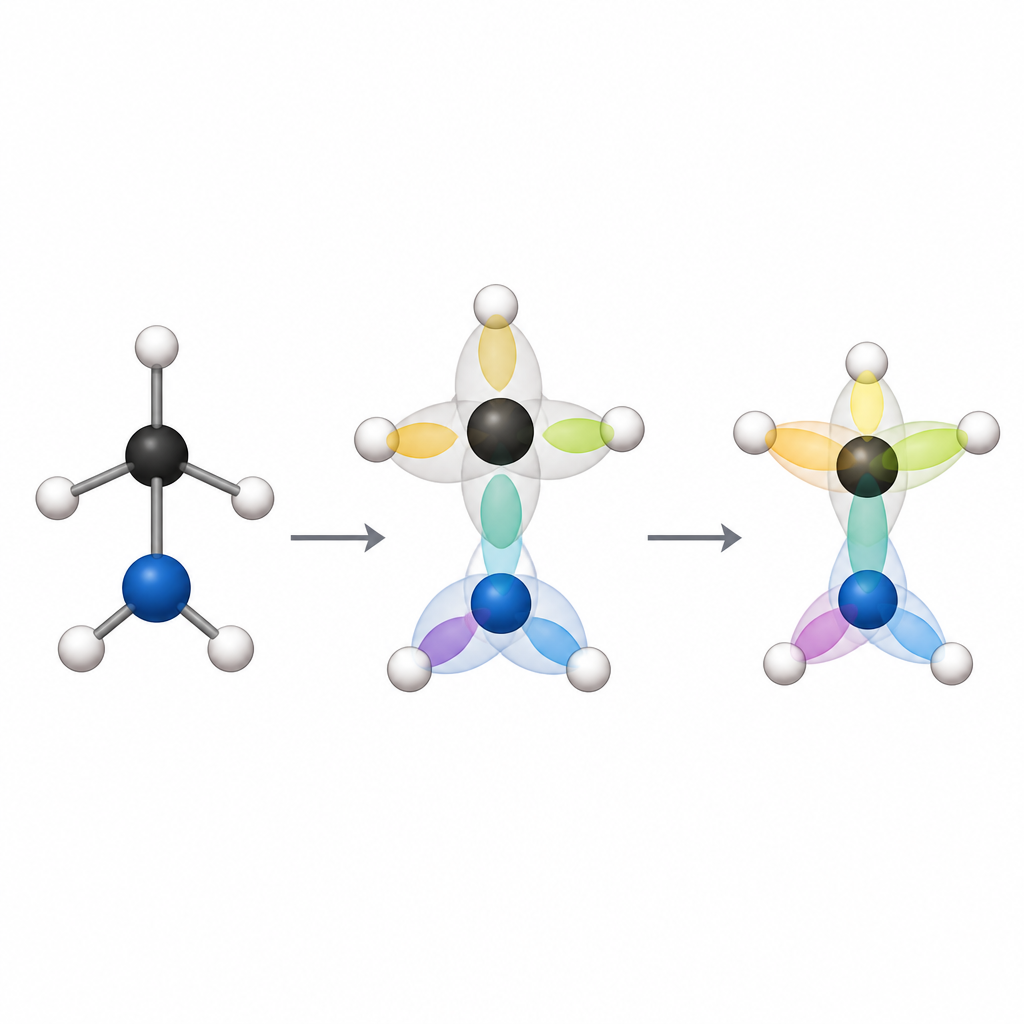
The central idea is a special set of localized orbitals called maximally entangled atomic orbitals. Here, “entangled” means that what happens to electrons in one orbital is tightly connected to what happens in another orbital, in a way that only quantum mechanics allows. The authors choose and rotate the starting atomic orbitals so that the total connection between orbitals on different atoms is as strong as possible. When they then examine how pairs or groups of these orbitals are correlated, they find that each strong pair corresponds to a conventional bond, and groups of more than two orbitals reveal more complex bonding patterns.
Recovering familiar bonds and tracking bond strength
Testing their method on simple molecules, the researchers show that these special orbitals automatically reproduce well known chemical features. In ethene, for example, the carbon orbitals rearrange themselves into the familiar sp2 pattern without any built in chemical rules. Strongly linked orbital pairs map one to one onto single, double, and triple bonds, and the amount of quantum connection in a pair closely follows the usual idea of bond order. Covalent bonds show high entanglement, while more ionic or weakly bound systems such as lithium fluoride and the helium dimer display much lower or even vanishing values. The method also captures subtle cases like the “harpoon” mechanism in lithium hydride, where the degree of sharing between atoms first rises and then falls as the bond stretches, something that standard population analyses struggle to describe.
Seeing multicenter bonds and aromatic rings as shared patterns
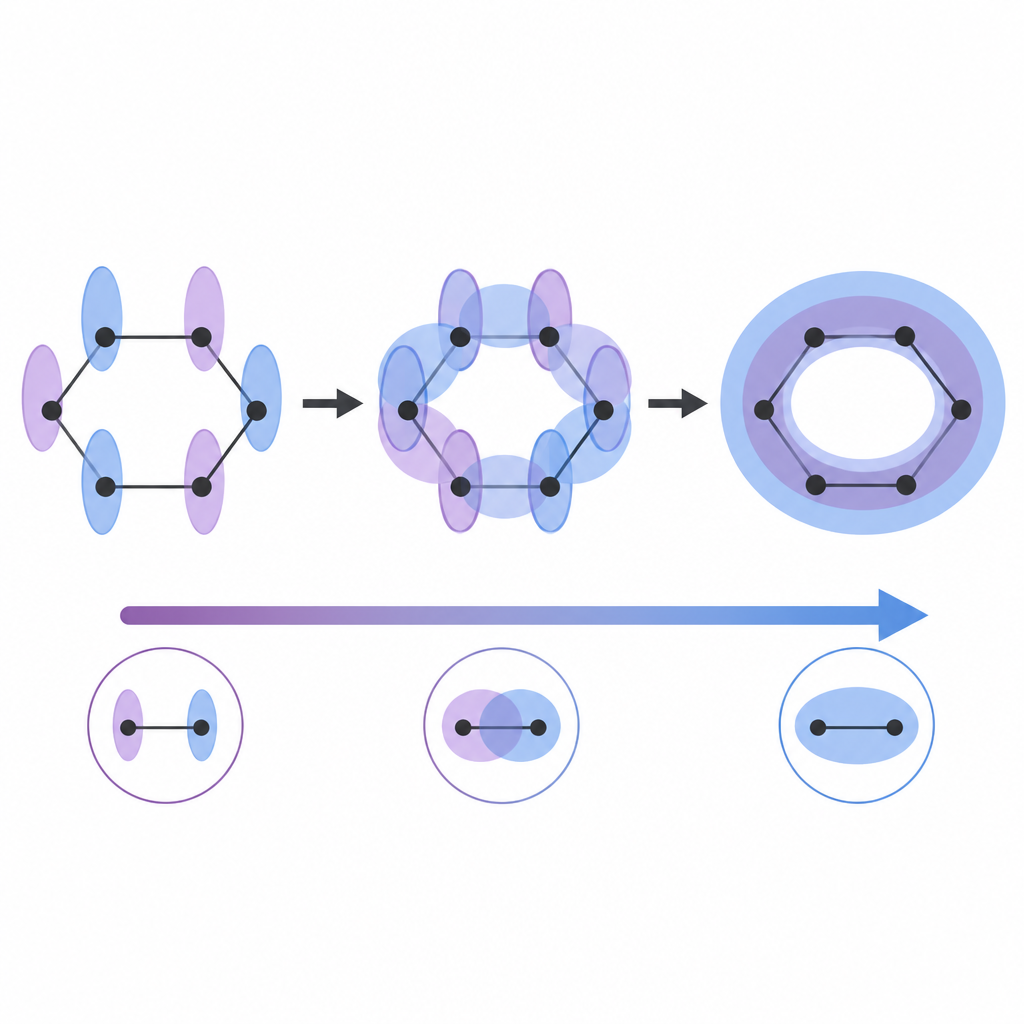
Many molecules cannot be described by simple two atom bonds. The authors extend their approach by looking at how entanglement is shared among three or more orbitals at once, a feature known as genuine multipartite entanglement. In three center bonds and in clusters of metal and main group atoms, high multipartite entanglement signals that electrons are spread over several atoms in a coordinated way. Aromatic molecules provide an even richer test. In benzene, six out of plane orbitals form a strongly connected ring with a very high multipartite entanglement value, reflecting the classic picture of electrons circulating around the ring. When some carbons are replaced by nitrogen or when the ring is distorted, this value drops, in line with the accepted idea that aromatic character decreases under these changes.
From textbook pictures to a unified quantum story
Taken together, the results show that a single quantum information based framework can describe ordinary bonds, multicenter bonds, aromaticity, and even tricky transition states in reactions. Instead of relying on several separate bonding models, chemists can in principle read bond strength and bonding patterns directly from how strongly localized orbitals are linked in the quantum state of the electrons. For a lay reader, the key message is that the lines and rings drawn in chemical structures are not just convenient symbols; they reflect deep patterns of quantum connection that this new method can now quantify in a precise and systematic way.
Citation: Ding, L., Matito, E. & Schilling, C. Chemical bonding concepts emerge naturally from maximally entangled atomic orbitals. Nat Commun 17, 4732 (2026). https://doi.org/10.1038/s41467-026-73527-w
Keywords: chemical bonding, quantum entanglement, aromaticity, multicenter bonds, molecular orbitals