Clear Sky Science · en
An attention-demanding hunting paradigm engages the superior colliculus–zona incerta circuit mediating analgesia in male mice
Chasing crickets to feel less pain
Anyone who has been absorbed in a good game or gripping task knows that pain can seem to fade into the background. This study explores that everyday experience using mice that hunt live crickets. By following how their brains change during this intense, attention‑demanding activity, the researchers identify a specific brain pathway that links focused attention to natural pain relief, offering clues for non‑drug approaches to chronic pain.
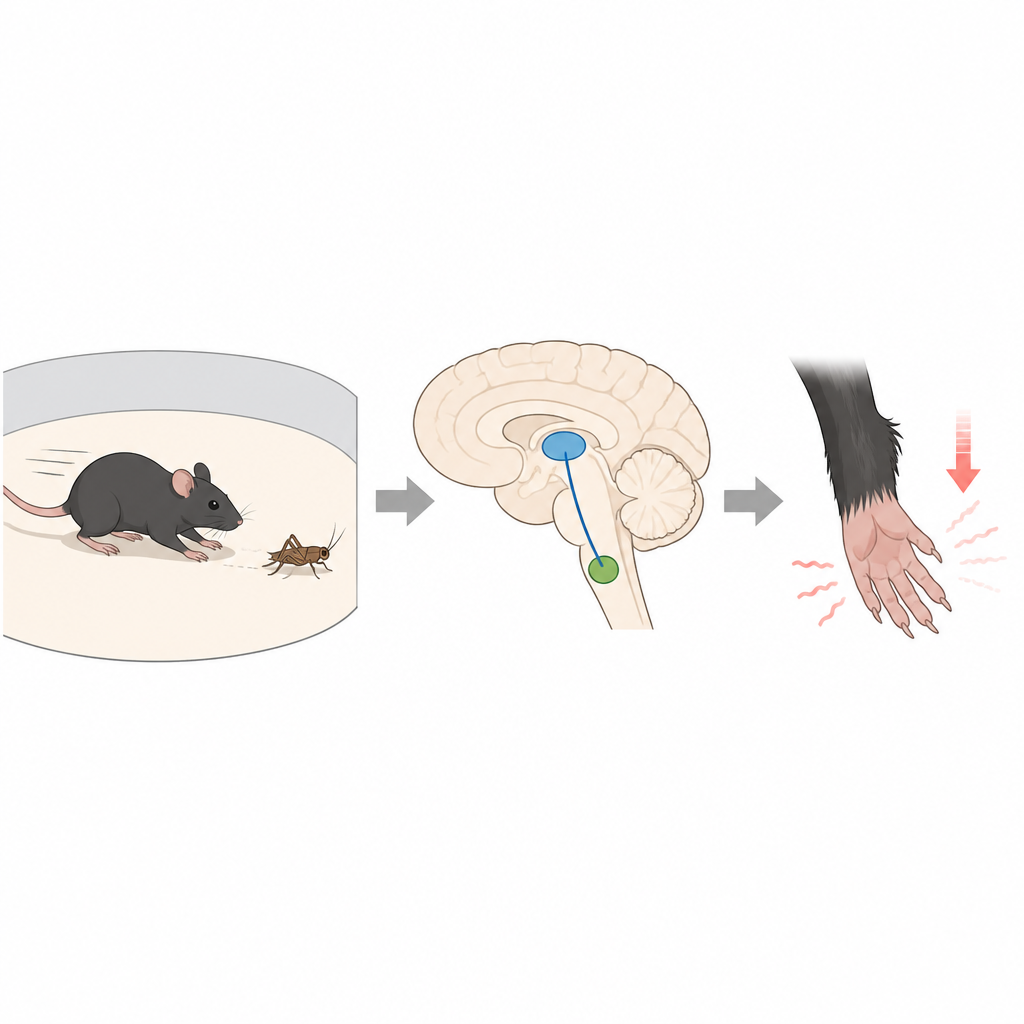
A natural game that dials down pain
The team trained male mice to hunt live crickets in a small arena after a brief fast, which made the animals highly motivated and focused. They then measured how sensitive the mice were to touch and heat on their paws, both under normal conditions and after nerve injury that mimics chronic neuropathic pain. Mice that actively chased, caught, and ate crickets became less sensitive to painful touch and heat right after the hunting session. This effect appeared in healthy animals and in those with nerve damage, and it also reduced spontaneous pain behaviors triggered by chemical irritants such as capsaicin and formalin. Simply moving around freely, eating regular food, or seeing a fixed cricket they could not chase did not produce the same benefit, showing that active, goal‑directed hunting is the key.
How a midbrain hub links attention and pain
To understand how this behavior changes pain processing, the researchers focused on a midbrain structure called the superior colliculus, which helps animals detect and respond to important sights, including moving prey. Using genetic tagging tools, they marked the specific superior colliculus cells that became active during cricket hunting. Most of these cells used an excitatory chemical signal and many produced a molecule called substance P. When the team recorded these cells in live mice, they found that the same hunting‑activated neurons also responded strongly to painful touch and heat. This suggests that a single group of cells can both guide visually driven hunting and register nociceptive, or pain‑related, input.
A pain‑relief pathway through a deep brain relay
The tagged superior colliculus cells send strong excitatory signals to another deep brain region, the zona incerta, which is rich in inhibitory neurons. Experiments in brain slices showed that this connection is direct and uses the excitatory transmitter glutamate to activate zona incerta cells that themselves quiet downstream targets. When the researchers turned on the hunting‑activated superior colliculus cells with light, or specifically stimulated their fibers in the zona incerta, mice became less sensitive to pain. This worked in both healthy and nerve‑injured animals and was accompanied by a preference for places where the stimulation occurred, hinting that activating this pathway not only eases discomfort but is experienced as positively valenced or rewarding.
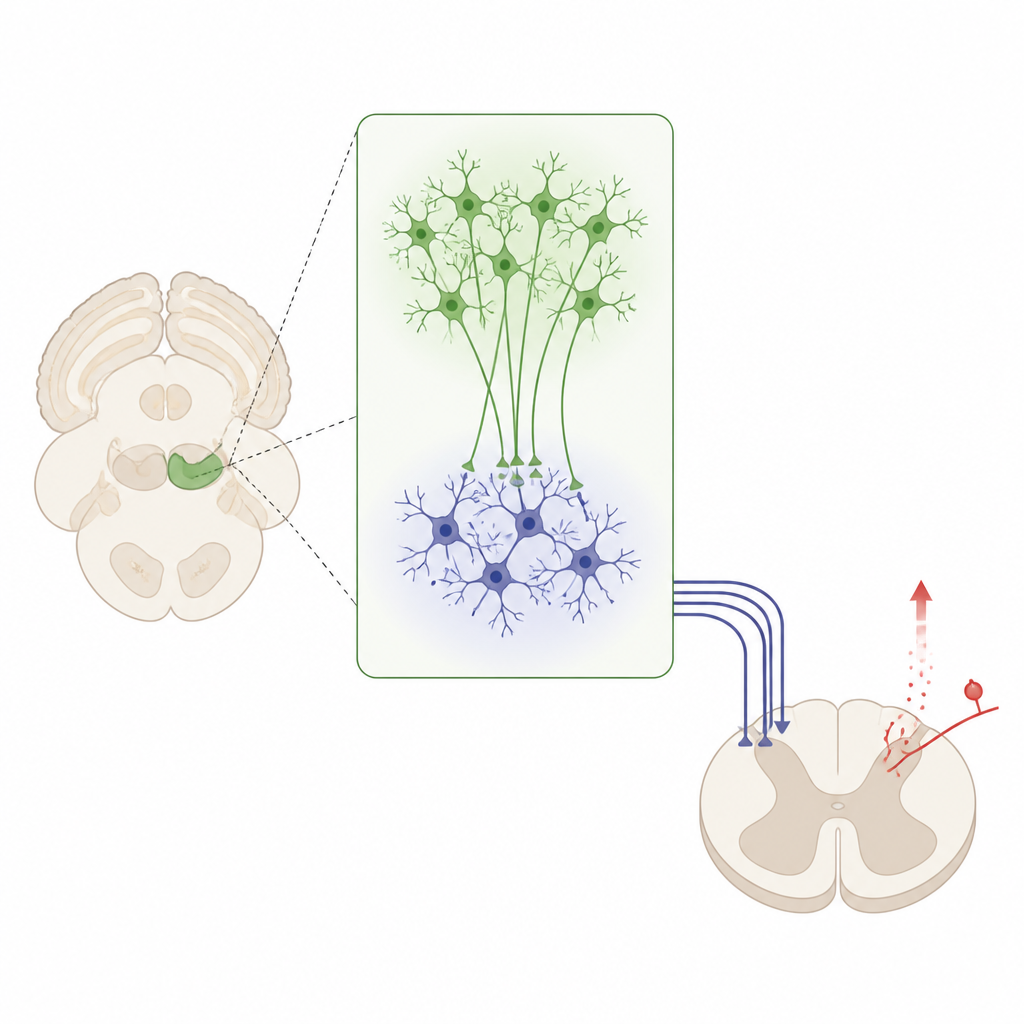
Lasting changes from repeated engagement
One striking finding is that repetition matters. A single hunting bout briefly raised pain thresholds, but daily sessions of either real hunting or repeated light stimulation of the superior colliculus–zona incerta pathway produced pain relief that lasted for at least six hours after the final session. In mice with neuropathic pain, the zona incerta neurons that receive superior colliculus input were less excitable than normal, suggesting a weakened brake on pain circuits. Repeated hunting or pathway stimulation strengthened the synapses onto these zona incerta cells and increased levels of a particular receptor subunit linked to long‑term synaptic strengthening. This LTP‑like change likely underlies the prolonged analgesia seen after repeated engagement.
A specific chemical flavor of relief
Because many of the hunting‑activated superior colliculus neurons produce substance P, the scientists asked whether this neuropeptide is important for the pathway’s effects. They showed that activating the substance P‑rich branch of the superior colliculus–zona incerta projection raised pain thresholds in nerve‑injured, but not healthy, mice. Blocking or genetically reducing substance P signaling in this pathway blunted the pain relief and weakened the excitatory drive onto zona incerta neurons, especially under neuropathic conditions. This indicates that substance P and its receptor fine‑tune the pathway’s power to counter chronic pain, without strongly affecting normal sensation.
What this means for future pain control
Overall, the study reveals that an attention‑grabbing natural behavior, predatory hunting, recruits a defined brain circuit running from the superior colliculus to the zona incerta to dampen pain. In healthy and injured states, artificial activation of this circuit can mimic the analgesic effect of hunting, and repeated engagement induces lasting changes in the strength of its connections. Although the work is in mice, it offers a biological explanation for why immersive, effortful tasks can make pain feel less intense and points to the superior colliculus–zona incerta pathway, and its substance P signaling, as a potential target for future non‑pharmacological or targeted treatments for chronic pain.
Citation: Zhang, X., Liu, XJ., Yin, C. et al. An attention-demanding hunting paradigm engages the superior colliculus–zona incerta circuit mediating analgesia in male mice. Nat Commun 17, 4419 (2026). https://doi.org/10.1038/s41467-026-73206-w
Keywords: attention and pain, chronic pain, superior colliculus, zona incerta, analgesia