Clear Sky Science · en
Sensorimotor transformation of number in the primate parietal cortex
How the brain turns "how many" into "how often"
When you clap three times for a song or tap your fingers five times to count objects, your brain quietly converts a sense of "how many" into a precise series of movements. This study explores how that hidden translation works inside the primate brain, showing how simple number perception is turned into action and what this might reveal about the roots of our numerical abilities.
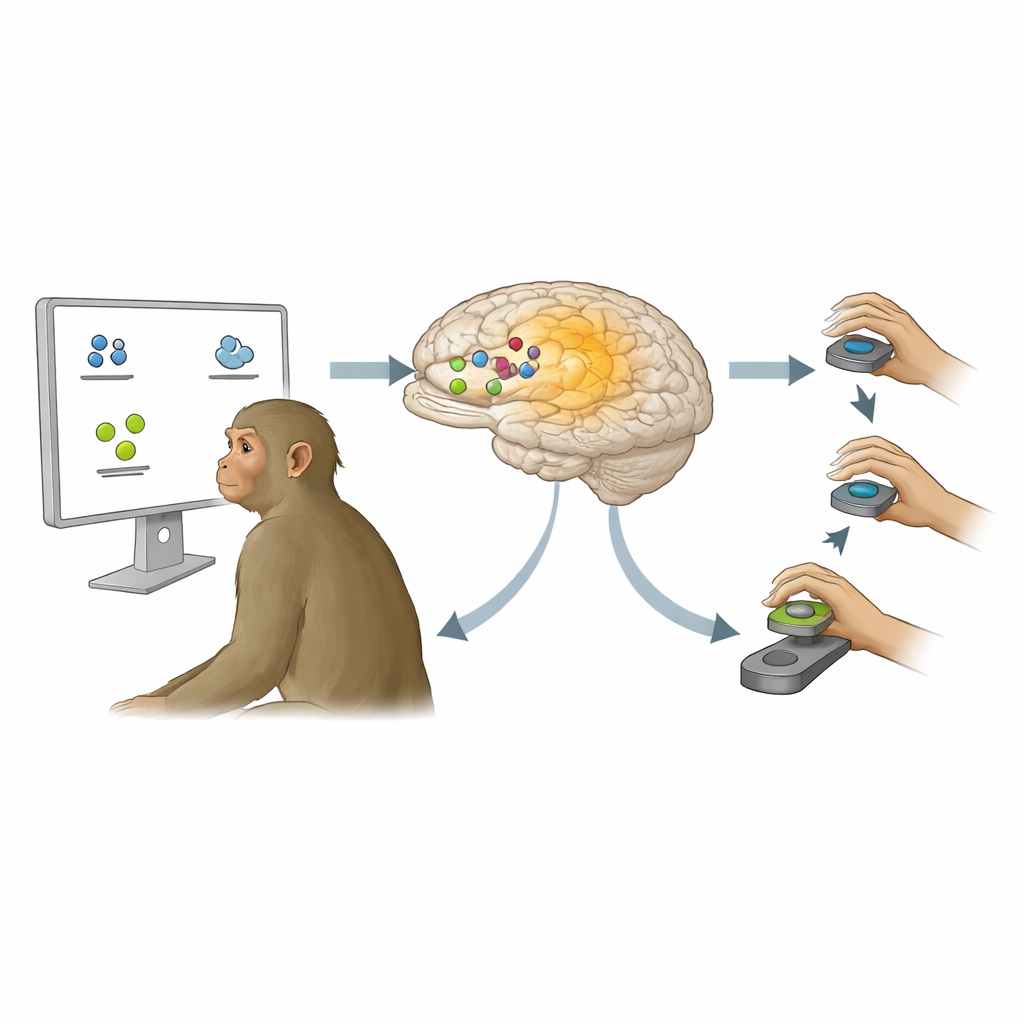
A counting game for monkeys
Researchers trained two rhesus monkeys to play a kind of manual counting game. First, the animals saw a brief visual cue on a screen that indicated a number from one to five, either as a small cluster of dots or as a learned symbol. After a short pause, the monkeys had to release a handle exactly that many times, waiting for a cue between each release, and then look at a confirmation spot to signal that they believed they had reached the target count. Because the timing between cues varied in several ways, the animals could not rely on rhythm or simple timing tricks, forcing them to keep track of the actual count of movements.
How well the animals could count
Both monkeys performed well above chance, typically matching the requested number of handle releases. Their mistakes followed clear patterns familiar from human estimation of quantity: errors were most common near the target number, and they increased when larger numbers were involved. In other words, it was easier to distinguish two from three actions than four from five. The animals also tended to do slightly better with the learned symbols than with clusters of dots, probably because dots can vary more in size, spacing, and arrangement, which adds visual noise to the task.
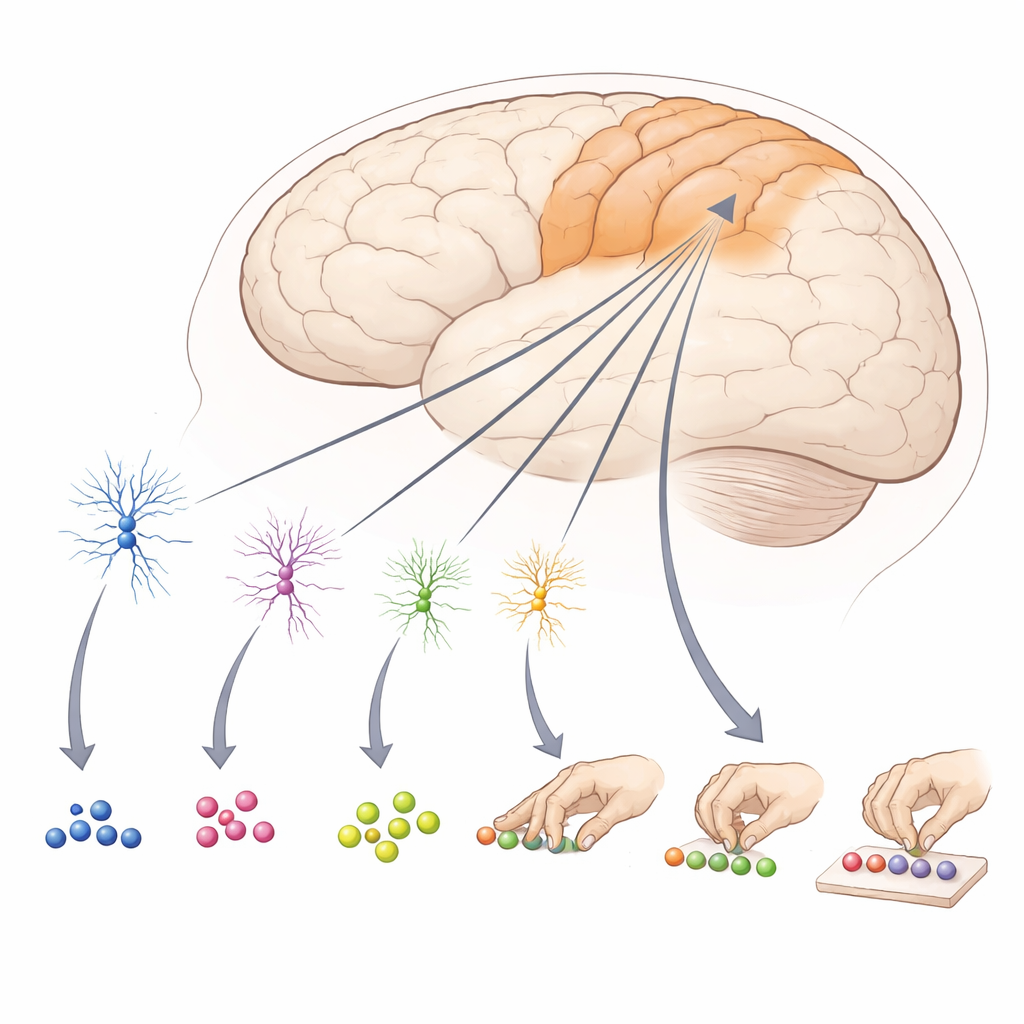
Finding number-to-action signals in the brain
To look inside the brain during this counting game, the team recorded activity from single nerve cells in a region called the ventral intraparietal area, part of the parietal cortex known to respond to the number of seen items. They found that many of these cells changed their firing rates depending on how many movements the monkey was planning to make, not just which visual cue it had seen. Some cells fired most strongly when the animal prepared one movement, others for two, three, four, or five, and their responses faded as the actual number moved away from their preferred value. Taken together, the population of cells formed overlapping “humps” of activity that closely mirrored the animals’ behavior and their pattern of errors.
Tracing the flow from seeing to planning
By applying machine-learning tools to the recorded activity, the researchers showed that the same population of cells carried usable information about the target number across time. As soon as the visual cue appeared, the pattern of activity began to signal which number had been shown. That signal then flowed smoothly into the planning period, when no stimulus was on the screen, and still predicted how many movements the animal intended to make. Some cells kept a stable preference for a given number throughout this period, while others were only briefly tuned and changed their contribution over time. This mix of steady and shifting patterns suggests that the area supports both holding the number in mind and gradually shaping it into a movement plan.
Linking brain activity to counting mistakes
The study also linked brain signals directly to the monkeys’ successes and failures. When a cell’s preferred number matched the number the monkey was supposed to produce, its activity was stronger on correct trials than on errors. On trials where the monkey accidentally produced one more or one fewer movement than instructed, the activity patterns in this brain area shifted in a way that reflected whether the animal was about to overshoot or undershoot. Classifiers trained on the neural data could reliably tell apart correct counts from these plus‑one and minus‑one mistakes, showing that the brain region carries detailed information about both intended and actual outcomes.
What this means for our sense of number
Overall, the findings suggest that a part of the parietal cortex acts as a bridge between sensing quantity and producing actions based on that quantity. Rather than merely storing a number or merely planning movements, this region transforms a rough sense of “how many” into “how many times” to act, using both stable and flexible activity patterns. Because similar brain regions support number perception in humans, this sensorimotor bridge may underlie everyday behaviors from tapping out counts to more complex forms of numerical reasoning.
Citation: Seidler, L.E., Westendorff, S. & Nieder, A. Sensorimotor transformation of number in the primate parietal cortex. Nat Commun 17, 4227 (2026). https://doi.org/10.1038/s41467-026-73037-9
Keywords: numerical cognition, parietal cortex, sensorimotor, monkey counting, neurons