Clear Sky Science · en
Freeform optical flow based on meta-conveyors for compact, programmable in situ nanomanipulation
Light as an Invisible Conveyor Belt
Imagine steering tiny particles the size of viruses through a twisting path, stopping them on command, and sending them back the way they came — all without touching them. This study shows how an ultrathin optical device called a “meta‑conveyor” can turn light into a programmable conveyor belt for nanoparticles. The approach could shrink today’s bulky optical tweezers into chip‑scale tools for lab‑on‑a‑chip diagnostics, targeted drug delivery, and even future minimally invasive surgery.

Why Moving Tiny Objects with Light Is Hard
For decades, scientists have used optical tweezers — tightly focused laser beams — to trap and move microscopic objects by pushing on them with light. These systems are powerful but cumbersome. They rely on large lenses and spatial light modulators, devices that reshape laser beams using millions of slowly switching pixels. To move a particle along a complex path, the computer must constantly refresh holograms, adding noise and heat while taking up a lot of space. This makes it difficult to bring precise light‑based manipulation into compact, portable or in‑body devices.
A Flat Chip That Programs the Flow of Light
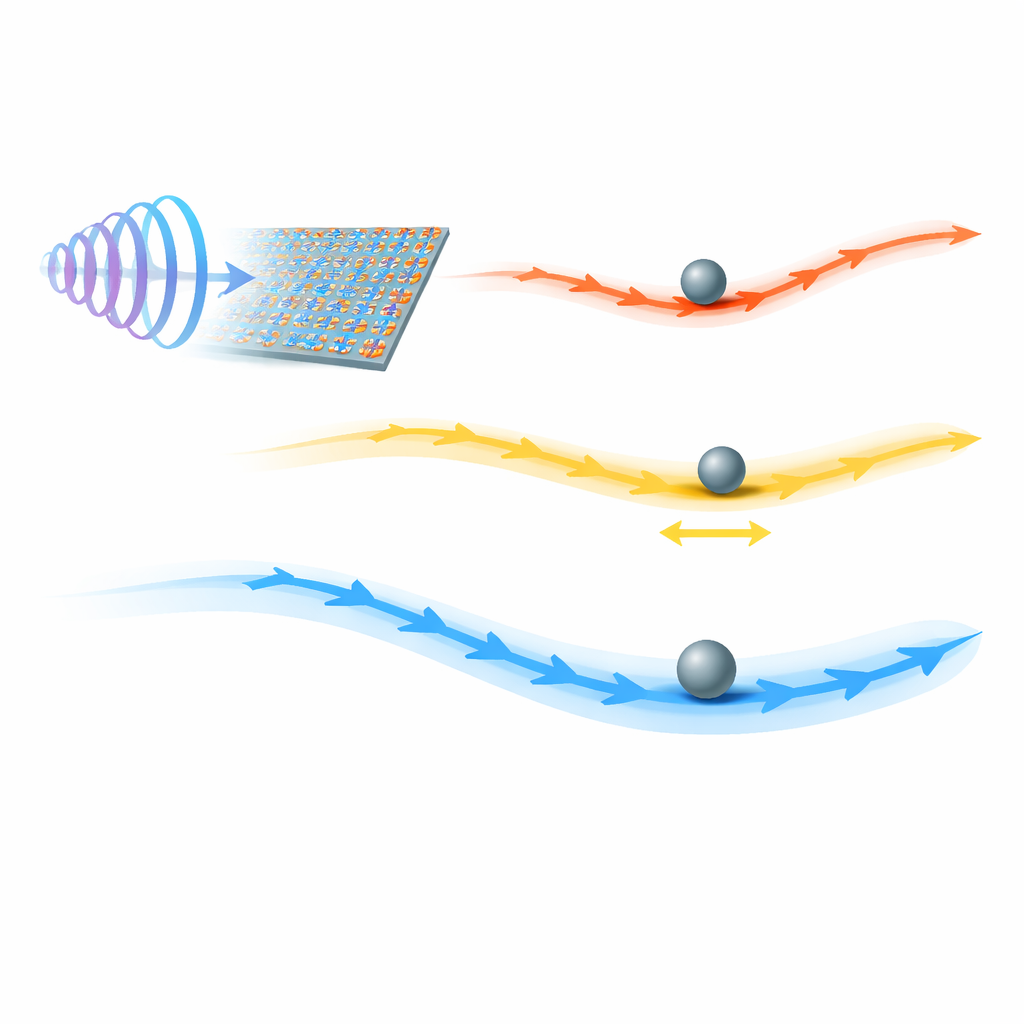
The researchers replace this bulky hardware with a single flat optical chip — a metasurface — patterned with an array of silicon nanopillars. Each nanopillar locally delays and redirects light in a controlled way. By carefully designing the size and orientation of these pillars, the team encodes a custom “flow field” for the light: its intensity and how its phase, or wavefront, changes across the surface. When a laser beam passes through, the metasurface converts it into a beam whose internal structure exerts sideways pushes on nearby nanoparticles, guiding them along a chosen path in the plane.
Three Light Channels: Forward, Stop, and Reverse
The key innovation is that this single metasurface actually hosts three independent light‑driven “tracks” that share the same physical path but differ in how they push the particle. The trick is polarization — the orientation of the light’s electric field. By switching the handedness of circular polarization at the input and selecting the output polarization, the device toggles between three modes: one where the particle is driven forward along the path, one where it is held in place, and one where it is pushed backward. These states arise from carefully combining two kinds of phase control in the nanopillars: a propagation phase linked to how light travels through the material, and a geometric phase set by each pillar’s angle. Together they produce tunable “phase‑gradient” forces that act like a controllable conveyor belt along the pre‑drawn route.
Drawing Freeform Paths and Solving a Nano‑Maze
Because the metasurface works like a physical map of the desired light flow, the researchers can literally draw any path they want — such as a wavy track that threads between obstacles — then translate that drawing into a phase pattern for the nanopillar array. In experiments, they used a near‑infrared laser and their meta‑conveyor to move gold nanoparticles suspended in water. With one polarization setting, particles glided forward along the wavy line; with another, they froze in place; and with a third, they retraced their steps. Crucially, all of this was achieved without moving the sample or changing holograms — only by switching polarization. To showcase complexity, the team encoded the solution of a tiny maze into the device. When illuminated appropriately, the metasurface produced a light path that led particles from an entrance port to an exit port while naturally avoiding dead ends, and could even stop and restart motion inside the maze.
From Lab Curiosity to Future Medical Tools
This work demonstrates that a passive, ultrathin optical chip can replace much of the bulk and complexity of traditional holographic tweezers while offering fast, programmable control of particle motion. Although the trajectories are predefined at fabrication, switching between forward, stop, and reverse states can be done at millisecond or faster time scales using simple polarization optics. Because metasurfaces are compact and compatible with optical fibers and photonic chips, the meta‑conveyor concept could be built into lab‑on‑a‑chip platforms or endoscopic probes. In the long run, such devices might guide cells, drug carriers, or other nanoparticles along safe, optimized paths inside sealed microfluidic networks or even inside the body, bringing precision optical manipulation out of the optics lab and into real‑world environments.
Citation: Li, T., Li, X., Gao, Z. et al. Freeform optical flow based on meta-conveyors for compact, programmable in situ nanomanipulation. Nat Commun 17, 4212 (2026). https://doi.org/10.1038/s41467-026-73024-0
Keywords: optical tweezers, metasurfaces, nanoparticle manipulation, structured light, lab-on-a-chip