Clear Sky Science · en
Unconditionally teleported quantum gates between remote solid-state qubit registers
Connecting Quantum Computers Across Distance
Today’s experimental quantum computers are small and fragile, but many future ideas rely on linking them together into a kind of quantum internet. This study shows that two tiny diamond-based processors, sitting in separate cryostats and connected only by optical fiber and classical wires, can perform a crucial joint operation as if they were one machine. That capability is a building block for long-distance secure communication, powerful distributed computing, and tests of the foundations of quantum physics.
A New Kind of Remote Control
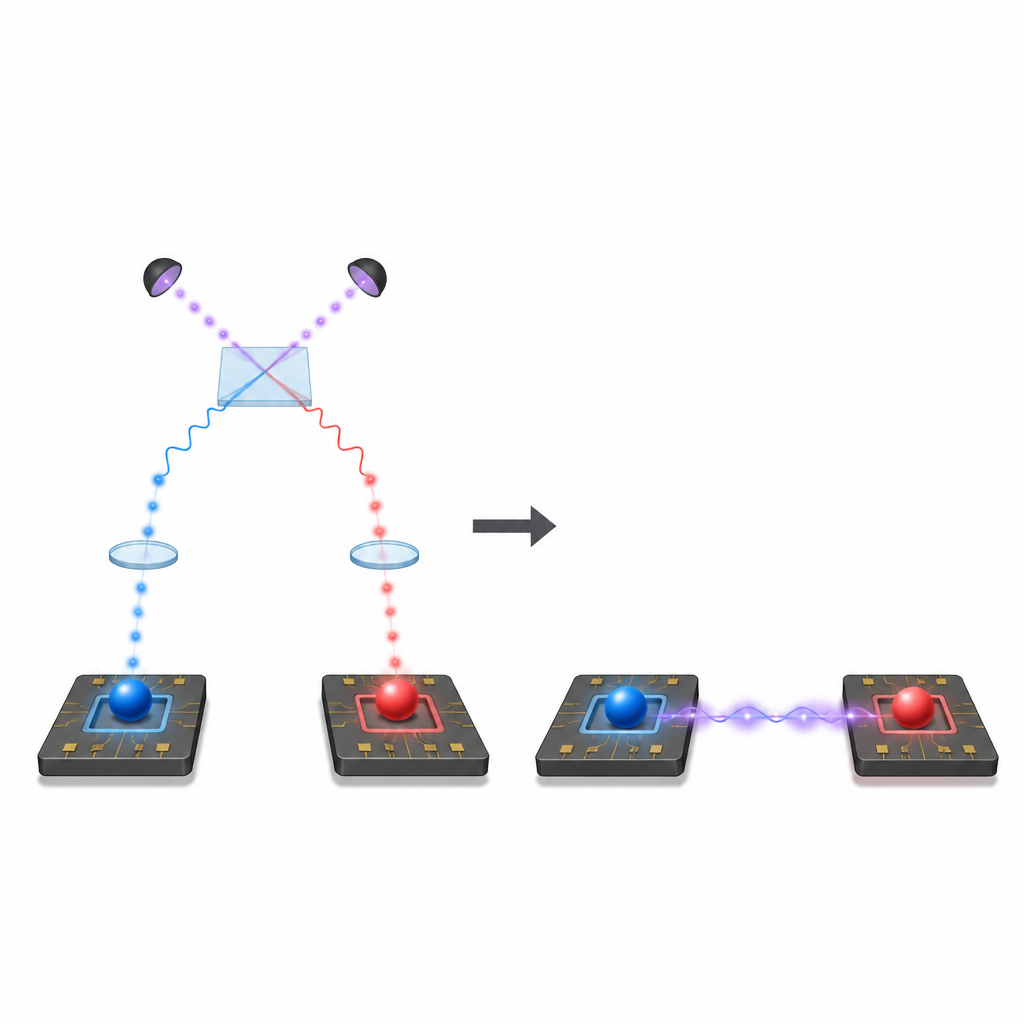
In ordinary computing, sending information between machines is straightforward: bits are copied and moved. Quantum devices are different, because reading out a quantum bit, or qubit, usually destroys its delicate state. Instead of shipping qubits back and forth, theorists proposed “teleporting” the effect of a quantum gate from one node to another. The basic recipe is to first create entanglement between two remote qubits, then use local operations and shared measurement results to make a gate act non-locally. The key challenge is to do this deterministically, without discarding unsuccessful runs, so that the operation behaves like a true, reliable building block in larger quantum circuits.
Diamond Chips Playing in Concert
The researchers use defects in diamond known as nitrogen-vacancy centers, which host an electron spin that talks to nearby carbon-13 nuclear spins. In each of two separate setups, dubbed Alice and Bob, the electron spin serves as a communication qubit, while one carbon nucleus acts as a long-lived data qubit. Microwaves steer the electron spins, radio waves steer one of the nuclear spins, and finely tuned laser pulses handle initialization, readout, and the creation of entanglement via photons sent through optical fiber. A voltage across the diamond chips adjusts the color of emitted photons so that both nodes produce indistinguishable light, a requirement for reliable remote entanglement.
Keeping Fragile States Alive During Networking
While the two nodes repeatedly attempt to generate entanglement by interfering single photons at a central beam splitter, the nuclear spins are supposed to quietly store quantum information. In practice, their phase slowly drifts because they are weakly coupled to the active electron spins. To counter this, the team develops node-specific control strategies. One node directly drives its nuclear spin with radio-frequency pulses interleaved with dynamical decoupling on the electron, while the other node shapes sequences of microwave pulses so that the electron’s motion imprints precise corrective phases on the nucleus. By tracking how many entanglement attempts have occurred and adjusting phases in real time, they maintain data-qubit coherence over hundreds of attempts, long enough to complete the non-local operations.
Building and Testing Networked Quantum States
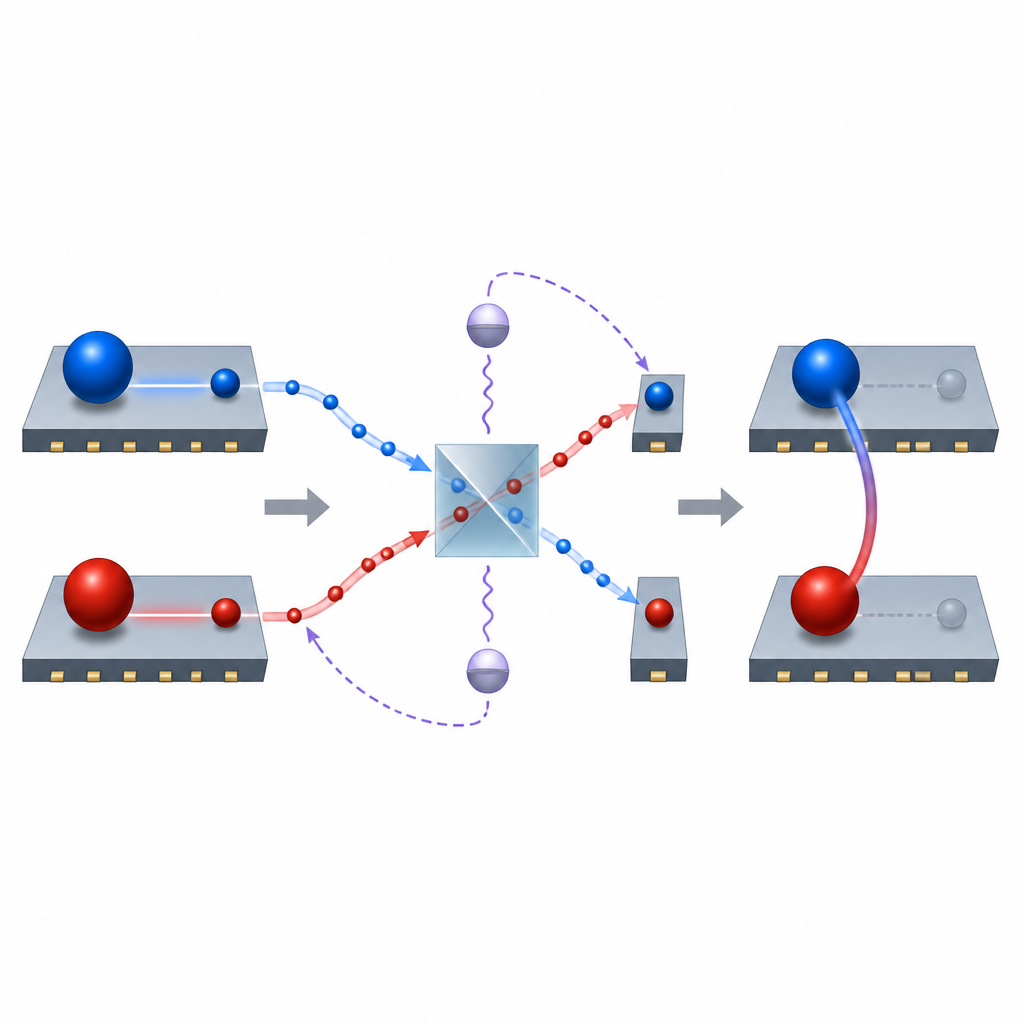
Armed with these tools, the team first assembles a four-qubit Greenberger–Horne–Zeilinger (GHZ) state spread across both nodes. This highly correlated state links the two electron spins and the two nuclear spins into a single, shared quantum resource. Importantly, they accept every measurement outcome and apply corrections on the fly, rather than cherry-picking successful runs. The measured state matches detailed simulations and reaches a fidelity high enough to certify genuine four-partite entanglement between the nodes. This experiment stress-tests the entire stack: local control, remote entanglement generation, mid-circuit measurements, and real-time feedforward.
A Quantum Gate That Jumps Between Machines
Finally, the authors demonstrate their main goal: a controlled-NOT (CNOT) gate between the two remote nuclear data qubits. Using a teleportation-based circuit, they convert shared electron-spin entanglement and local operations into an effective gate that flips Bob’s nuclear spin only when Alice’s is in a particular state. They verify the classical truth table by preparing definite input states and checking the outputs, and they confirm genuinely quantum behavior by generating entanglement between the distant data qubits via a single application of the teleported gate. The observed fidelities agree well with error models based on imperfect pulses, limited photon indistinguishability, and occasional mistakes in mid-circuit readout.
What This Means for the Quantum Future
For a non-specialist, the key message is that two tiny quantum processors, separated in space and linked by light, can now perform a shared logic operation in a fully unconditional way. Rather than just sharing entanglement and then carefully selecting the best runs, the system accepts all outcomes and corrects them on the fly, which is essential for scaling up. While the error rates still need improvement, the techniques shown here point toward larger distributed quantum computers, more complex network protocols, and eventually a functional quantum internet where many small devices cooperate as one.
Citation: Iuliano, M., Demetriou, N., van Ommen, H.B. et al. Unconditionally teleported quantum gates between remote solid-state qubit registers. Nat Commun 17, 4694 (2026). https://doi.org/10.1038/s41467-026-72818-6
Keywords: quantum networks, teleported quantum gates, nitrogen vacancy centers, distributed quantum computing, remote entanglement