Clear Sky Science · en
Ancient DNA reveals a family ossuary and long-distance migration on the Pacific coast before the Inca Empire
Families, Journeys, and Clues in Ancient Bones
On Peru’s southern coast, long before the rise of the Inca Empire, people built thriving communities tied together by trade, family, and shared rituals for the dead. This study uses genetic clues from centuries-old skeletons to trace how families moved along the Pacific shoreline, how they married, and how they honored their ancestors. It shows that coastal societies were already closely linked across hundreds of kilometers, changing our picture of life in the Andes before Spanish invasion.
Life in a Busy Coastal Valley
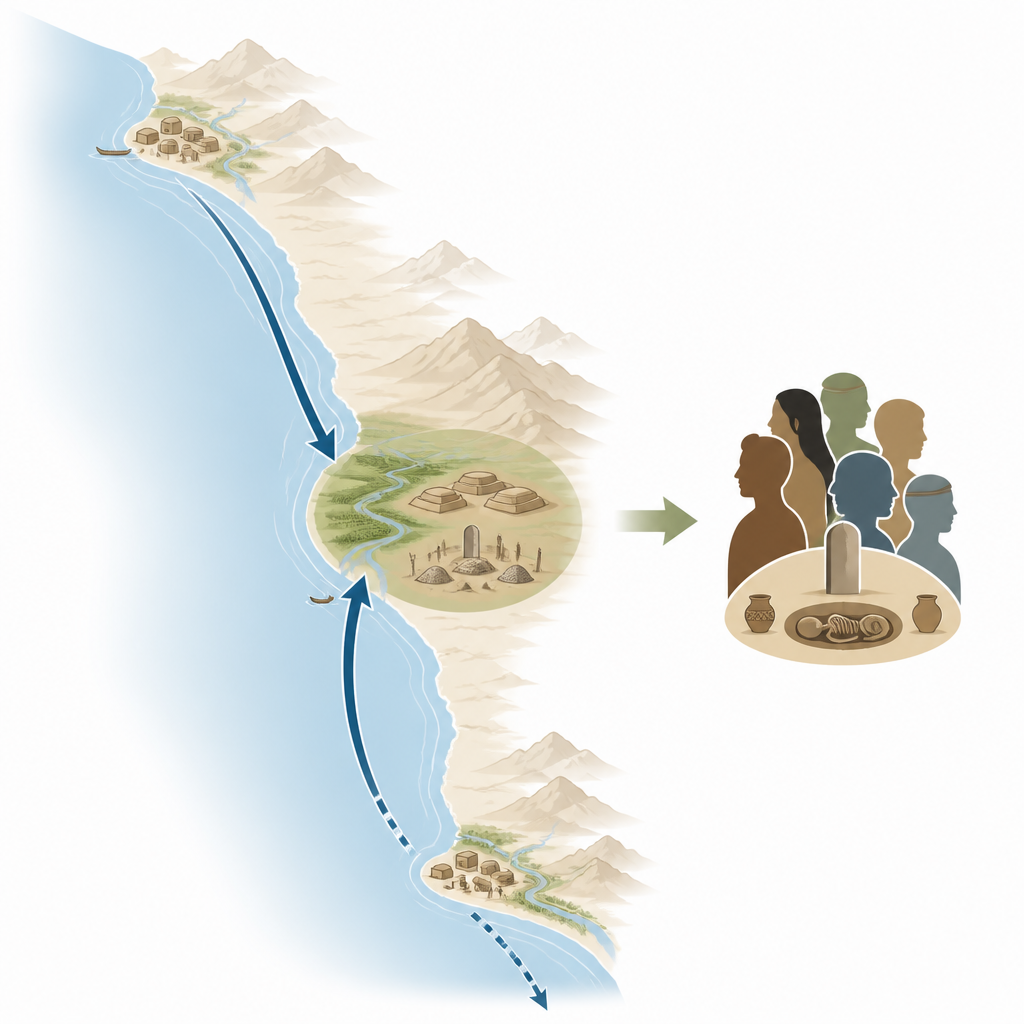
The research focuses on the Chincha Valley, a fertile corridor between desert coast and highland slopes. Historical accounts describe the Chincha Kingdom as a powerful coastal society with tens of thousands of fishermen, farmers, artisans, and merchants who traveled by raft and llama caravan. Archaeologists have found rich burial grounds there, including underground tombs and large above-ground mausoleums. Many skulls were reshaped in infancy and coated with red pigment after death, hinting at strong ideas about identity and ancestry that stretched back for generations.
Reading Family History from Ancient DNA
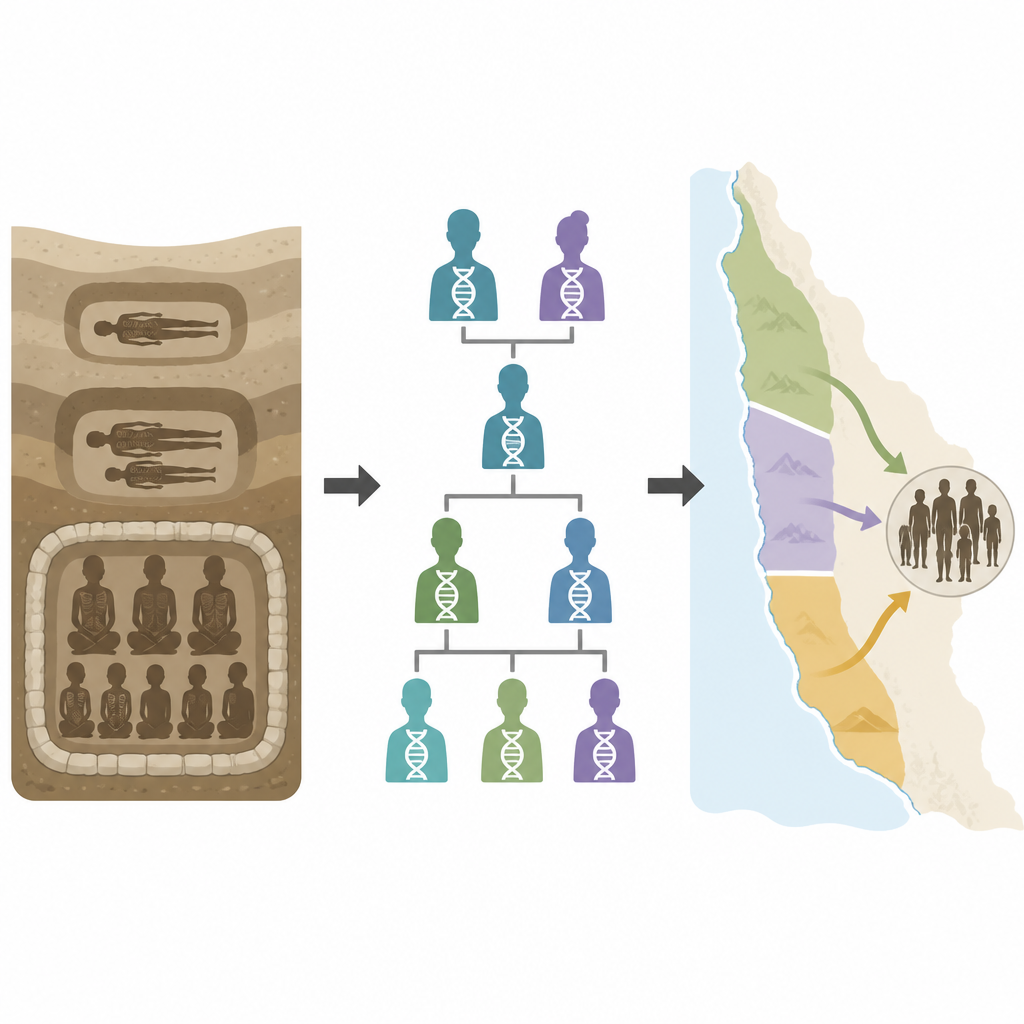
Scientists sampled teeth and bones from 21 individuals buried in lower and middle parts of the valley between the thirteenth and sixteenth centuries AD. By extracting and analyzing ancient DNA, they could identify biological sex, measure genetic diversity, and detect family relationships. In one large communal ossuary at a site called Las Huacas, several people turned out to be closely related. Their DNA, ages, and burial positions revealed a multi-generation family group who were buried together, likely part of a tight-knit social unit that favored marriage within the group.
Long Coastal Journeys and Blended Roots
When the researchers compared these genomes with other ancient people from along the Peruvian coast, a clear pattern appeared. Many Chincha individuals shared strong ancestry with communities more than 700 kilometers to the north, rather than with nearer southern neighbors. The earliest migrants into the valley had genetic profiles matching the north coast with little or no mixing. Over time, however, later individuals carried combinations of north, central, and south coastal ancestry, showing that migrants and local groups intermarried. These movements and marriages began at least a century before the Inca arrived, so imperial policies cannot explain the initial waves of migration.
Pinpointing Time with Diet and Radiocarbon
To place these people more precisely in time, the team used radiocarbon dating together with chemical signals from their diets. Because eating seafood can make radiocarbon ages appear older, they built a new statistical model that estimates how much marine food each person ate and corrects for local ocean conditions. This approach sharpened the dates to the scale of human generations, revealing that north coast ancestry remained present in Chincha communities from the 1200s through the 1400s, just as the Chincha Kingdom rose, dealt with the Inca, and moved toward the era of Spanish contact.
What These Ancestors Tell Us Today
For a general reader, the key message is that coastal Peru was already a web of far-reaching ties long before the Inca Empire. Families from the far north settled in the Chincha Valley, kept close marriage circles in some places, and forged new bonds with neighbors in others. Their shared burial customs and long-lasting north coast ancestry show both continuity and change across three centuries. By combining ancient DNA, careful dating, and archaeology, the study turns scattered bones into a vivid story of migration, kinship, and community in one of South America’s great coastal landscapes.
Citation: Bongers, J.L., Dalton, J.A., Marsh, E.J. et al. Ancient DNA reveals a family ossuary and long-distance migration on the Pacific coast before the Inca Empire. Nat Commun 17, 4222 (2026). https://doi.org/10.1038/s41467-026-72216-y
Keywords: ancient DNA, Chincha Valley, pre-Inca migration, Andean archaeology, kinship