Clear Sky Science · en
Mesoscale carbon fiber lattices with foam-like weight and bulk strength
Stronger Than Foam, Lighter Than Metal
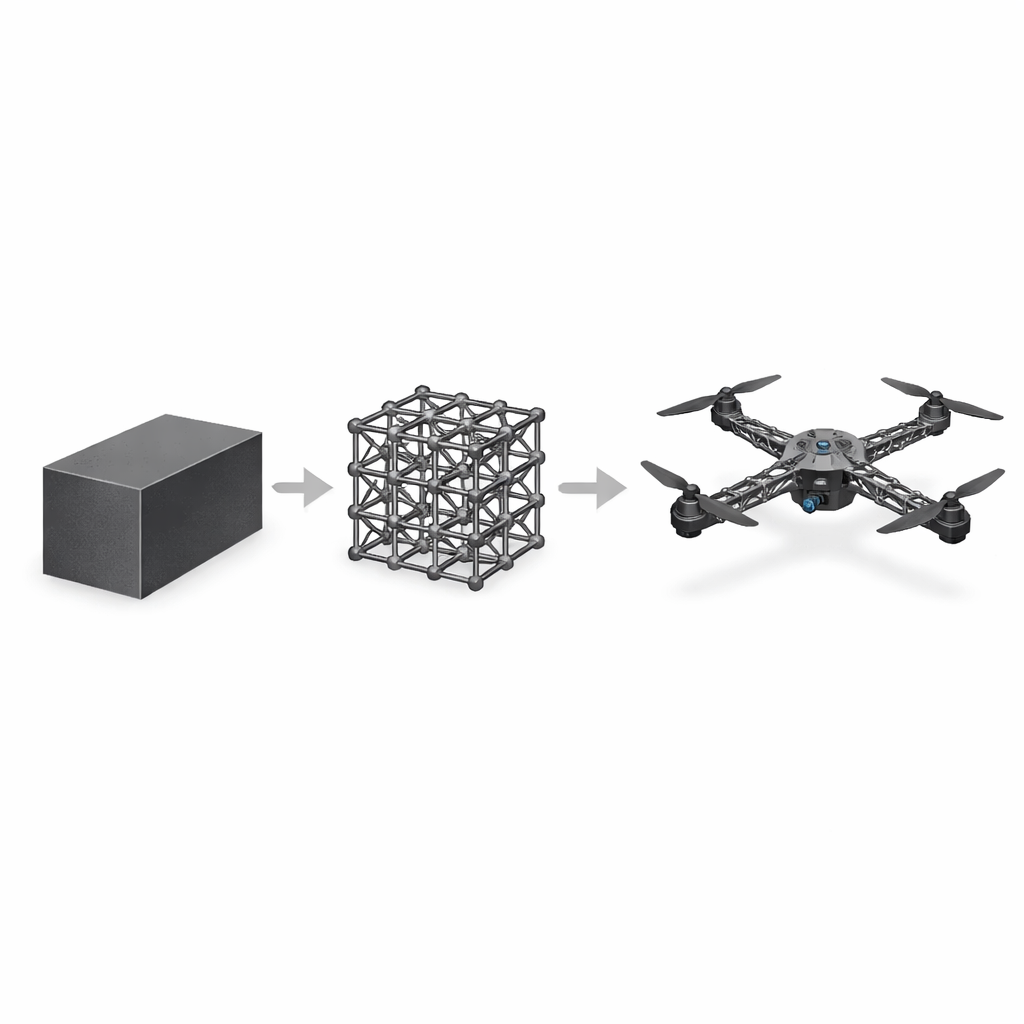
From airplanes to delivery drones, designers constantly battle the same problem: how to build structures that are both strong and light. This study introduces a new way to arrange carbon fibers into airy, three-dimensional cages that weigh about as much as foam yet approach the strength of solid high-performance composites. That combination could translate into safer, more efficient vehicles, robots, and flying machines that travel farther on the same amount of energy.
Why Light Structures Usually Break the Rules
Carbon-fiber-reinforced plastics are already a favorite in aerospace and high-end sports gear because they are much stronger than metals for the same weight. But in most real products, these fibers are chopped, layered, or joined with bolts and glue. Each break or joint interrupts the path by which forces travel through the material, creating weak spots that can crack suddenly, especially under compression. Attempts to build open, lattice-like structures—which should be ideal for shedding weight—have often relied on short fibers, complex fasteners, or tiny lab-scale fabrication methods, keeping their impressive performance out of reach for everyday structures.
Weaving Carbon in Three Dimensions
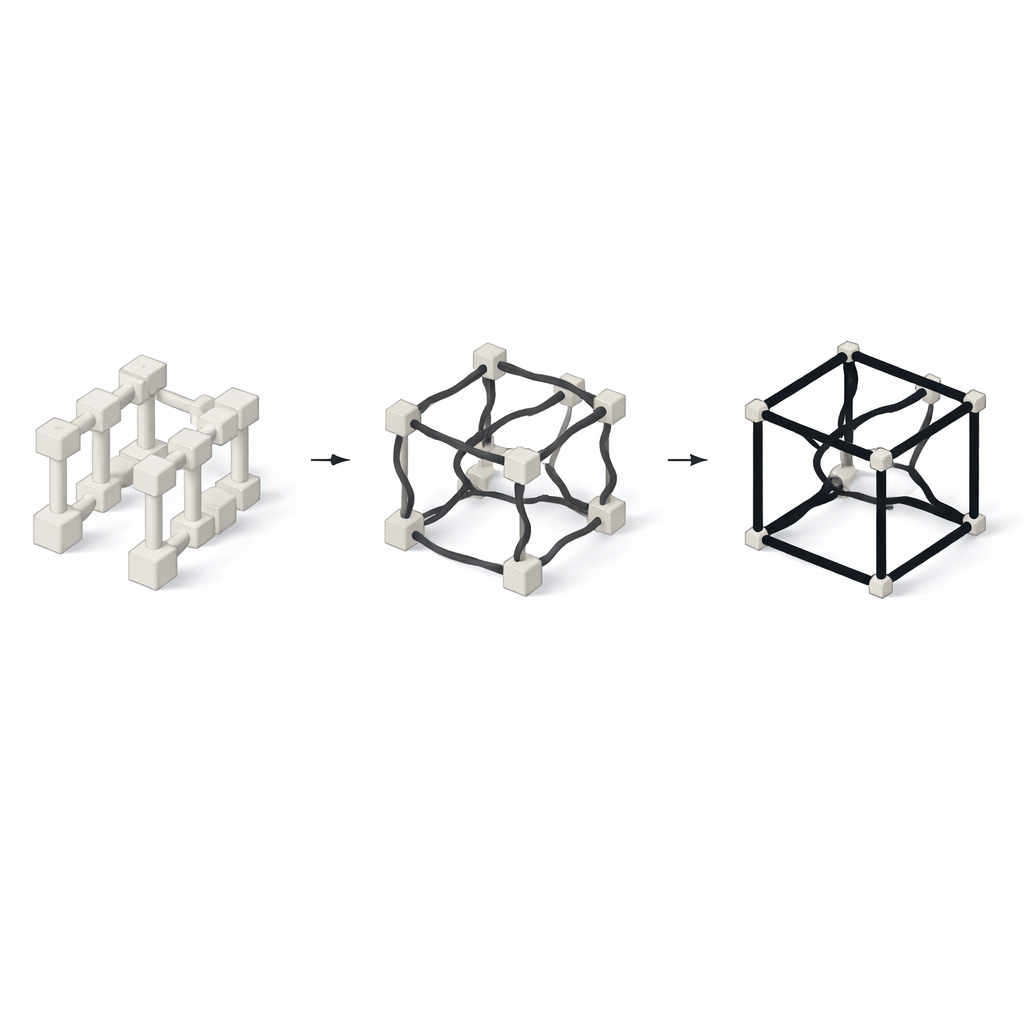
The researchers tackled this problem by treating the entire lattice as one continuous thread. Their method, called three-dimensional node winding, uses 3D-printed plastic pieces as temporary anchors, or “nodes,” arranged into the desired lattice shape. A single bundle of carbon fiber is then routed around these nodes in a carefully planned path, pulled tight so that it stays straight and aligned. After the winding is complete, the whole assembly is soaked in resin and cured, and the plastic supports are removed or minimized, leaving behind a rigid, joint-free cage made almost entirely of continuous carbon fibers.
Designing the Hidden Skeleton
Not all lattice layouts are equal. The team focused on two simple patterns—simple cubic and face-centered cubic—that balance good connectivity with manageable overlap where fibers meet at the nodes. They also developed specially shaped plastic nodes that guide the fibers along mostly straight paths instead of forcing them to bend sharply around bolts. Behind the scenes, an algorithm searches for the shortest continuous path that traces all the required struts while avoiding unnecessary crossings. This path planning is crucial: the fewer interruptions and tight turns, the closer the final structure comes to using the fibers at their full strength.
Foam-Light, Metal-Strong Behavior
When these lattices were squeezed in compression tests, they reached specific strengths—that is, strength per unit weight—close to those of solid carbon-fiber composites, even though they contain large amounts of empty space. Some samples achieved strengths over an order of magnitude higher than previous mesoscale carbon-fiber lattices at similar densities. Instead of snapping abruptly like traditional layered composites, the cages deformed in stages. Columns bowed, buckled, and formed kinked zones where the resin cracked along the fibers, but many fibers remained unbroken. As a result, the structures could partially spring back after the load was removed and withstand repeated loading cycles without collapsing.
From Lab Cages to Flying Drones
To show what these lattices can do outside the test machine, the team built frames for small quadcopter drones. One frame used a conventional injection-molded nylon body, while two others used carbon-fiber lattices of increasing refinement. The lightest lattice frame weighed only about a fifth as much as the nylon version. With identical motors, batteries, and propellers, the lattice-framed drones stayed aloft up to roughly one-third longer and drew less electrical power, thanks to both reduced weight and higher stiffness that cut vibration losses. Modeling suggests that these advantages persist as drones get larger, and similar benefits were demonstrated in a robotic arm link and a model aircraft wing.
What This Means for Future Machines
By carefully steering a single continuous fiber through space, this work shows that it is possible to build “air-filled” structures that act almost as strong as the solid material they are made from, while failing in a gentler, more predictable way. For everyday technologies, that means lighter vehicles that travel farther, robots that move faster with less energy, and structural components that show visible signs of damage before they break. As winding robots and automated planning algorithms mature, these foam-like yet robust carbon lattices could become a practical building block for the next generation of aircraft, drones, and lightweight machines.
Citation: Choi, J.Y., Ahn, SH. Mesoscale carbon fiber lattices with foam-like weight and bulk strength. Nat Commun 17, 3615 (2026). https://doi.org/10.1038/s41467-026-72105-4
Keywords: carbon fiber lattices, lightweight structures, continuous fiber composites, drone airframes, architected materials