Clear Sky Science · en
Human brain changes after first psilocybin use
A New Look at How Psychedelics Touch the Mind
Many people have heard that psychedelic drugs like psilocybin—the active ingredient in “magic mushrooms”—can lead to lasting changes in mood and outlook. But what actually happens inside the human brain after a person takes such a substance for the first time? This study followed healthy adults through their very first high-dose psilocybin experience, using brain scans and psychological tests to see how a single session might reshape the brain and, in turn, people’s well-being weeks later. 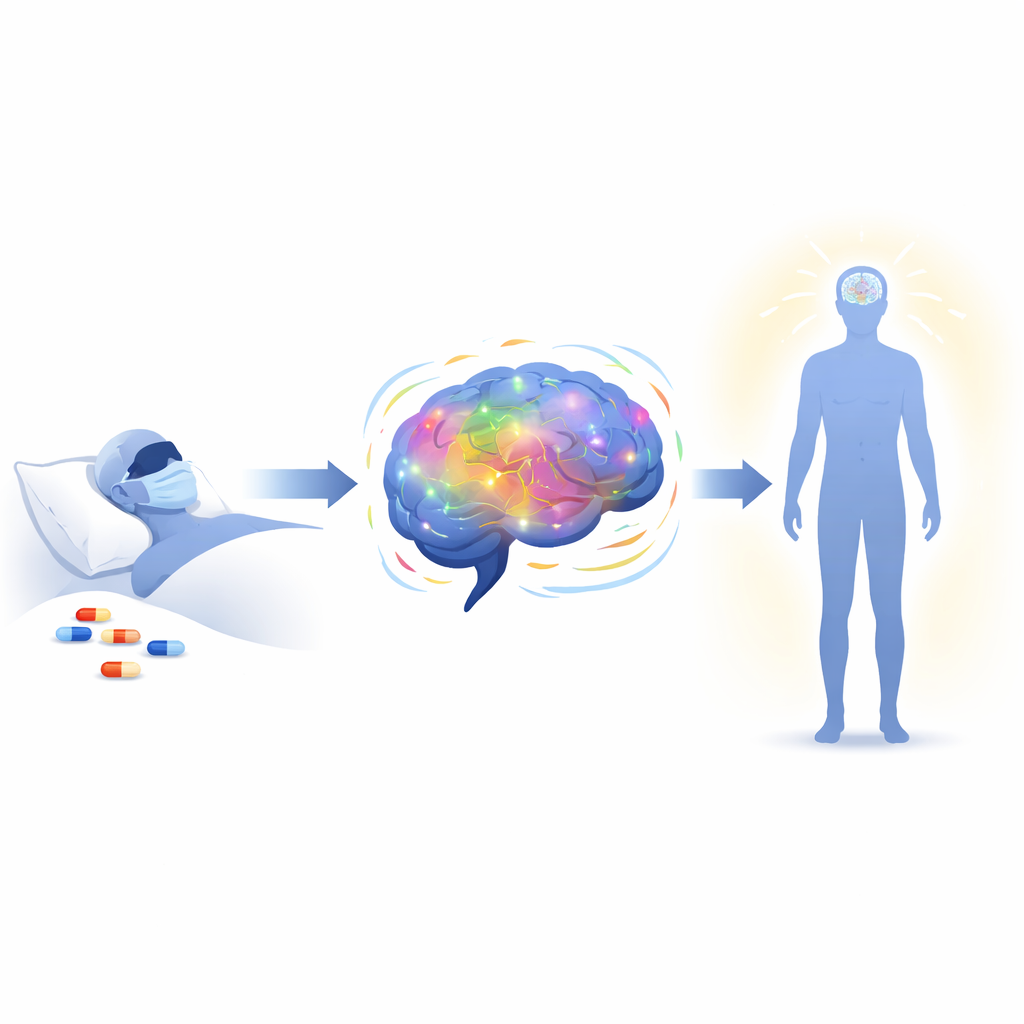
One Powerful Session, Carefully Watched
The researchers recruited 28 adults who had never before taken a psychedelic. Each person came in for two dosing sessions a month apart. In the first, they received a very small 1 milligram capsule of psilocybin, expected to have little to no mind-altering effect and used here as a placebo. In the second, they received a much larger 25 milligram dose designed to trigger a full psychedelic experience. Throughout both sessions, volunteers lay in a comfortable, supportive setting with eyes covered and music playing, while their brain activity was recorded. Before and after the sessions—up to one month later—they completed brain scans and tests of mood, insight, and thinking ability.
Brain Signals Grow More Complex During the Trip
During the high-dose session, the team used electroencephalography (EEG) to track the brain’s electrical signals while participants rested quietly with their eyes closed. They focused on a measure called “signal entropy,” which reflects how rich and unpredictable the brain’s activity patterns are. One to two hours after taking 25 milligrams of psilocybin, signal entropy rose sharply, while a common brain rhythm called alpha waves dropped. These changes did not appear after the 1 milligram dose. In plain terms, the brain temporarily shifted into a more flexible, less stereotyped mode of operation, matching volunteers’ reports that the experience was the most unusual state of consciousness of their lives.
Subtle Structural Shifts and a Looser Network
The scientists also looked for longer-lasting changes using magnetic resonance imaging (MRI). A technique called diffusion imaging suggested that white matter fibers linking the frontal lobes to deep brain structures became slightly more compact one month after the high dose, but not after the placebo-like dose. At the same time, the brain’s large-scale communication network appeared a bit less rigid when compared to its own baseline: activity patterns were somewhat less neatly divided into separate modules, hinting at a more globally integrated system. These shifts were modest in healthy people but lined up with earlier work in patients with depression, where similar decreases in network separation have tracked with clinical improvement. 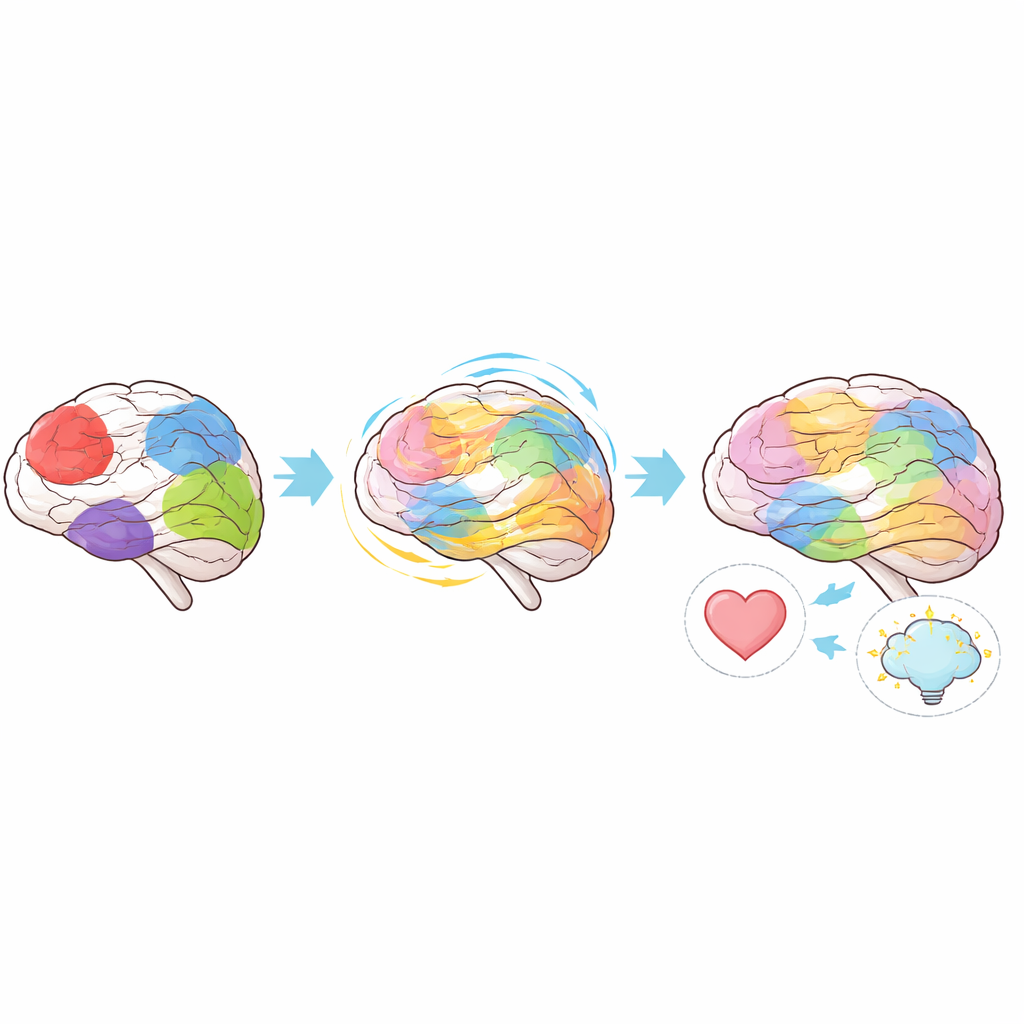
Lasting Changes in Mood, Insight, and Flexibility
The most striking long-term effects showed up in psychology, not just imaging. After the 25 milligram session, participants reported bigger gains in mental well-being that were still present a month later, compared with changes after the low dose. They also described strong feelings of psychological insight—the sense of seeing personal issues more clearly—especially in the days immediately following the experience. On a computerized task that measures how easily people can shift mental rules, they made fewer errors one month after the high dose, suggesting improved cognitive flexibility. None of these improvements appeared after the 1 milligram session, supporting the idea that they were tied to the full psychedelic experience rather than to practice or expectation alone.
From a Busy Brain to a Better Outlook
One of the most important findings was a chain linking brain activity during the session to life changes a month later. The more a person’s brain entropy rose during the peak of the psilocybin experience, the more psychological insight they reported the next day—and the greater their improvement in well-being a month afterward. Statistical tests suggested that this next-day insight partly carried, or mediated, the effect of the brief brain change on lasting mood. In other words, a short-lived period of unusually flexible brain activity seemed to open a window for powerful personal reflection, which in turn was tied to feeling better weeks later.
What This Means for People Curious About Psychedelics
For lay readers, the key message is that a single, carefully supported psilocybin session can temporarily push the brain into a more flexible state, and that this brief shift can forecast longer-lasting gains in mood, self-understanding, and mental agility. The study also hints—cautiously—at structural brain changes, though these will need confirmation in future work. While this research was done in healthy volunteers under medical supervision, and does not imply that unsupervised use is safe, it strengthens the view that both the unusual brain state and the psychological insights it supports may be central to how psychedelic therapy works.
Citation: Lyons, T., Spriggs, M., Kerkelä, L. et al. Human brain changes after first psilocybin use. Nat Commun 17, 3977 (2026). https://doi.org/10.1038/s41467-026-71962-3
Keywords: psilocybin, brain plasticity, mental well-being, cognitive flexibility, psychedelic therapy