Clear Sky Science · en
Detecting complex-energy braiding topology in a dissipative atomic simulator with transformer-based geometric tomography
Why tangled energy loops matter
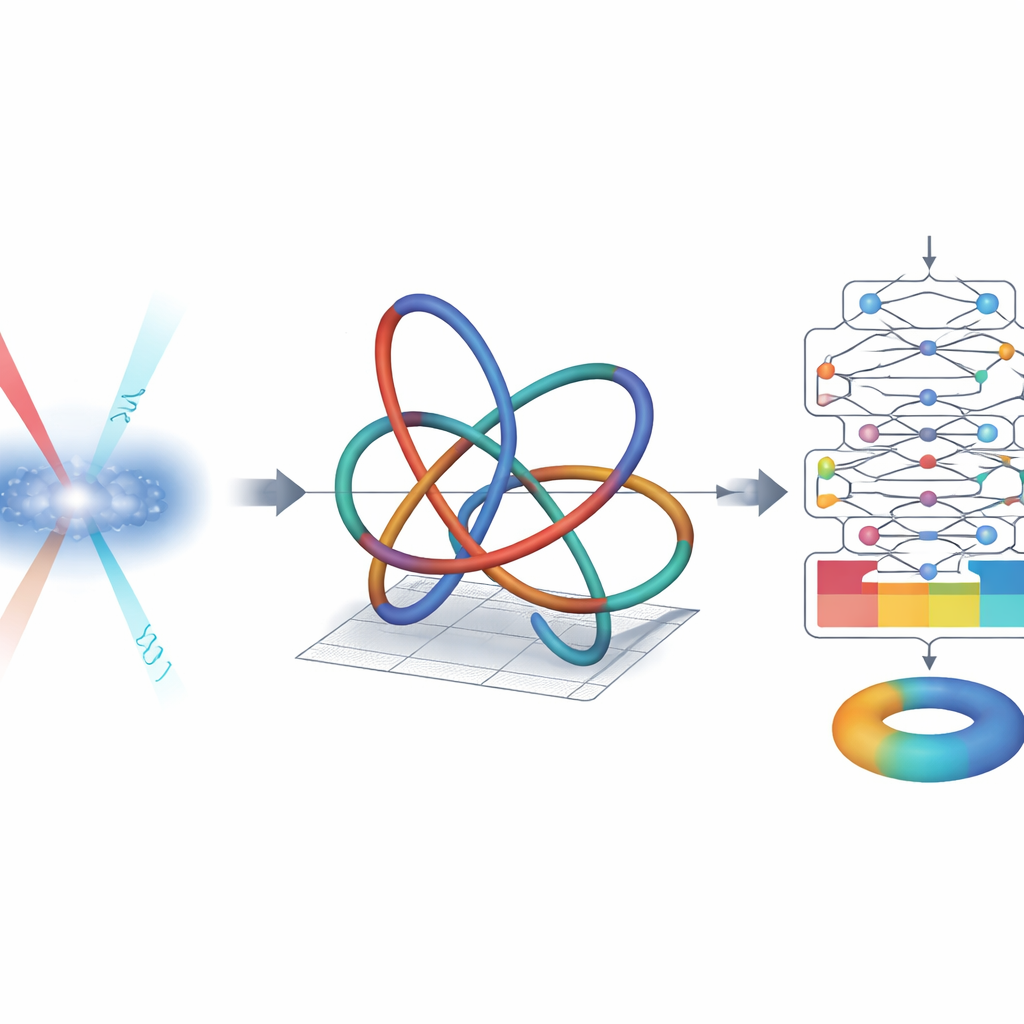
When we think of knots and braids, we picture shoelaces or strands of hair. But in modern physics, similar tangles can appear in the energy levels of quantum systems, especially when particles can leak out or be lost. These twisted "energy braids" carry robust, topological information that could be useful for future quantum technologies — yet they are notoriously hard to see and interpret in experiments. This article shows how a cutting-edge machine learning model, the Transformer, can both detect these subtle topological patterns and reveal the geometric features that make them tick, using a carefully engineered cloud of ultracold atoms as a testbed.
From smooth landscapes to knotted energy
In many quantum materials, the overall “phase” of matter is not defined by a simple order parameter, like magnetization, but by global, topological properties. These are tied to the geometry of the system’s quantum states or energy spectrum. In open, or non-Hermitian, systems where particles can be lost, the energies become complex numbers with real and imaginary parts. As one scans through momentum, the energies of different quantum states trace out loops in a three-dimensional space of energy and momentum. These loops can link and knot around each other, forming braids whose connectivity encodes a topological invariant — an integer that counts how many times the bands wind and exchange. Such structures have been predicted and seen in photonics and other platforms, but directly connecting the topology of these braids to their geometric origin in an experiment is a major challenge.
Why standard machine learning falls short
Machine learning has already helped classify topological phases from raw data, using tools such as convolutional neural networks or unsupervised clustering. However, these approaches often behave like black boxes: they may output the correct topological label, but they do not clearly show which physical features matter most, or how the answer is tied to the detailed shape of the energy bands. In many cases, they rely on local patterns and have difficulty capturing the nonlocal structure that defines topology. The authors instead turn to Transformers, a family of models originally developed for language, whose self-attention mechanism naturally compares every point in the data to every other point. This allows the model not only to assign the right topological “braid degree” to a given spectrum, but also to highlight which parts of the spectrum are decisive.
Teaching a Transformer to read braids
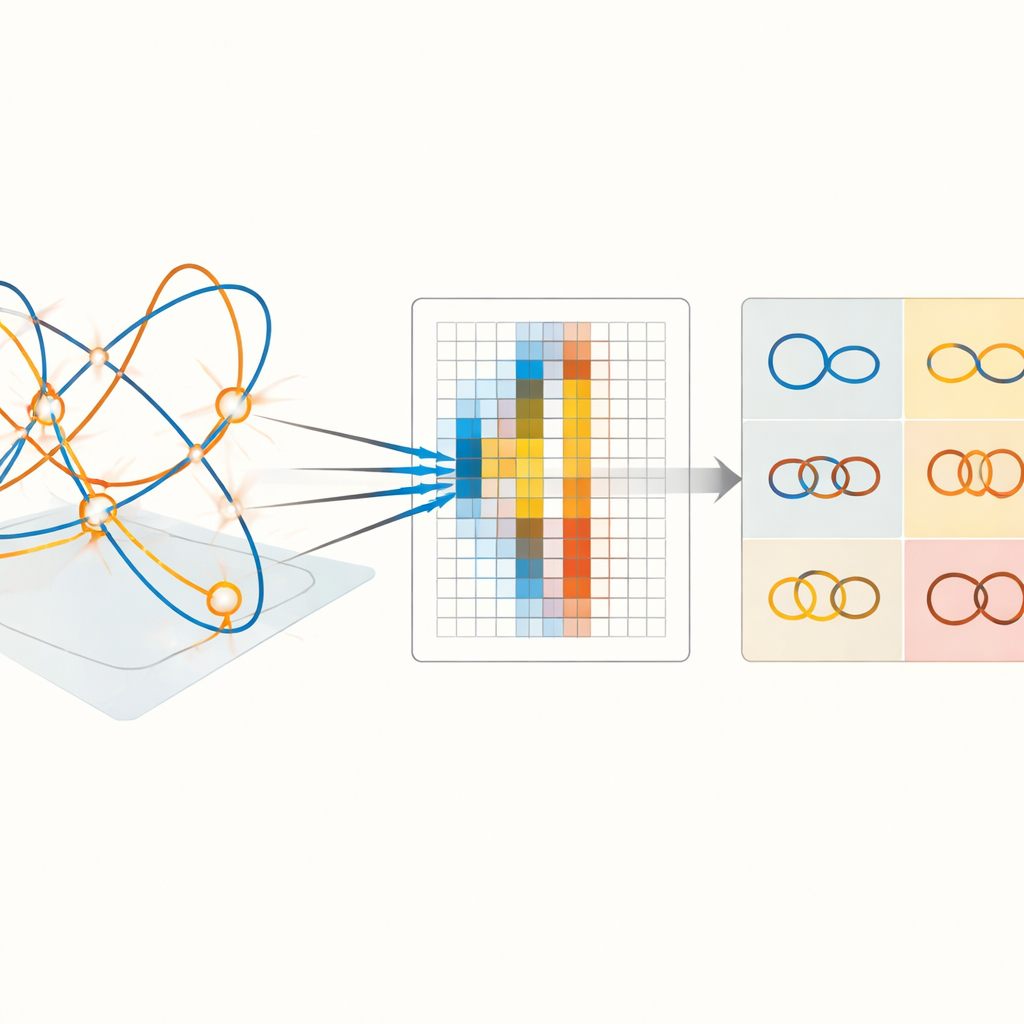
The researchers first generate many synthetic examples of two-band complex-energy spectra with different braid types — from simple unlinked loops to more intricate knots. Each spectrum is represented as a sequence of points along momentum, where each point contains the real and imaginary parts of the two energy levels. They train a Transformer to take this sequence as input and output the braid degree, a number that classifies the topology. Internally, the self-attention layers produce a map of how strongly each momentum point influences every other. By projecting these attention weights back onto the spectra, the team can visualize which regions the model considers most important. The trained Transformer achieves extremely high accuracy in distinguishing different braid types, even outperforming comparable convolutional networks.
Putting the method to the test with ultracold atoms
To see whether this machine learning tool can handle real-world data, the authors build an atomic simulator using a Bose–Einstein condensate of rubidium atoms. They create an effective two-level system by coupling two internal states with microwave radiation, while a resonant laser introduces controlled loss from one state. By tuning microwave frequency and laser power, they map out how the complex energies of the two levels vary as a control parameter is swept, forming braids in energy space. Because the dissipation depends on the atomic density, these braids change shape over time: at short times they can form nontrivial knots or links, while at long times, as atoms are lost, the braids can untie into a topologically trivial configuration. After smoothing and resampling the measured spectra, the team feeds them into the trained Transformer.
Seeing where the model “looks”
The Transformer correctly identifies the braid degree of the experimental spectra, both in the early-time and late-time regimes, and thus detects topological phase transitions driven purely by changing dissipation. Crucially, the attention maps reveal that the model focuses on band crossings — the points where the real or imaginary parts of the two energy levels meet or nearly meet. These crossings are precisely where the phase of the quantum states winds most sharply, and where the bands can exchange and form nontrivial braids. Even though the experimental system breaks some of the symmetries assumed in training and shows many-body, density-dependent loss, the Transformer generalizes well, confirming that these crossings are the geometric backbone of the topology.
Untangling quantum knots with intelligent tools
Overall, the study demonstrates a powerful combination: an experimentally tunable, dissipative quantum system that naturally hosts knotted energy structures, and an interpretable machine learning model that can both classify their topology and point to the key geometric features responsible. For a non-expert, the takeaway is that advanced AI tools can do more than just label complex quantum phases — they can help scientists “see” how and where the system ties its knots. This approach could guide the search for new topological effects in a wide range of open quantum platforms and bring us closer to practical control of robust, geometry-driven behavior in future quantum devices.
Citation: Yue, Y., Li, N., Zhang, X. et al. Detecting complex-energy braiding topology in a dissipative atomic simulator with transformer-based geometric tomography. Nat Commun 17, 3539 (2026). https://doi.org/10.1038/s41467-026-71880-4
Keywords: topological phases, non-Hermitian physics, Bose-Einstein condensate, transformer machine learning, energy band braiding