Clear Sky Science · en
Reduced-crosstalk antennas for grating-lobe-free and wide-field-of-view integrated optical phased arrays
Light Beams Without Moving Parts
Imagine steering a laser beam the way you move a cursor on a screen—instantly, precisely, and with no moving mirrors or motors. That is the promise of integrated optical phased arrays, tiny chips that can direct light electronically. They are central to emerging technologies like self‑driving car sensors, ultra‑fast wireless links through the air, and miniature projectors. Yet today’s chips struggle to see or send light over a wide angle without creating stray “ghost” beams. This research shows how to redesign the light‑emitting antennas on such chips so they can scan a much wider field of view while keeping the beam clean and bright.
Why Chip-Based Light Steering Matters
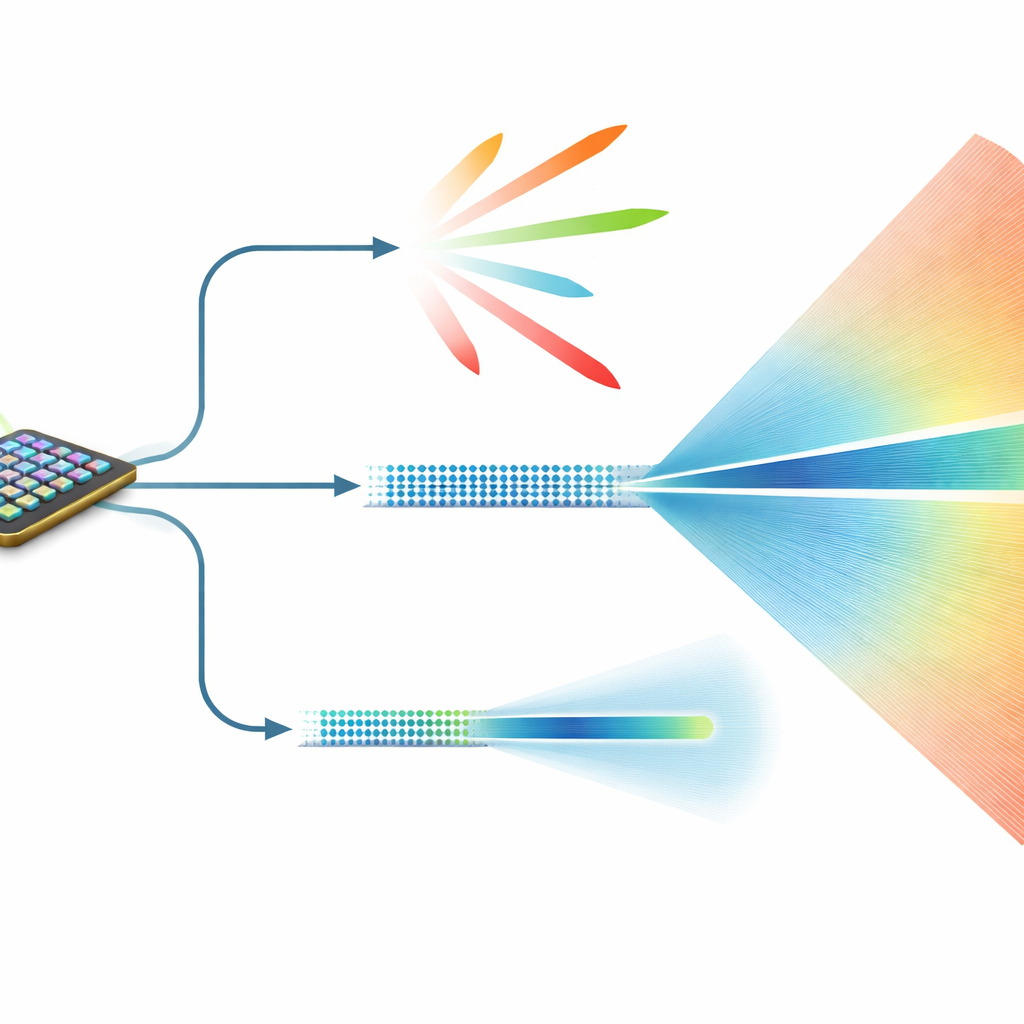
Many devices need to send and receive narrow beams of light that can be steered quickly and reliably. Examples include LiDAR systems that map the surroundings of a car, free‑space optical links that transmit data through the air, and optical tweezers that move microscopic objects with light. Integrated optical phased arrays pack dozens or thousands of tiny antennas onto a single chip. Light is split into many paths, each path gets a carefully chosen phase shift, and all the antennas radiate together. The interference of these waves determines where the combined beam goes in space, much like musicians in an orchestra aiming their sound in a concert hall.
The Problem of Unwanted Ghost Beams
For the chip to see a wide field of view, the antennas must be placed very close together—about half a wavelength of the light apart. This tight spacing avoids so‑called grating lobes, extra beams that appear when antennas are spaced too far apart and that waste power and confuse the signal. However, placing antennas this close introduces another problem: their electromagnetic fields overlap strongly, allowing energy to leak sideways from one antenna to another. This crosstalk scrambles the precise phase relationships that are needed to form a sharp main beam, reducing image quality and signal‑to‑noise ratio. Earlier attempts to remove ghost beams either sacrificed beam brightness, complicated the array layout, or restricted steering to only one direction.
A New Way to Quiet the Neighbors
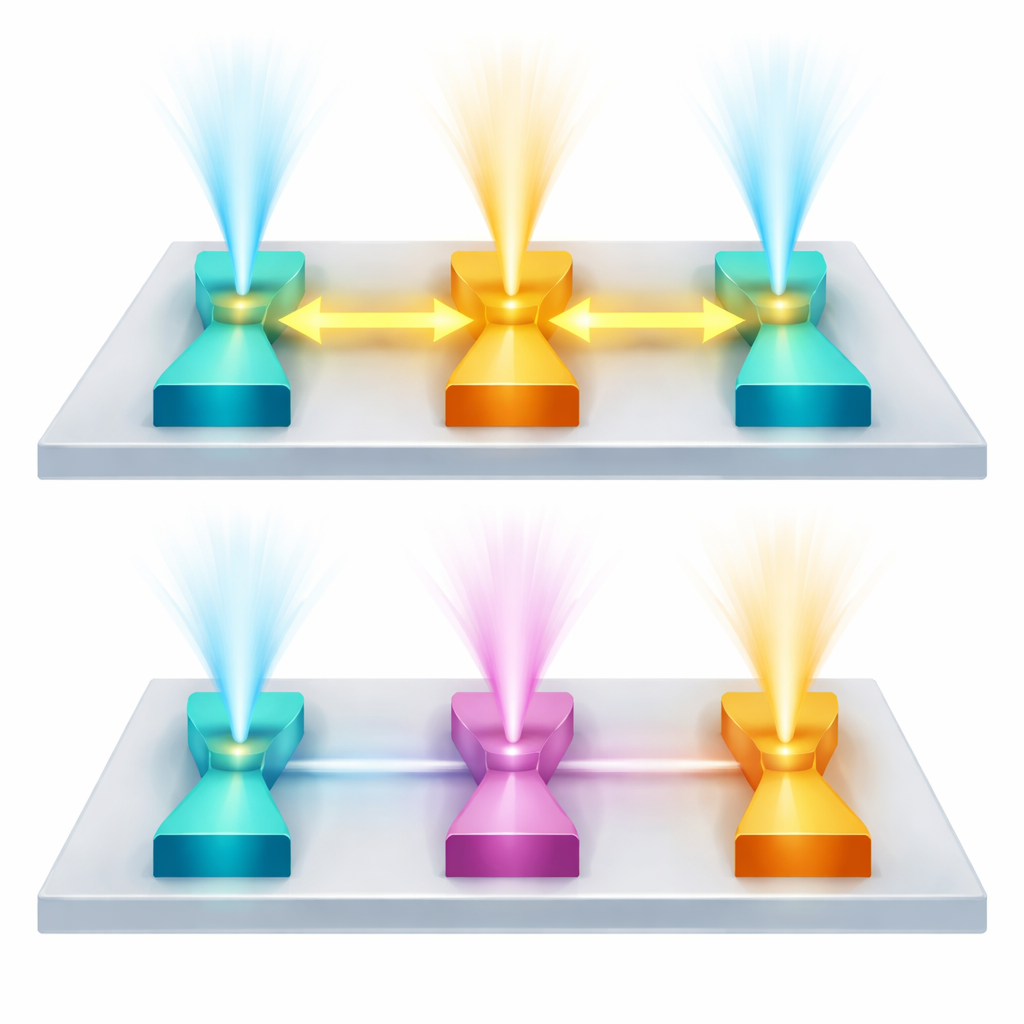
The authors tackled the crosstalk problem at its root: the way neighboring antennas interact. They first developed a general theory describing how light travels and couples between elements that not only exchange energy but also lose some of it as they radiate into space. This framework extends standard coupled‑mode theory to include different loss rates in each element, which turns out to be crucial for antennas that are meant to leak light deliberately. Using this theory and detailed computer simulations, they designed three slightly different grating‑style antennas—distinguished mainly by their widths—that all radiate in the same direction with nearly identical strength, but guide light with different internal speeds. When these three types are placed in an alternating pattern across the chip, their mismatched internal properties dramatically reduce the sideways flow of energy between neighbors.
From Theory to Working Devices
The team fabricated test structures in a commercial silicon photonics process to compare standard antennas with their new reduced‑crosstalk versions. In simple two‑antenna setups spaced at the tight half‑wavelength pitch, they measured how much power moved from one antenna to the other as the antennas were made longer. Standard, identical antennas traded almost all their power back and forth, confirming strong crosstalk. By contrast, the alternating‑geometry antennas exchanged only about one percent of their power—a reduction of two orders of magnitude—matching both simulations and the new theory. The researchers then built a full phased‑array chip with 16 of the new antennas, each fed through an independently controlled phase shifter. Using a custom microscope setup that could rotate to follow the beam, they calibrated the phases so the antennas worked together to form a single, sharp spot of light.
Seeing Wider Without the Noise
With the new antenna design, the integrated phased array achieved what many applications demand: a single, clean beam that can be steered over a wide span of angles without extra lobes popping up elsewhere. The demonstrated device scanned across about 60 degrees of view while maintaining a narrow, high‑contrast beam and showed compatibility with steering by changing the light’s wavelength as well as by adjusting phases. Because the antennas sit at the ideal half‑wavelength spacing, the underlying design supports a theoretical field of view approaching a full half‑circle. In everyday terms, this work shows how careful engineering of the tiny light emitters on a chip can tame unwanted interactions between them, clearing the way for compact, low‑cost, and high‑performance beam steering in future sensing, communication, and display systems.
Citation: Crawford-Eng, H., Garcia Coleto, A., Mazur, B.M. et al. Reduced-crosstalk antennas for grating-lobe-free and wide-field-of-view integrated optical phased arrays. Nat Commun 17, 3942 (2026). https://doi.org/10.1038/s41467-026-71832-y
Keywords: optical phased arrays, silicon photonics, beam steering, integrated antennas, LiDAR