Clear Sky Science · en
Channelized topography amplifies melt-sensitivity of cold Antarctic ice shelves
Why hidden under-ice rivers matter for our coasts
Far below the creaking white expanse of Antarctica’s ice shelves, the ocean is quietly sculpting the ice from underneath. This study reveals that long, tunnel-like grooves cut into the base of some cold East Antarctic ice shelves can act like traps for slightly warmer deep ocean water. That makes these shelves melt much faster than their overall frigid surroundings would suggest, with potential knock-on effects for global sea-level rise.
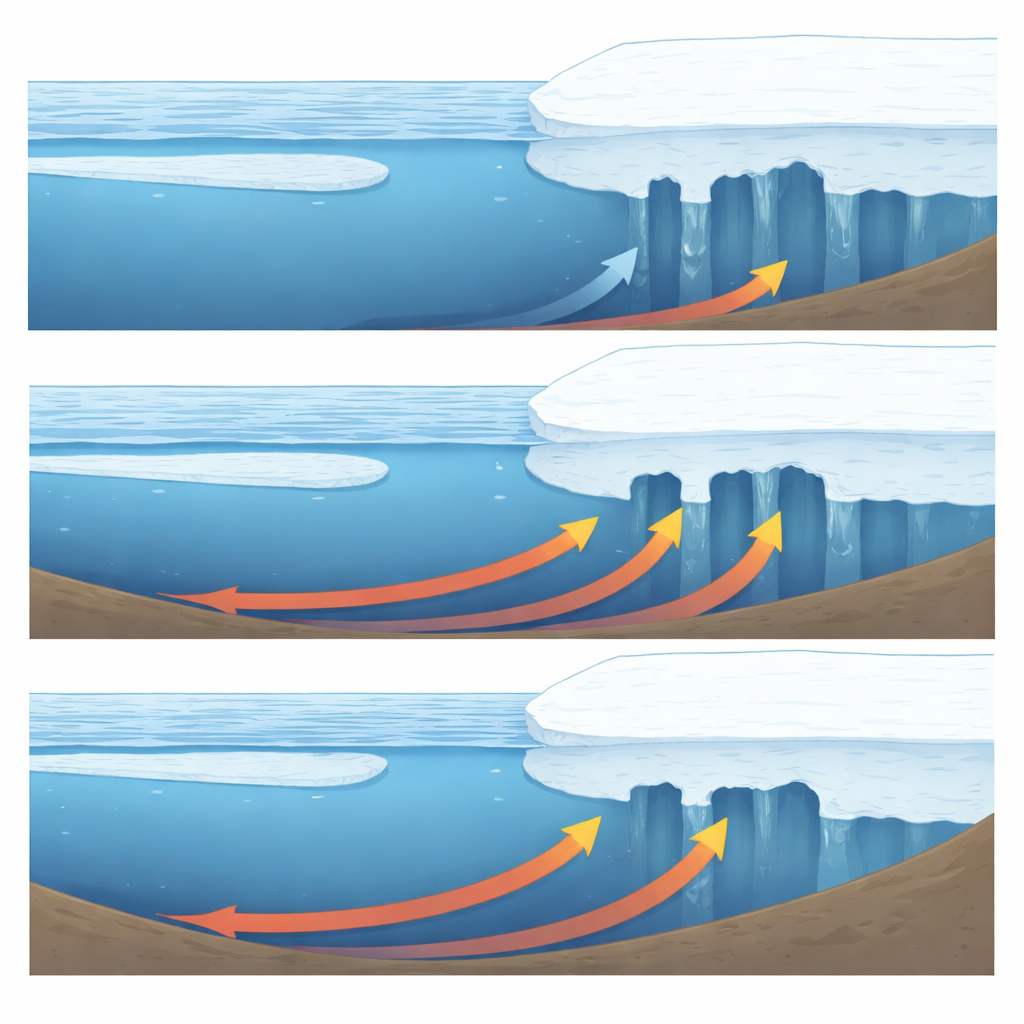
The giant ice dam holding back the sea
The Antarctic Ice Sheet holds about 70% of Earth’s fresh water, enough to raise global sea levels by many meters if it were to flow into the ocean. Floating ice shelves fringe much of this ice sheet and act as buttresses—natural brakes that slow the flow of grounded ice into the sea. Over recent decades, the thinning and weakening of these shelves by ocean-driven melting has become a major driver of Antarctica’s net ice loss. Yet the details of how the ocean melts the intricate underside of ice shelves remain poorly understood, especially in regions where the water filling the cavities is close to the freezing point.
Hidden grooves under the ice
Many Antarctic ice shelves have basal channels—elongated troughs that can be several kilometers wide and hundreds of meters deep, running for tens to hundreds of kilometers from the grounding line toward the ice front. These channels redistribute melting: some areas thin rapidly while neighboring ice barely melts or even refreezes. In warm-water regions of West Antarctica, such channels are known to concentrate melt and can weaken shelves. But similar features also exist beneath cold East Antarctic shelves where melt rates are typically low and access of warm deep water is limited. Until now, it has not been clear whether these grooves stabilize such shelves by localizing melt, or destabilize them by carving structural weak spots.
A digital laboratory beneath Fimbulisen
The authors focus on Fimbulisen Ice Shelf in East Antarctica, a relatively cold system where the ocean cavity is usually filled with near-freezing “winter water.” Using a high-resolution ocean model, they simulate the cavity both with a realistic, rough underside that includes deep channels, and with an artificially smoothed underside that removes them. They then test each geometry under two ocean states: a cold state with almost no warm deep water entering the cavity, and a warm state where a modest intrusion of Circumpolar Deep Water—still only slightly above the local freezing point—reaches the deep parts of the shelf. This allows them to isolate how small-scale topography interacts with subtle ocean warming.
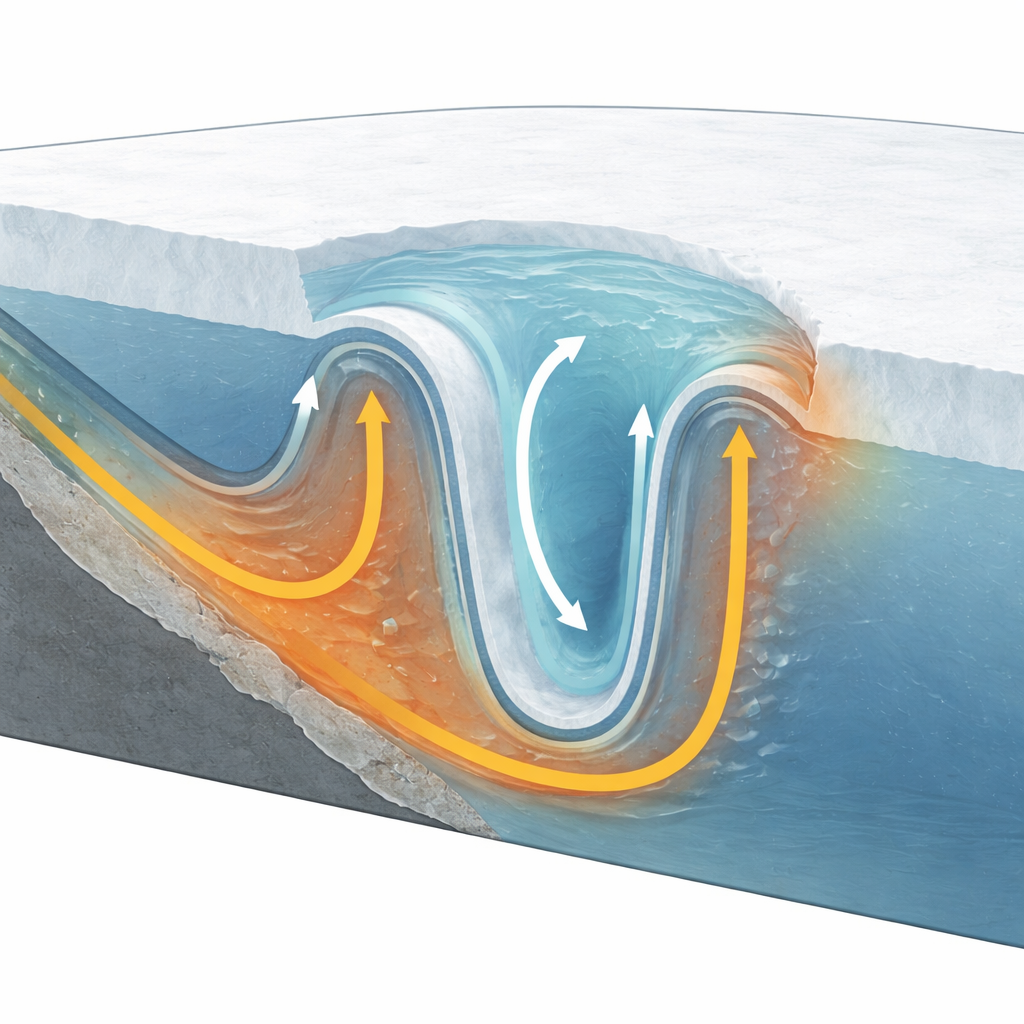
Warm water gets caught in the grooves
The simulations show that when the underside of the ice is channelized, the incoming warm deep water does not simply slide past. Instead, it is transformed as it mixes and melts the ice, becoming both fresher and more buoyant while remaining relatively warm. In the deep-ice region, this transformed water rises into the channels and becomes trapped near their crests, setting up a localized overturning circulation. Faster flow along the channel walls increases turbulent heat transfer, and the presence of warmer water near the ice further boosts melting. Under warm conditions, melt rates inside channels can increase by more than ten meters per year compared with a smoothed underside, even though average melt across the whole shelf remains modest.
From extra melting to structural risk
The team then compares this focused ocean-driven thinning to the natural tendency of ice to flow and “heal” the channels by creeping and filling in depressions. In cold conditions without warm intrusions, ice deformation wins: the combined effect leads to net channel closure. When warm deep water intrudes, however, the extra melt within the channels more than offsets that healing, so channels can be maintained or even deepen over time, particularly beneath the thicker parts of the shelf near the grounding line. This focused thinning has the potential to weaken the structural backbone of the ice shelf, reducing its buttressing strength and making the upstream ice sheet more vulnerable to faster flow.
What this means for future sea levels
The study concludes that small-scale under-ice channels can greatly amplify how sensitive even cold, weakly melting ice shelves are to relatively modest ocean warming. Rather than acting as harmless surface texture, these grooves help draw scarce warm water up to the ice base, increasing melting where it matters most for stability. As climate change shifts Southern Ocean winds and currents in ways that are already bringing more warm deep water onto the Antarctic continental shelf, such channelized overturning may make some ice shelves more fragile than previously thought, with important implications for long-term sea-level projections.
Citation: Zhou, Q., Hattermann, T., Zhao, C. et al. Channelized topography amplifies melt-sensitivity of cold Antarctic ice shelves. Nat Commun 17, 3790 (2026). https://doi.org/10.1038/s41467-026-71828-8
Keywords: Antarctic ice shelves, basal channels, ocean warming, sea-level rise, Circumpolar Deep Water