Clear Sky Science · en
Significant Southern Hemisphere contribution to the Indonesian Throughflow over the last 800,000 years
Why an Ocean Shortcut Matters to Our Climate
The oceans do not just sit still; they move heat, salt, and nutrients around the planet in vast conveyor belts of water. One of the narrowest and most important chokepoints in this system lies in the maze of islands between the Pacific and Indian Oceans, where the Indonesian Throughflow carries water westward. This study asks a deceptively simple question with big climate implications: over the last 800,000 years, has this flow been fed mainly by waters from the Northern Hemisphere, as often assumed, or has the Southern Hemisphere played a much larger role than we thought?
A Hidden Gate Between the Oceans
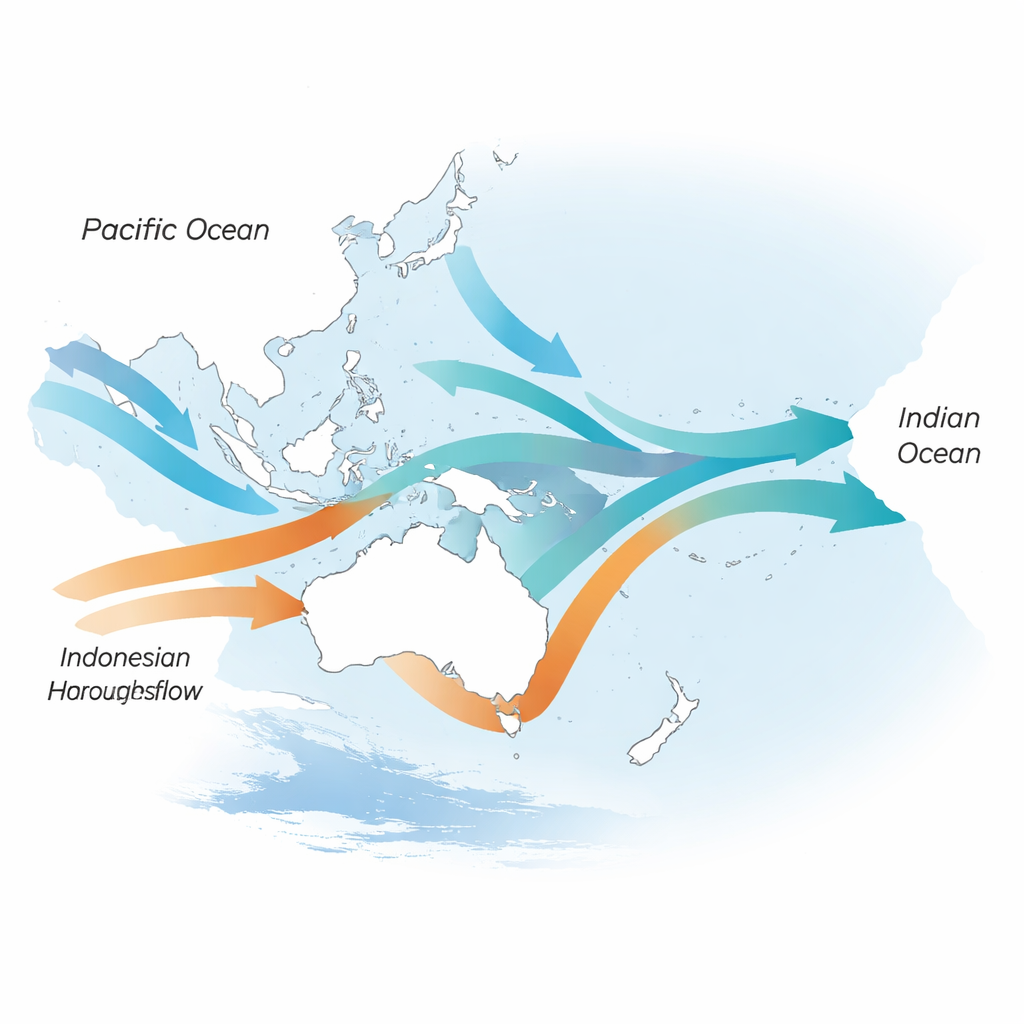
The Indonesian Throughflow is like a control valve between the world’s largest ocean, the Pacific, and the Indian Ocean. Most of its water travels at depths below the surface, carrying with it stored heat and dissolved nutrients that help regulate weather patterns, marine ecosystems, and even the strength of currents in the Atlantic. Modern measurements suggest that these subsurface waters come mainly from the North Pacific, with only a modest contribution from southern sources. However, direct observations cover just a few decades and only parts of the passageways, leaving the deeper history and exact mix of northern and southern waters largely unknown.
Reading Ancient Water From Seafloor Clues
Because we cannot measure ancient currents directly, the researchers turned to a chemical fingerprint preserved in seafloor mud. They focused on nitrogen, a key nutrient for marine life. In the Western Equatorial Pacific, subsurface waters from north and south of the equator have distinct ratios of the heavier nitrogen isotope, known as nitrogen-15. Southern-sourced waters tend to be “heavier,” while northern waters are “lighter.” When microscopic plants use up nitrate near the surface and then sink, the nitrogen they contain is locked into sediments. Over time, these sediments stack up, creating a record that reflects the blend of northern and southern source waters. By measuring nitrogen-15 in a long sediment core from the Banda Sea—right in the heart of the Indonesian Throughflow—the team reconstructed this history over the last 800,000 years.
Southern Waters Leave a Strong and Steady Mark
The nitrogen record from the Banda Sea shows values that are consistently higher than would be expected from a purely northern source, and much closer to those seen in southern Pacific waters today. By comparing the Banda Sea core to other cores from the northern and southern Western Pacific, the authors estimate that Southern Hemisphere waters have often supplied around half—or more—of the subsurface flow feeding the Throughflow over the last 160,000 years, and have made a substantial contribution throughout the entire 800,000-year record. Additional measurements of other sediment components linked to biological productivity reveal rhythmic swings that line up with regular shifts in Earth’s orbit. These patterns point back to processes in the Southern Ocean that control how many nutrients are injected into the water masses that eventually reach the tropics.
Connecting Distant Seas Over Long Times
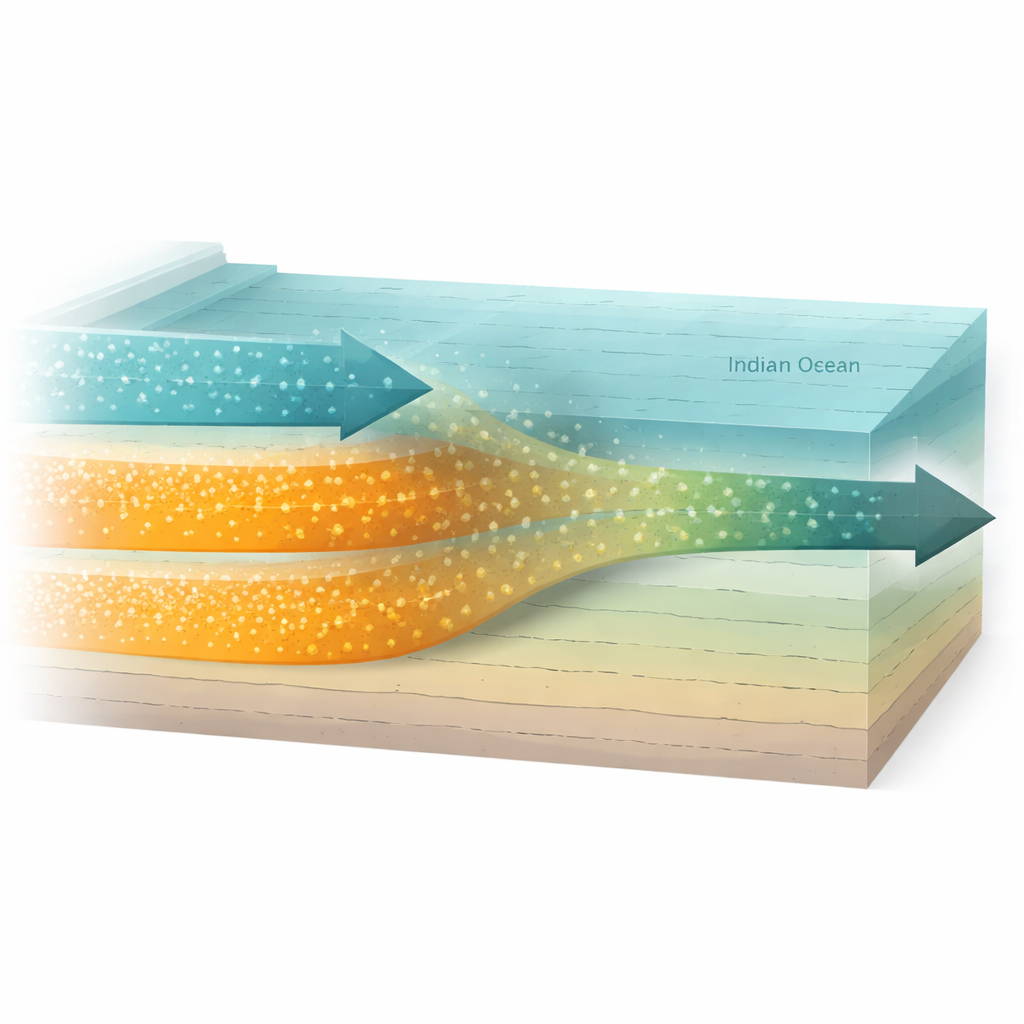
The study argues that a crucial portion of the nutrients in the Indonesian Throughflow originates from high southern latitudes, traveling northward and then westward before being funneled through the Banda Sea gateway. The persistent signal of Southern Hemisphere influence—even as ice ages came and went and sea level rose and fell—suggests a remarkably stable long-term link between the Southern Ocean and low-latitude Pacific. This link helps explain why nitrogen signals with the same pacing appear across the equatorial Pacific and through to the Indian Ocean, carried onward by currents that ultimately feed into the Atlantic and beyond.
What This Means for the Planet’s Future
To a non-specialist, the key message is that waters from the Southern Hemisphere have long been a major supplier of nutrients and properties to the Indonesian Throughflow, not just a minor side stream. This means changes in winds, sea ice, and nutrient use around Antarctica can ripple through the tropical Pacific, alter the supply of “fertilizer” to marine food webs, and influence climate signals far away, including in the Indian and Atlantic Oceans. Understanding this enduring southern contribution helps scientists better interpret past climate shifts and improves the foundations for predicting how the interconnected ocean system may respond to human-driven warming.
Citation: Kienast, M., Hollstein, M., Lehmann, N. et al. Significant Southern Hemisphere contribution to the Indonesian Throughflow over the last 800,000 years. Nat Commun 17, 3484 (2026). https://doi.org/10.1038/s41467-026-71786-1
Keywords: Indonesian Throughflow, ocean circulation, Southern Ocean, marine nitrogen cycle, paleoclimate