Clear Sky Science · en
Necking of the active Turkana Rift Zone and the priming of eastern Africa for continental breakup
When a Continent Begins to Tear
Deep below the deserts and lakes of East Africa, a slow-motion drama is unfolding: a continent is beginning to split apart. This study peers under the surface of northern Kenya’s Turkana Rift Zone to understand how and when Africa might eventually break into separate landmasses. Using detailed seismic imaging and geological fieldwork, the authors show that this region has entered a pivotal stage in the life of a rift—one that not only primes eastern Africa for future ocean formation, but also helped create the extraordinary fossil record that underpins much of what we know about human evolution. 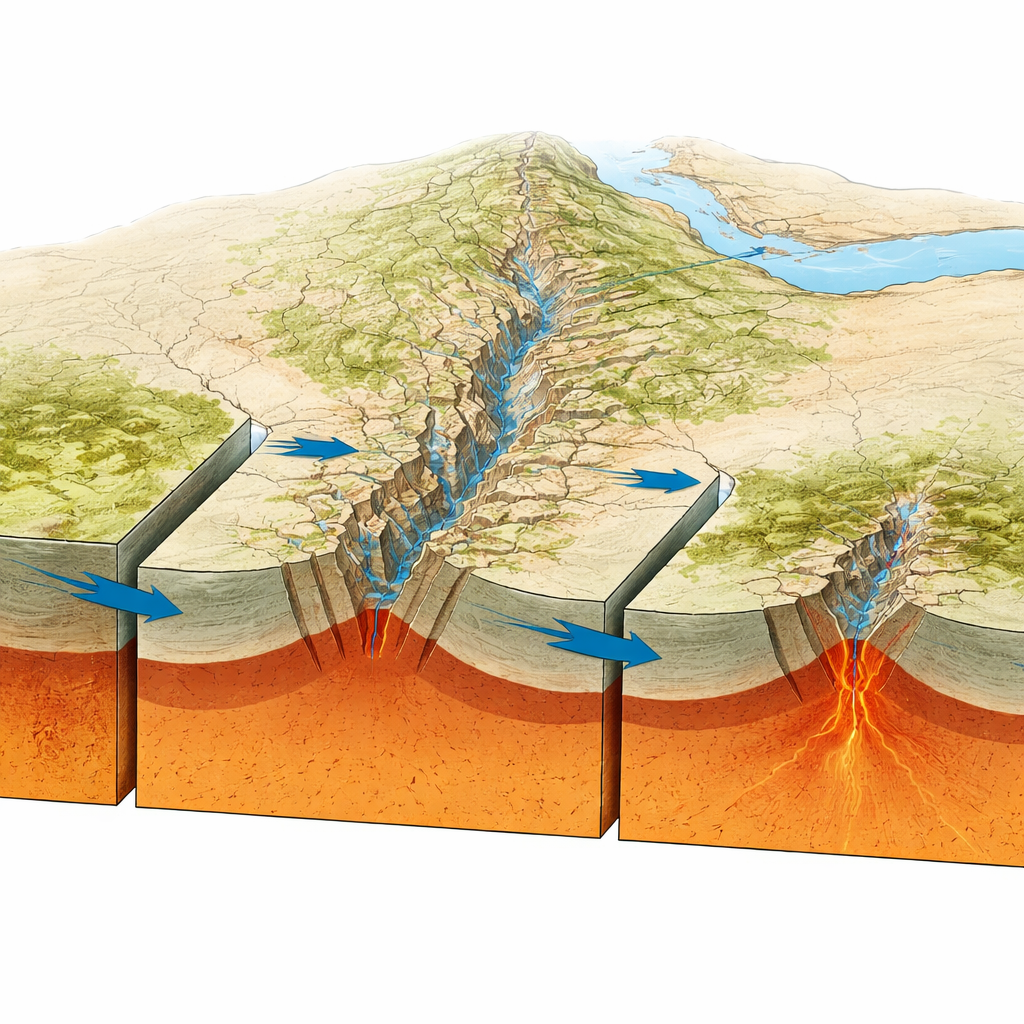
How Continents Stretch and Snap
Continental breakup does not happen all at once. It moves through stages, starting with gentle stretching, progressing to focused thinning, and ending with new ocean floor. In the early “stretching” phase, the crust is pulled apart over a wide area and broken by many scattered faults, but remains thick overall. In the crucial “necking” phase, movement becomes concentrated along a narrow central zone, where the crust is dramatically thinned and weakened. Only after this does true ocean crust begin to form. Around the world, most active rifts appear stuck in the early stretching stage, with deep, thick crust that suggests they are far from actual breakup.
A Hidden Weak Spot in East Africa
The Turkana Rift Zone, part of the great East African Rift System, is an exception. Drawing on high-resolution seismic reflection data and borehole records, the authors reconstructed the shape and thickness of the crust beneath northern Kenya. They found that along the rift axis the solid continental crust has thinned to roughly 13 kilometers—close to values seen beneath the already more advanced Afar region to the north. In cross-section, the crust here forms a clear wedge that narrows toward the rift axis, a hallmark of the necking stage. Earthquake activity clusters above this thinned zone, while surrounding regions with thicker crust remain comparatively quiet, indicating that present-day deformation is tightly focused where the crust is already weakest.
Old Wounds Guiding New Cracks
Why has Turkana raced ahead of other rift segments that are being pulled apart at similar or even higher rates? The study shows that the region sits where two generations of rifting overlap: an older system that opened during the age of dinosaurs, and the younger East African Rift that is active today. Geological outcrops and subsurface images reveal ancient fault-bounded basins and coarse debris deposits from this earlier episode, showing that the crust had already been stretched and thinned. When younger rifting began, it re-used these older weak spots. Later pulses of volcanic activity further softened the crust. Together, inherited structure and magmatic heating made the Turkana sector especially easy to pull apart, allowing necking to begin earlier than plate motions alone would predict. 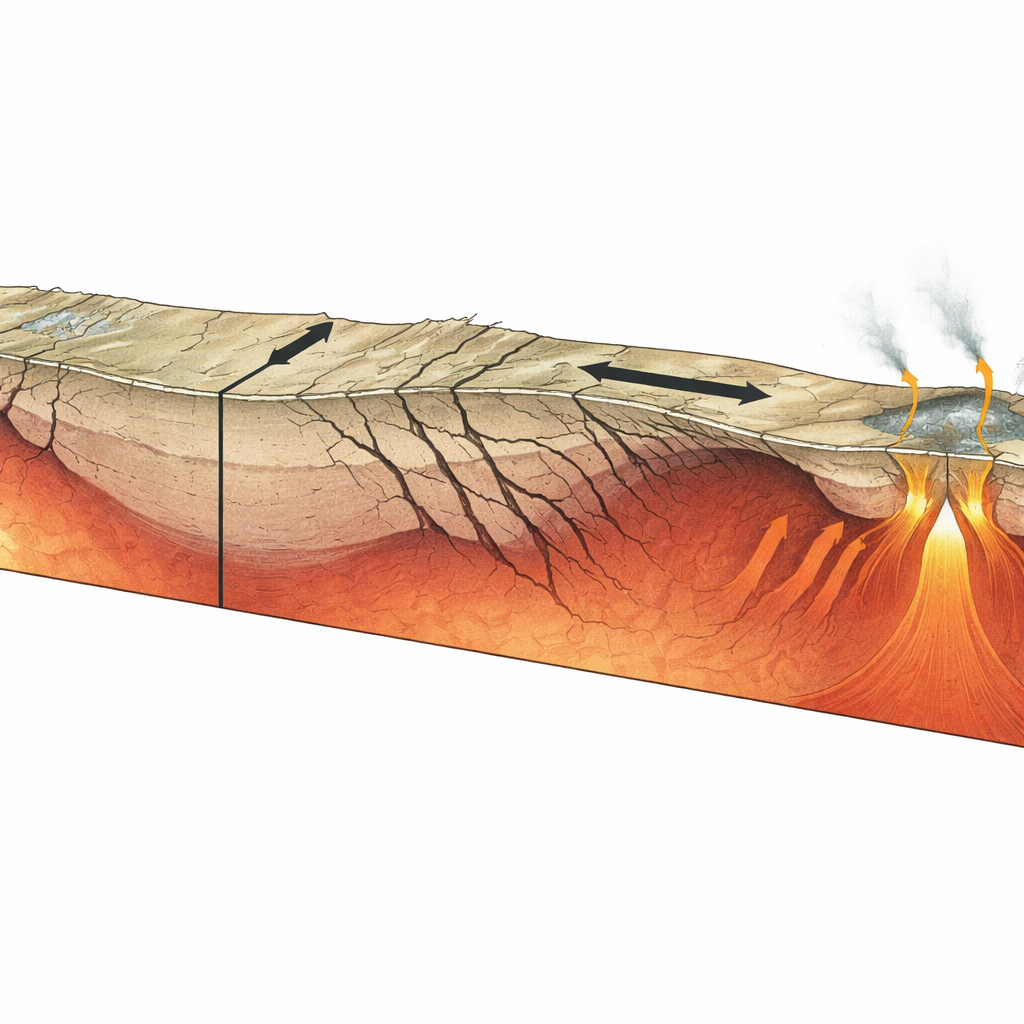
Rifts, Sediment, and the Story of Us
The shift to a necked crust around four million years ago did more than reshape the deep Earth: it transformed the surface landscape in ways that favored fossil preservation. As motion localized onto a linked complex of large faults, the rift floor subsided faster and in a more focused way, opening a single, long-lived basin with abundant space to trap sediments. Sedimentation rates increased sharply, burying plants and animals more quickly and continuously. This change coincides with the onset of the thick, laterally connected deposits of the Omo Group around Lake Turkana, which host many of the most famous hominin fossils and stone tools, from early australopiths to Homo erectus and beyond. Before this transition, fossil-bearing rocks were scattered, thinner, and often interrupted by lava flows, making the record patchier.
Poised on the Edge of a New Ocean
Taken together, the findings show that the Turkana Rift Zone is not just stretching—it is already in the critical necking phase that typically precedes successful continental breakup. Along with the nearby Afar region, which has begun to form ocean-like crust, Turkana marks a second place where eastern Africa has crossed a threshold toward eventual separation. While the final opening of a new ocean basin remains far in the future, the study reveals that key steps in that process are already under way, and that the same deep forces preparing a continent to split also helped preserve the geological archive from which we trace our own origins.
Citation: Rowan, C.M., Kolawole, F., Bécel, A. et al. Necking of the active Turkana Rift Zone and the priming of eastern Africa for continental breakup. Nat Commun 17, 3585 (2026). https://doi.org/10.1038/s41467-026-71663-x
Keywords: East African Rift, continental breakup, Turkana Basin, crustal thinning, human evolution fossils