Clear Sky Science · en
Collapse and resurgence of the Iceland mantle plume
Hidden Heat Beneath the North Atlantic
Far below the waves south of Iceland, a rising column of hot rock deep inside Earth acts like a slow, pulsing blowtorch. This “mantle plume” has built the island of Iceland and shaped the seafloor for tens of millions of years. Yet until now, scientists did not know whether this plume burned steadily or flickered through time. By drilling into the Atlantic seafloor and reading the chemical clues locked in ancient lava, this study shows that the Iceland plume dramatically weakened, then came back to life, reshaping both the ocean floor and even the pathways of ocean circulation.
Drilling Into the Ocean’s Past
To trace the history of this deep-earth engine, researchers used the drill ship JOIDES Resolution to recover volcanic rocks from five sites along the seafloor south of Iceland. These holes, each more than 100 meters into solid rock, lie along a path that follows the motion of the tectonic plates away from the Mid-Atlantic Ridge. Because the plates spread apart at a known rate, the distance from the ridge gives the age of the crust, from about 3 million years old near the present-day ridge to roughly 32 million years old farther away. Some sites sit on smooth, thick crust marked by long V-shaped ridges and troughs linked to plume activity, while the oldest site lies on rough, fractured crust whose origin has been debated.
Reading Chemical Fingerprints in Frozen Lava
The team measured tiny variations in elements such as rare earth metals and isotopes of neodymium within glassy margins of the basalts, along with existing seismic surveys that reveal crustal thickness. These chemical patterns act like a thermometer and DNA test for the mantle source: hotter rock and a strong plume signal tend to produce thicker crust and melts enriched in certain elements, while cooler, ordinary mantle yields thinner crust and more depleted lavas. By comparing drill-core samples with lava dredged directly from the Mid-Atlantic Ridge at different latitudes, the scientists could see where the plume’s influence was strong, weak, or absent through time.
When the Plume Faded Away
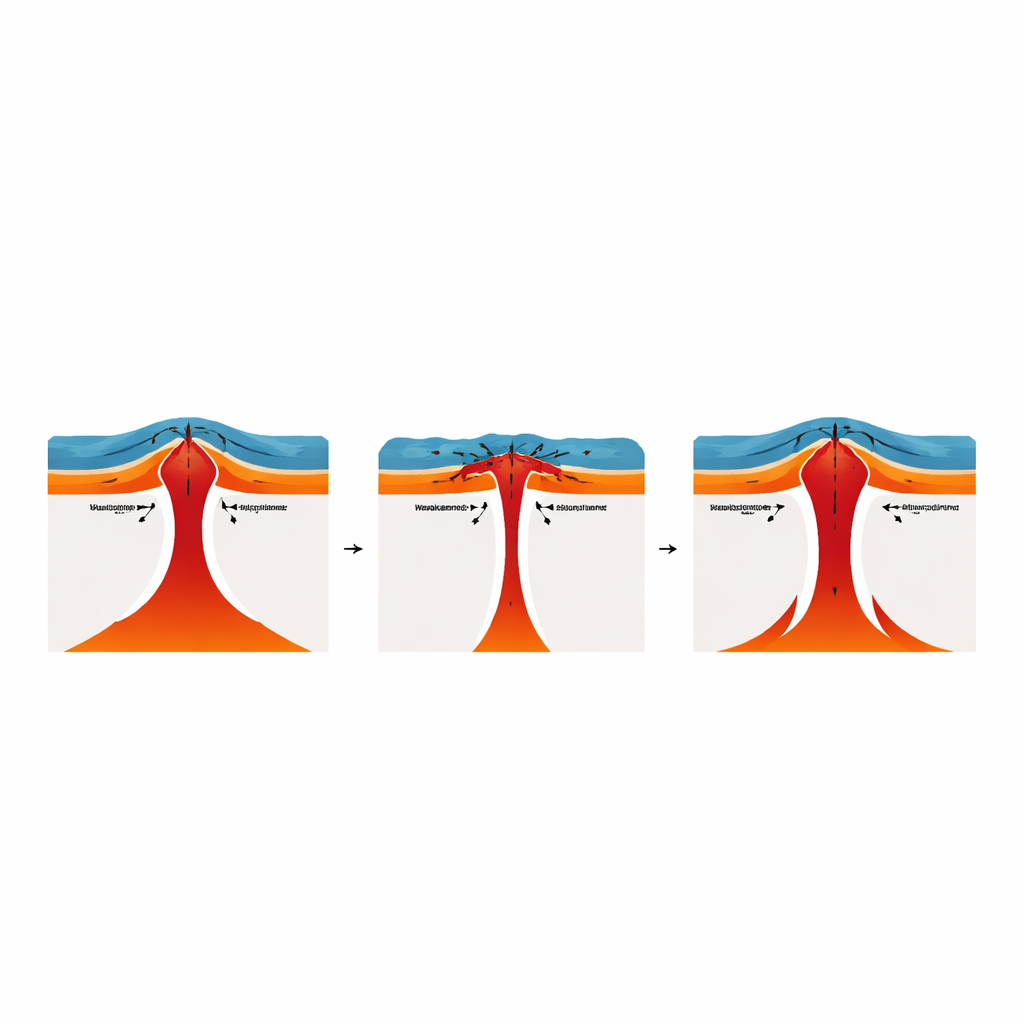
The oldest drilled site, about 32 million years old and sitting today near 60°N, turned out to be crucial. Its lavas closely match those from a distant stretch of the Mid-Atlantic Ridge that lies outside Iceland’s “hot spot” zone. They record relatively cool mantle temperatures, typical crustal thickness of about 6 kilometers, and no clear chemical fingerprint of plume material. Yet this crust formed close to where the plume’s center is thought to have been at that time. The simplest explanation is that the once-large plume head had shrunk dramatically, withdrawing toward Iceland and leaving much of the North Atlantic under ordinary mantle conditions. Seafloor imaging shows that this period also saw a switch to thin, fractured crust and the growth of major transform faults—surface signs of a weakened thermal engine below.
Reawakening Under the Ridge
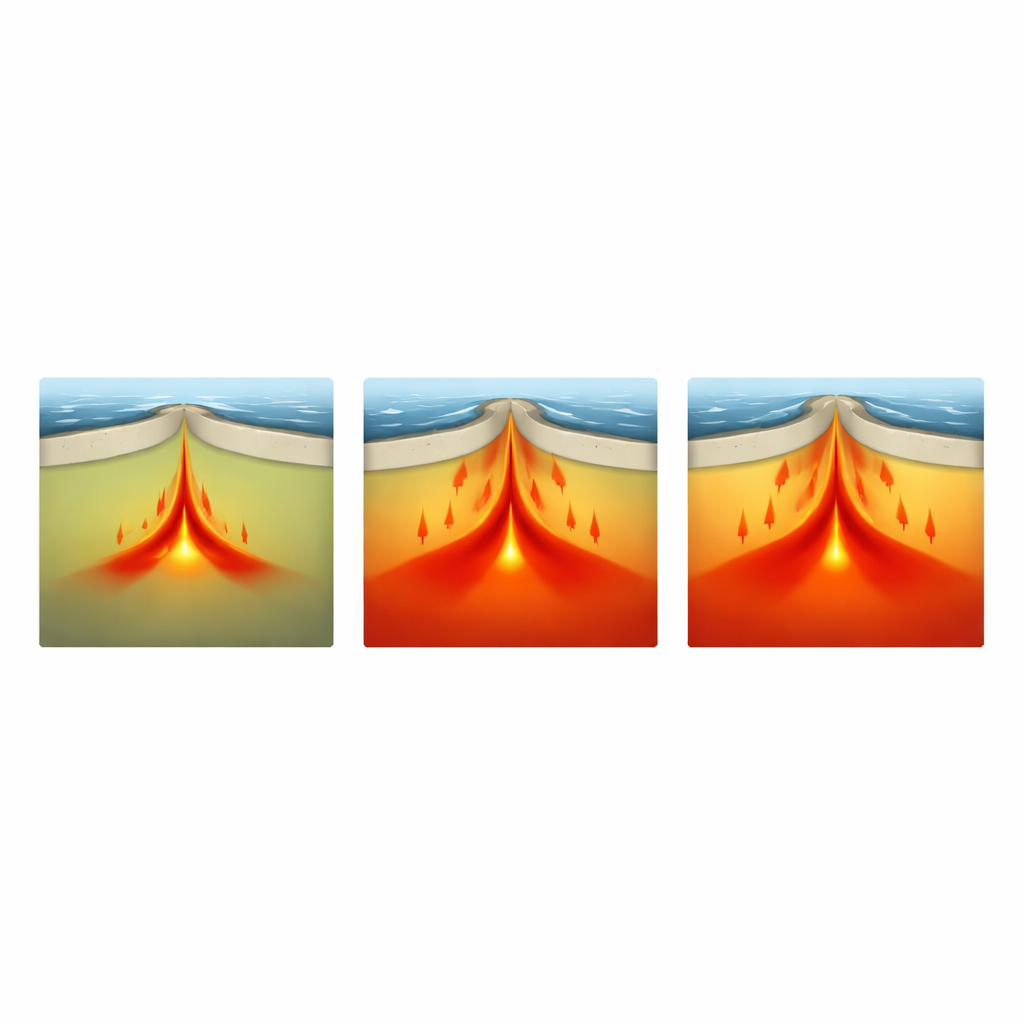
Younger sites, ranging from about 14 to 3 million years old and lying on V-shaped ridges and troughs, tell a very different story. Their lavas are richer in certain elements, and modelling shows they formed from hotter mantle—up to roughly 50–100 °C above ambient—and thicker crust, clear signs of renewed plume influence. The pattern suggests that after collapsing, the plume’s reach expanded again, and the spreading ridge gradually migrated back toward the plume’s narrow tail. As hot material flowed out from beneath Iceland and met the ridge, it produced pulses of extra melting that built the V-shaped ridges flanking the Reykjanes Ridge. Subtle changes in isotopes also point to a shifting mix of recycled oceanic crust and more depleted mantle within the plume over time.
Why Deep Earth Pulses Matter
Together, these lines of evidence reveal that the Iceland mantle plume is not a steady, unchanging heat source. Instead, it breathes in geological time: after an initial surge that helped open the North Atlantic, its influence waned and nearly vanished in this region by about 32 million years ago, only to recover and strengthen again in more recent times. This rise-and-fall pattern altered the thickness and structure of the ocean floor, the layout of faults and ridges, and likely the depth of key ocean gateways that affect currents and climate. For non-specialists, the key message is that Earth’s deep interior is far more dynamic and changeable than a simple textbook “hot spot” suggests—and that by drilling into the seafloor and decoding lava chemistry, we can reconstruct the heartbeat of the planet’s mantle over tens of millions of years.
Citation: Pearman, C., Tien, CY., White, N. et al. Collapse and resurgence of the Iceland mantle plume. Nat Commun 17, 4104 (2026). https://doi.org/10.1038/s41467-026-71618-2
Keywords: Iceland mantle plume, North Atlantic seafloor, mantle convection, mid-ocean ridge volcanism, plate tectonics