Clear Sky Science · en
Direct electrochemical appraisal of black coffee quality using cyclic voltammetry
A New Way to Judge Your Morning Cup
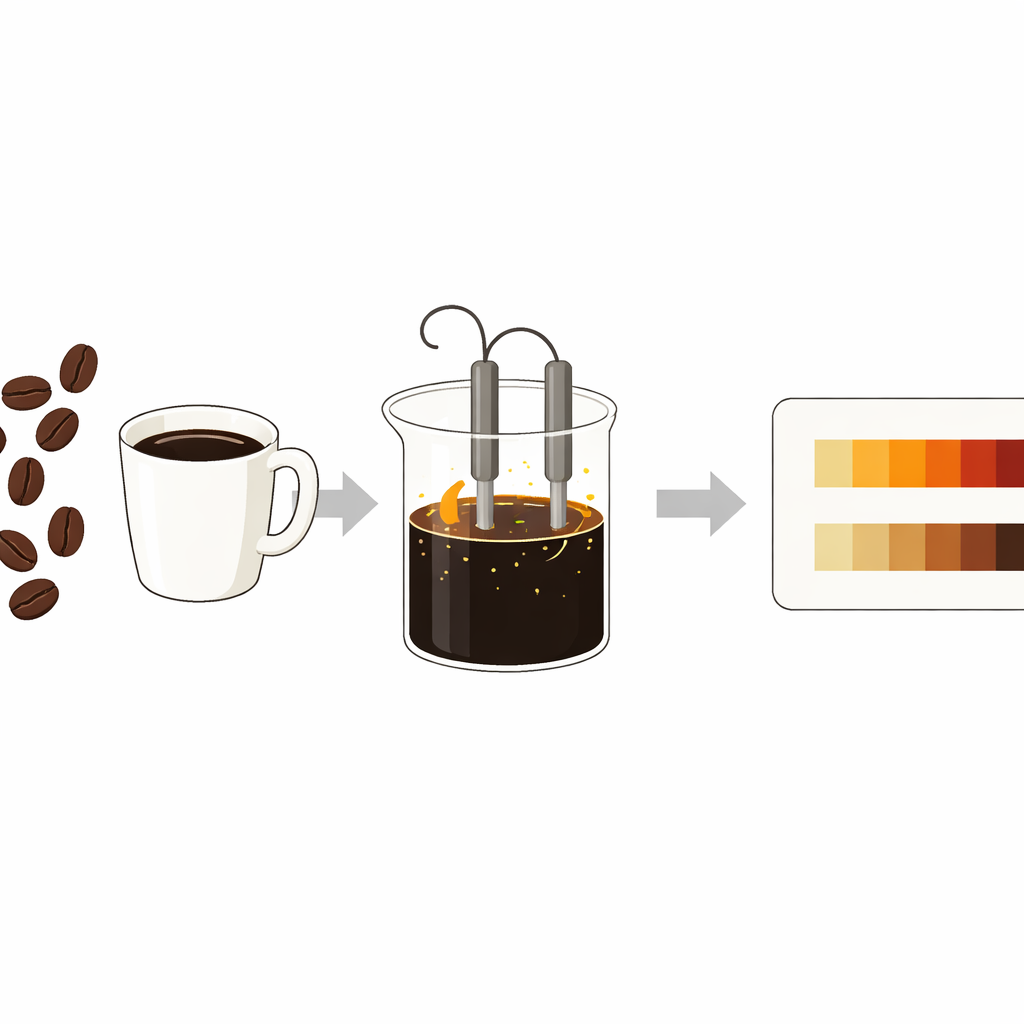
For decades, baristas and scientists have known that how strong a coffee is and how dark it has been roasted both shape what we taste. Yet there has been no quick, objective way to measure those qualities directly in the liquid in your cup. This study introduces a simple electrical test that can be done on black coffee as you drink it, revealing both how concentrated the brew is and how the roasting has tuned its chemistry—and, by extension, its flavor.
Why Current Methods Miss the Full Picture
The coffee industry usually relies on refractometers—handheld tools that shine light through brewed coffee and report a number related to total dissolved solids, often shortened to TDS. That measure is very useful for brew strength, but it has a blind spot: it cannot tell what those dissolved substances actually are. Two coffees, one light-roasted and one dark-roasted, can show the same refractive reading even though their underlying chemistry, and therefore their taste, is quite different. More sophisticated laboratory tools such as chromatography and mass spectrometry can separate and identify thousands of molecules in coffee, but they are slow, expensive, and impractical for daily use in a roastery or café.
Turning Coffee Into an Electrical Signal
The researchers instead turned to a technique called cyclic voltammetry, which measures how much electrical current flows when a changing voltage is applied between metal electrodes dipped into a liquid. Brewed filter coffee, as it turns out, is conductive enough to be tested directly, without adding any extra salts or doing any special preparation. When they used a platinum electrode and scanned through negative voltages, they saw a distinctive set of features just before bubbles of hydrogen gas would normally begin to form. These features arise as protons and other acidic species in the coffee interact with the platinum surface. The team found that the size of this current feature scales cleanly with how strong the coffee is: more dissolved material, and therefore more available protons, leads to more charge passed during the measurement.
How Roast Level Leaves a Fingerprint
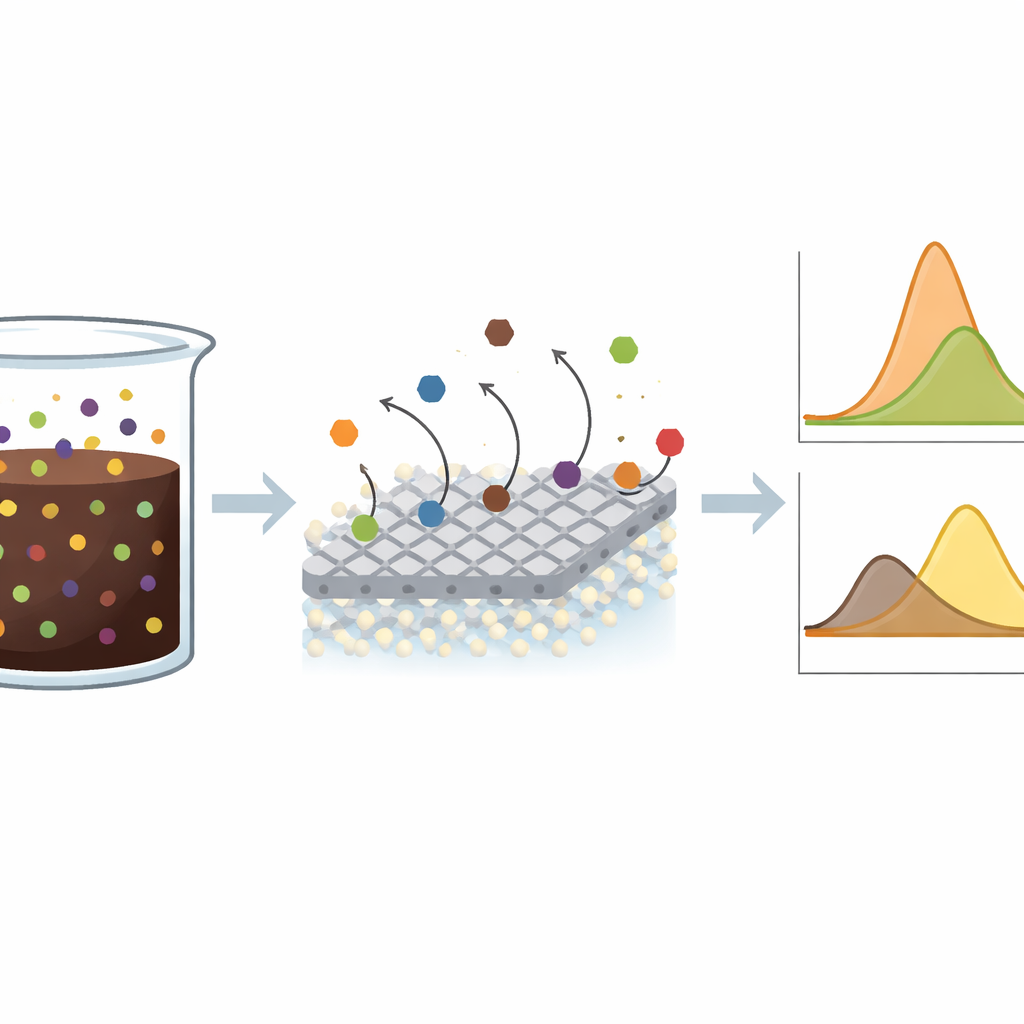
Curiously, when the same coffee was repeatedly scanned, the proton-related signal shrank. Using a sensitive balance built into the electrode, the scientists showed that coffee molecules were actually building up on the platinum surface, partially blocking it. Chemical analysis of the material scraped back off the electrode revealed caffeine, and computer simulations indicated that caffeine and chlorogenic acids—compounds whose levels shift strongly with roast—bind readily to platinum. To test how roast color changes the electrical response, the team roasted the same Colombian coffee to a series of well-controlled light-to-dark levels and brewed them under standardized conditions. Even when all brews were adjusted to the same TDS by refractometer, lighter roasts produced larger proton features than darker ones. Plotting charge, roast color, and strength together, they obtained a simple, nearly planar relationship: for a given coffee, the voltammetry cleanly separates the effects of how strong the brew is from how dark the beans were roasted.
Putting the Method to Work in a Roastery
To see whether this electrical approach could keep up with expert tasters, the researchers partnered with a specialty roaster that had produced several batches of the same coffee to the same target color. One batch had been rejected on the cupping table for off-flavors, even though its measured strength and color were nearly indistinguishable from the others. In a single-blind test, the scientists brewed all four coffees and recorded their voltammetric responses. Traditional measures such as TDS could not reliably separate the batches. However, the integrated current from the first scan in the key potential region clearly singled out one sample as statistically different from the others—and this sample turned out to be exactly the rejected batch. The rate at which the electrode became coated was similar for all four, highlighting that the absolute charge passed, not just the fouling, reflects meaningful differences in composition.
What This Means for Everyday Coffee
In practical terms, this work shows that a compact electrochemical test can read out both how strong a black coffee is and how its complex mixture of acids, bitters, and roast by-products is balanced, all with no more preparation than pouring the brew into a small cell. Because those same molecules shape perceived acidity, bitterness, and astringency, the electrical signal becomes a fast proxy for flavor. Roasters could use it to track batch-to-batch consistency, design blends, or detect subtle shifts in green coffee or roasting that current tools miss. For drinkers, it brings us a step closer to a world where the character of a cup can be quantified as easily as it is savored.
Citation: Bumbaugh, R.E., Pennington, D.L., Wehn, L.C. et al. Direct electrochemical appraisal of black coffee quality using cyclic voltammetry. Nat Commun 17, 3618 (2026). https://doi.org/10.1038/s41467-026-71526-5
Keywords: coffee quality, cyclic voltammetry, roast level, total dissolved solids, electrochemical sensing