Clear Sky Science · en
Experimental demonstration of high space compression by optical spaceplates
Why shrinking cameras matters
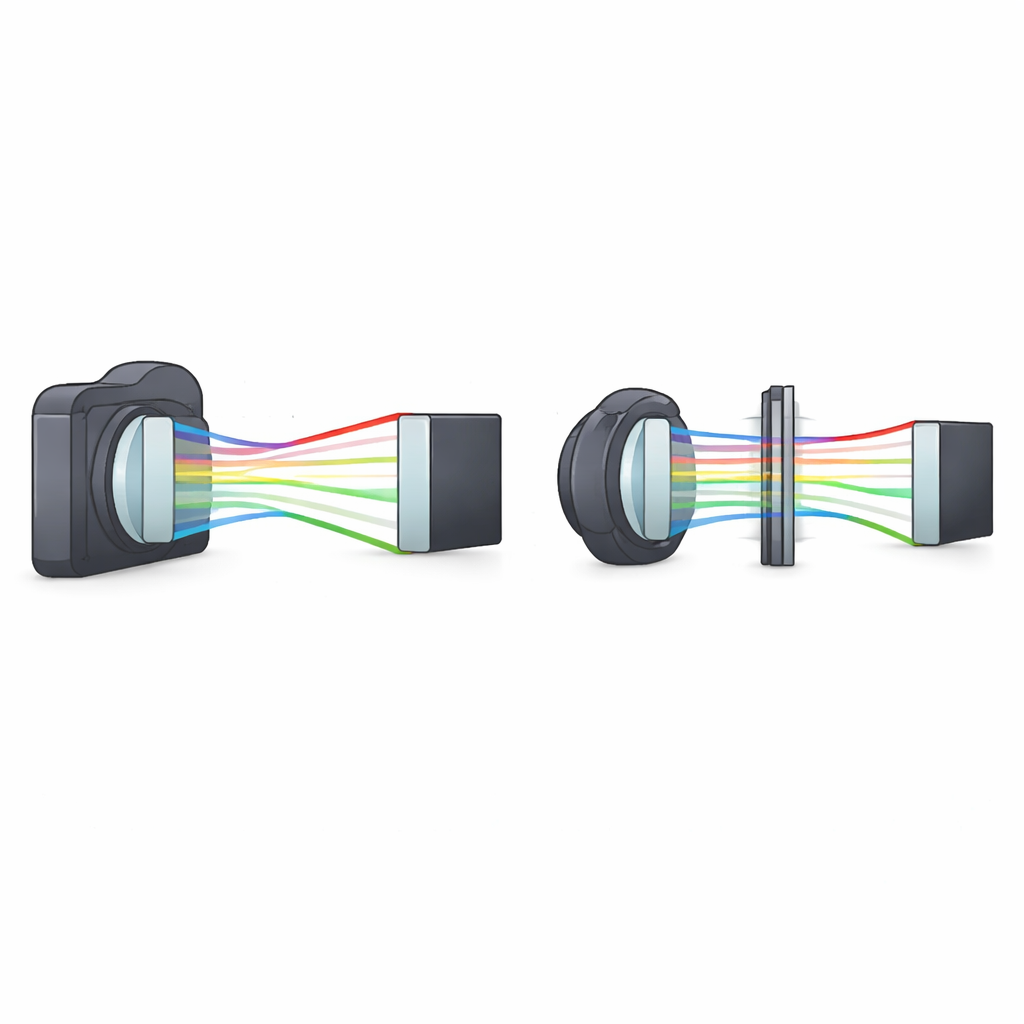
From smartphones to space telescopes, most advanced cameras share a stubborn problem: they are bulky. Even if we make lenses thinner and flatter, there still has to be empty space for light to travel between the lens and the image sensor. This “air gap” sets a hard limit on how slim our optical devices can be. The research in this paper introduces and experimentally proves a radically different idea: a special flat component called a “spaceplate” that can make light behave as if it has travelled a long distance, even though it has only crossed a sheet just a few micrometers thick. This could pave the way for paper-thin cameras and more compact instruments for medical imaging, autonomous vehicles, and virtual reality.
A new way to replace empty space
Instead of bending light to focus it, like a lens does, a spaceplate replaces part of the empty region that light normally crosses after leaving a lens. When a beam enters the spaceplate at an angle, it emerges at the same angle but shifted sideways, in exactly the way it would have shifted if it had travelled through a much thicker slab of air. In other words, the spaceplate mimics a long stretch of free space inside a very thin device. By inserting such a plate into a camera between the lens and the image plane, engineers can move the point where the image comes into focus significantly closer, shortening the entire system, while keeping the image size (magnification) the same.
Building a flat stand-in for distance
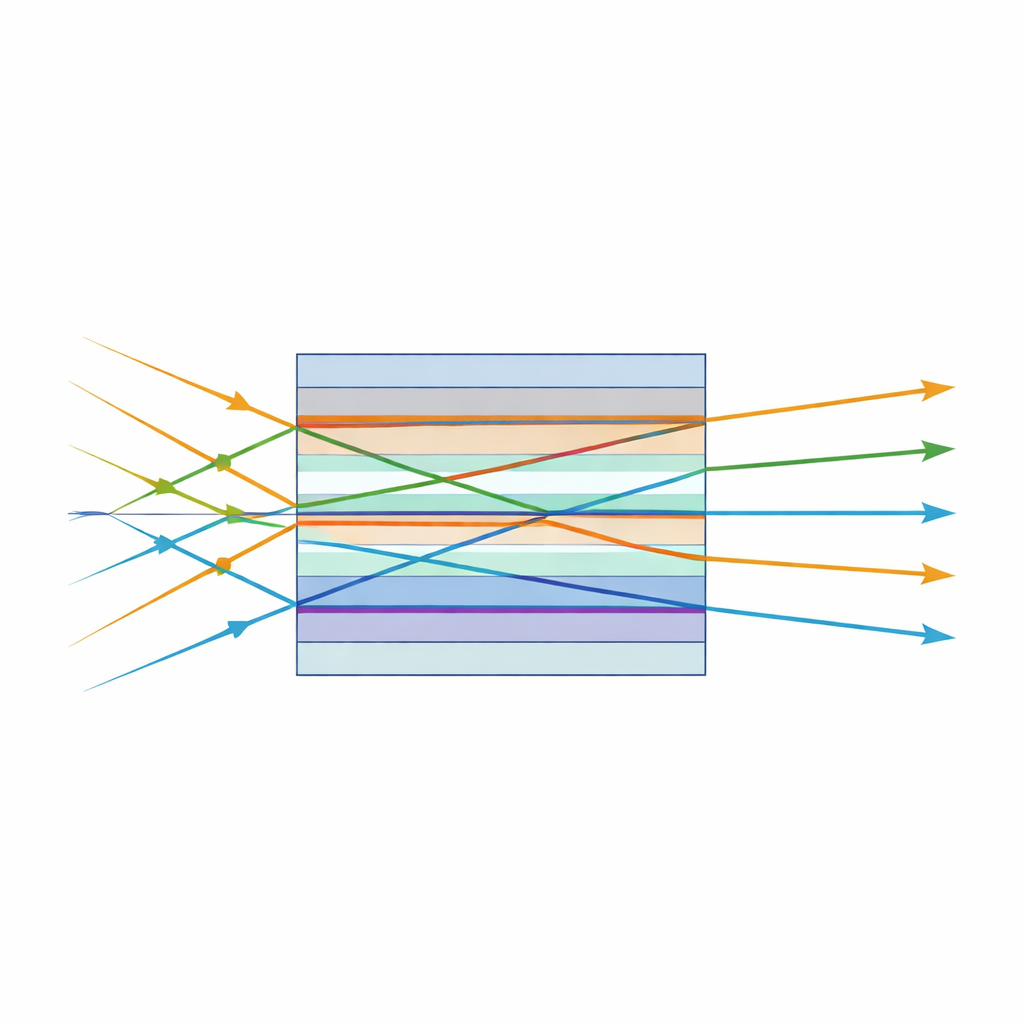
The authors realize this concept using technology that already underpins commercial optical filters: thin-film multilayer stacks. They deposit alternating layers of two common materials—silica glass and amorphous silicon—on a glass substrate, with each layer only a fraction of a micrometer thick. By carefully choosing the thickness of each layer, they shape how the device delays light depending on its angle of travel. This angle-dependent delay causes the desired sideways shift of the beam and makes the thin stack behave like a much thicker region of empty space. The team explores two design strategies: one found by a computer-based gradient-descent optimization and another based on repeating tiny optical cavities, similar in spirit to well-known Fabry–Pérot resonators.
Seeing the effect in real beams and images
To prove that their stacks truly compress space, the researchers perform several optical experiments at infrared wavelengths around 1550 nanometers, a standard telecommunication band. First, they place their spaceplate on top of a much thicker glass plate and shine a beam through it at various angles. Normally, tilting a glass plate makes the beam slide sideways in one direction; strikingly, the multilayer spaceplate shifts the beam in the opposite direction. For one design only 11.51 micrometers thick, the sideways shift from the spaceplate alone is so strong that it nearly cancels the shift produced by a 3-millimeter-thick glass plate beneath it—despite being about 260 times thinner.
Compressing the distance in a camera
The team then studies what happens when a lens focuses light through the spaceplate, mimicking a simple imaging system. They track where a narrow beam comes to its smallest spot as it passes through free space, through plain glass, and through the glass plus spaceplate. Plain glass by itself pushes the focus farther away, as expected when light travels through a denser medium. Adding the thin multilayer reverses this trend, pulling the focus closer to the lens by half a millimeter. When they form an actual image of a tiny patterned defect on glass, the sharpest picture with the spaceplate appears at this nearer distance, yet the image size remains unchanged. This confirms that the device shortens the system without altering magnification, something ordinary lenses cannot do alone.
How far can flat optics go?
By measuring how the sideways beam shift grows with angle, and how it varies with color, the authors quantify a “compression ratio”: how many times more space the plate imitates compared to its own thickness. Their best device effectively replaces a region of free space 176 times thicker than itself, the largest such ratio yet demonstrated at optical wavelengths and far beyond earlier prototypes. Different designs trade off compression strength, color bandwidth, and range of angles they can handle, but because the multilayer approach uses mature coating technology, these spaceplates could be tailored for specific tasks and mass produced. In the near term, their narrow color range is a feature rather than a bug for systems that already use single-color light, such as LIDAR scanners, retinal imagers, endoscopes, and laser-based displays. In the longer run, improved materials and multi-color designs could help turn the dream of ultra-thin, flat cameras and compact optical instruments into everyday reality.
Citation: Hogan, R., Mamchur, Y., Córdova-Castro, R.M. et al. Experimental demonstration of high space compression by optical spaceplates. Nat Commun 17, 3493 (2026). https://doi.org/10.1038/s41467-026-71500-1
Keywords: spaceplate, flat optics, compact imaging, multilayer thin films, LIDAR