Clear Sky Science · en
3D-printed NiTi alloys for elastocaloric cooling
Cooling our world in a cleaner way
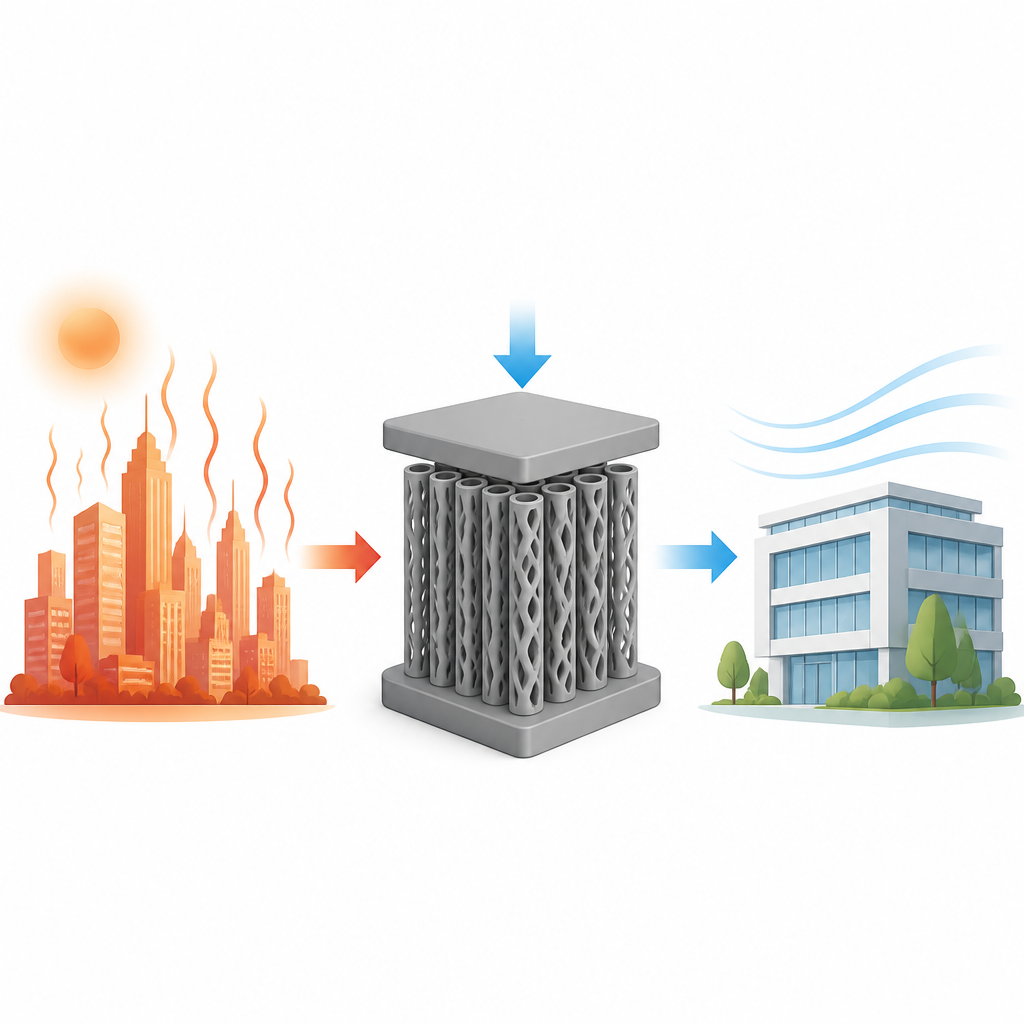
Air conditioners keep homes and data centers comfortable, but they usually rely on gases that can leak into the atmosphere and warm the planet. This study explores a solid metal alternative made from a nickel–titanium alloy shaped by 3D printing, aiming to cut greenhouse gas emissions while still delivering strong, reliable cooling performance.
From gas coolers to solid coolers
Most of today’s cooling systems use vapor-compression cycles, where special gases are squeezed and released to move heat. These gases often have high global warming potential, so any leaks add to climate change. Nickel–titanium alloys offer a different route: when they are squeezed, their internal structure shifts in a way that absorbs or releases heat, a behavior known as the elastocaloric effect. Prototypes using conventionally processed nickel–titanium have already shown that solid cooling can work in the lab, but making these parts usually requires many steps, such as repeated rolling and cutting, which are slow, costly, and waste a lot of material.
Why 3D printing these metals is hard
3D printing seems like an ideal way to shape nickel–titanium into compact cooling elements with intricate channels for fluids. Yet previous 3D-printed versions have faced a difficult trade-off. Some could survive many loading cycles but gave only a small temperature change for each unit of force. Others produced stronger cooling but failed after relatively few cycles, far below what would be needed in real machines. Tiny pores, cracks, and unfavorable grain structures left from the printing process made the metal prone to damage and gradually reduced how much of its internal structure could switch back and forth during use.
Designing a tougher and more efficient alloy
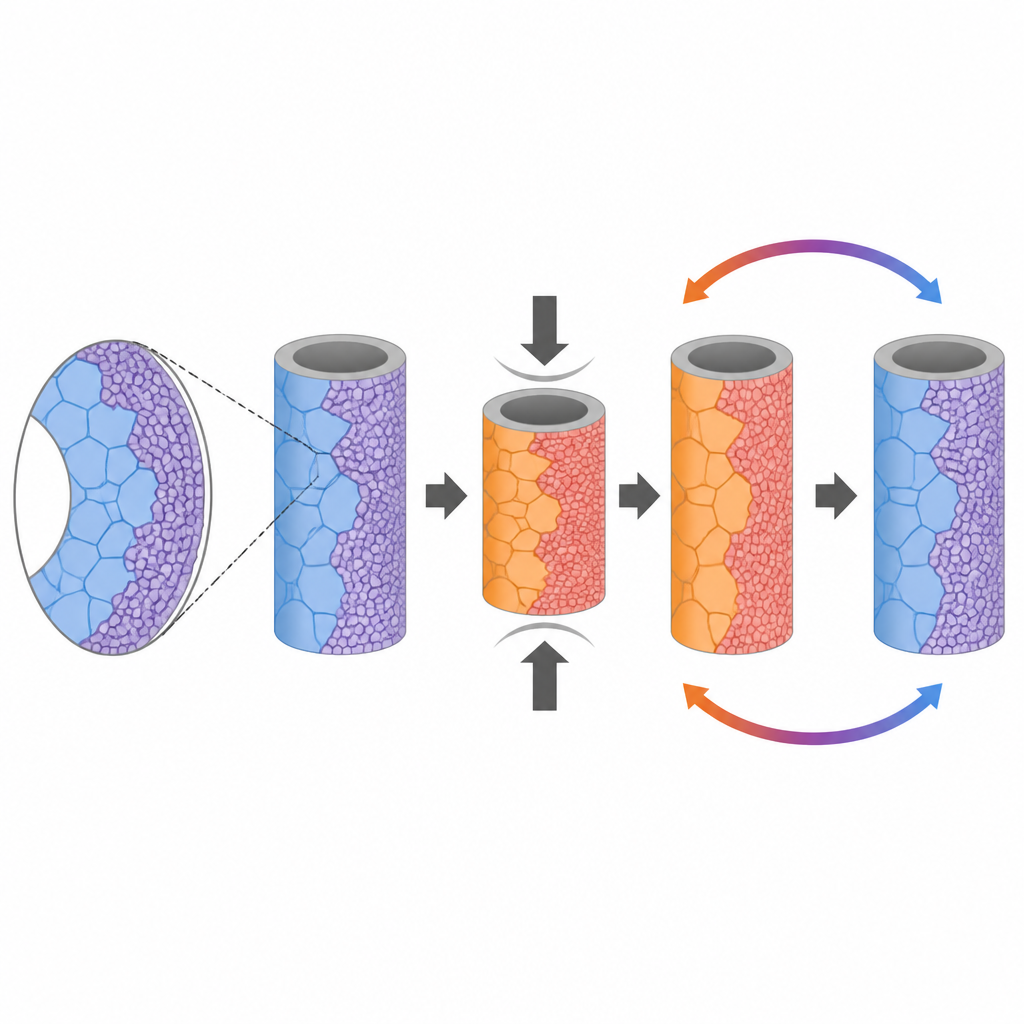
The authors tackled this challenge by fine-tuning the laser powder bed fusion process and a single heat-treatment step. By carefully choosing the laser energy, they produced material with an extremely low defect content, avoiding both un-melted regions and deep keyhole pores. Annealing then reshaped the internal grain pattern into a “bimodal” mix of larger grains and clusters of much finer grains, with a small amount of a titanium-rich secondary phase. This combination reduces dislocations that would otherwise pin parts of the structure, adjusts the temperature at which the metal switches phase, and makes the alloy more resistant to crack growth under repeated loading.
Record performance under repeated use
Under controlled compression tests, the new 3D-printed nickel–titanium showed a large temperature swing of nearly 20 degrees Celsius at an optimal stress level and, crucially, maintained useful cooling ability over three million loading cycles without fracturing. Its specific temperature change, a measure of how effectively it converts applied stress into a temperature shift, was more than ten times higher than the best previous 3D-printed counterpart and similar to, or better than, many commercial alloys made by traditional routes. Microscopy and X-ray imaging revealed that cracks form later, grow more slowly, and are repeatedly deflected or stopped by the mixed grain structure and by local phase changes that absorb energy near crack tips.
From printed tubes to working coolers
To show that the material can work beyond the lab bench, the team 3D-printed hollow nickel–titanium tubes with internal channels and built a compact cooling device. When these tubes were cyclically squeezed while water flowed through them, the system achieved a temperature difference of 20 degrees Celsius and a cooling power of about 50 watts, comparable to devices based on conventionally processed alloys. Because 3D printing can create complex internal paths and multiple shapes in a single batch with little wasted metal, it opens the door to designs that were previously impossible with cutting and machining alone.
What this means for future cooling
This work shows that 3D-printed nickel–titanium can deliver both long life and strong cooling performance, two requirements for real-world solid-state refrigerators and heat pumps. By reducing defects and carefully tailoring the internal grain pattern, the researchers reconcile durability with efficiency in a way earlier designs could not. While more engineering is needed before such systems reach homes or data centers, the study points toward a future where cleaner, more flexible cooling devices can be built directly from digital designs, helping to meet growing cooling demands with less impact on the climate.
Citation: Zhong, S., Lin, H., Li, Y. et al. 3D-printed NiTi alloys for elastocaloric cooling. Nat Commun 17, 4207 (2026). https://doi.org/10.1038/s41467-026-71399-8
Keywords: elastocaloric cooling, 3D-printed NiTi, solid-state refrigeration, sustainable cooling, shape memory alloys