Clear Sky Science · en
Recombinant haemostatic protein for therapeutic substitution of platelet function via tripartite haemostatic mechanisms in thrombocytopenic male mice
Why a New Way to Stop Bleeding Matters
Many people with cancer or immune diseases live with dangerously low levels of platelets, the blood cells that help stop bleeding. When platelets are scarce, even small injuries or natural wear and tear inside blood vessels can lead to serious blood loss. Today, the main treatment is platelet transfusion from donors, but supplies are limited and repeated use can cause complications. This study explores a lab made protein that aims to step in for missing platelets and help blood clot without relying on donated cells.
How Platelets Normally Protect Us
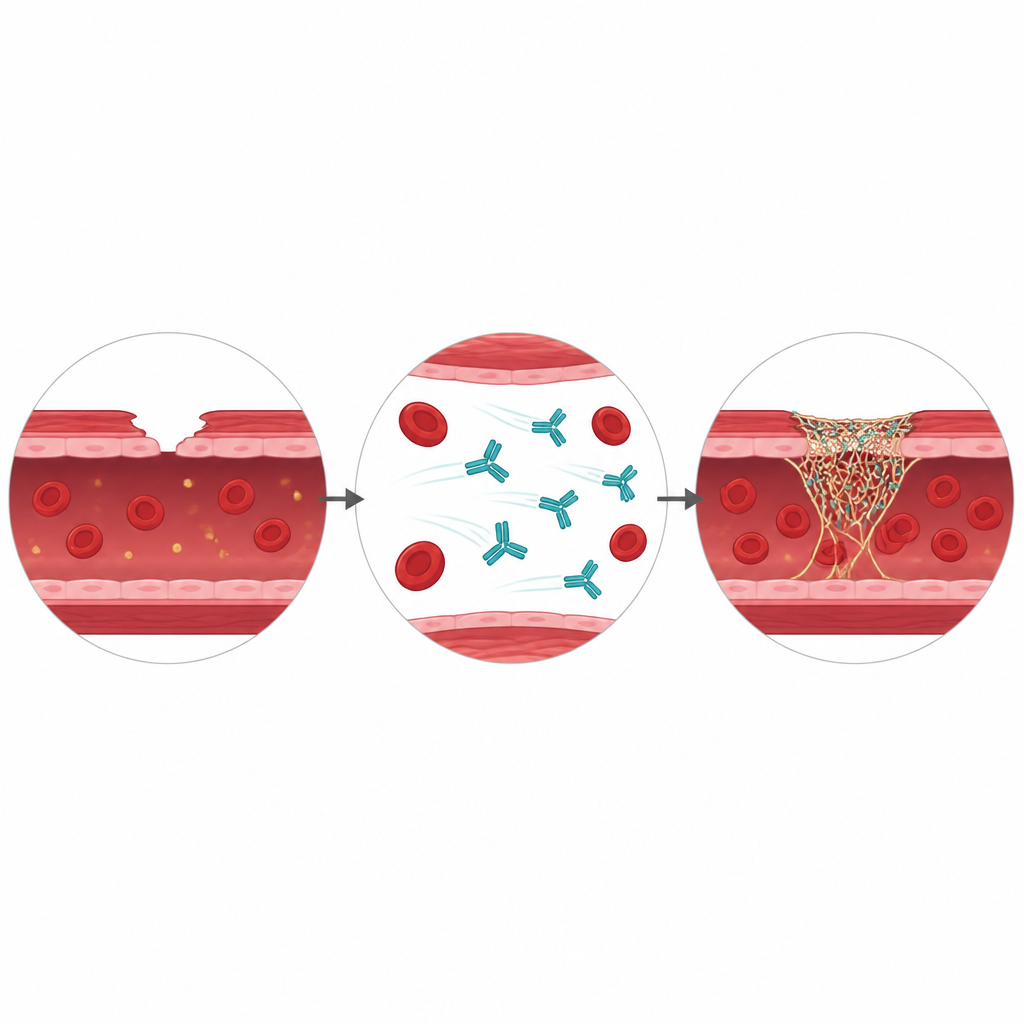
When a blood vessel is damaged, platelets rush in like first responders. They latch onto exposed collagen in the vessel wall, stick to one another through a protein called fibrinogen, and help trigger an enzyme called thrombin that turns fibrinogen into sticky fibrin strands. These strands weave into a mesh that plugs the leak. In people with thrombocytopenia, platelet counts fall so low that this carefully choreographed response breaks down, leaving them at risk of bleeding during surgery, after injury, or even without any obvious trauma.
Designing a Protein Stand In for Platelets
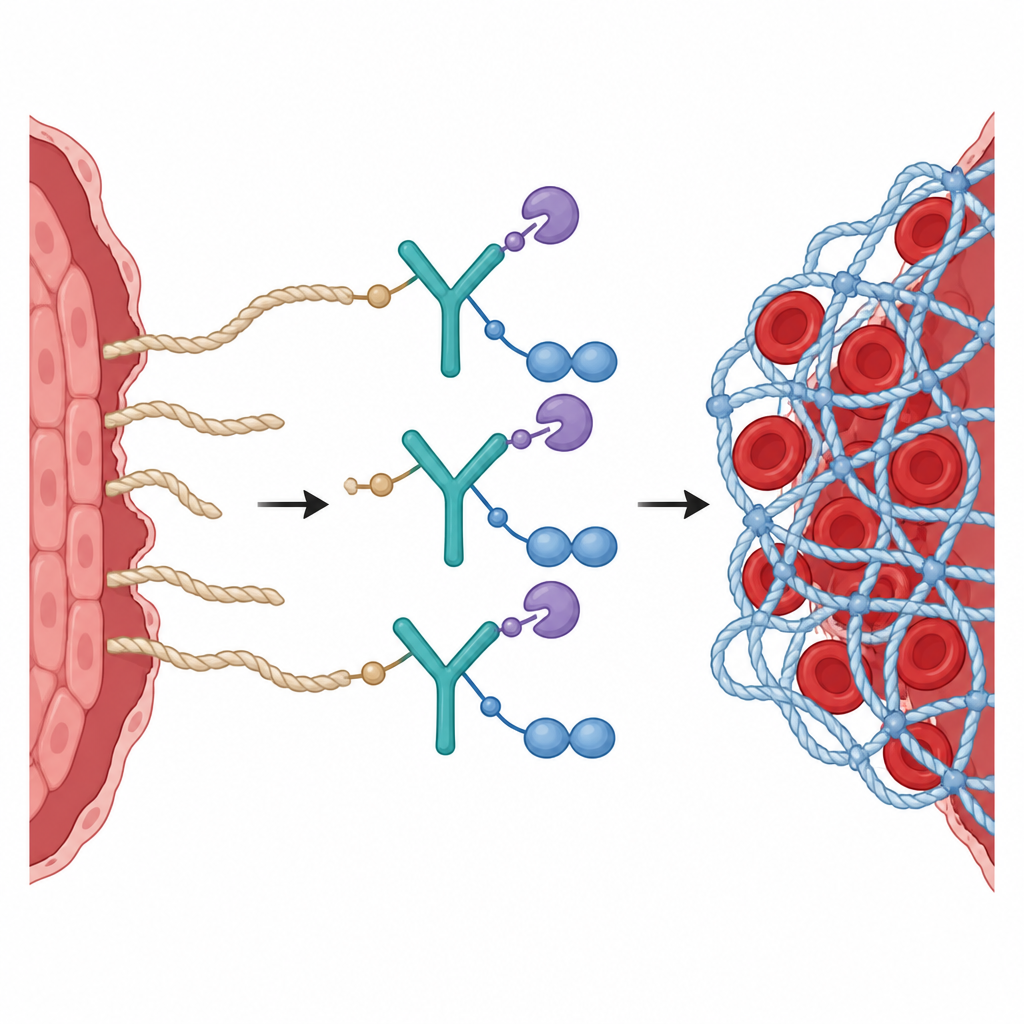
Instead of building artificial particles to mimic platelets, the researchers engineered special proteins that can latch onto the same key players platelets use. One version stitches together three natural binding pieces from human proteins that recognize collagen, thrombin or its inactive form, and fibrinogen, all joined to an antibody fragment that helps the whole structure circulate and pair up. A second version uses antibody like fragments selected from a large library for their ability to bind collagen, fibrinogen, and thrombin. Both designs are meant to travel harmlessly in the bloodstream until they encounter a wounded vessel, where they gather clotting factors and promote a strong fibrin mesh, even when platelets are scarce.
Putting the Protein to the Test in Mice
The team first confirmed in lab dishes that their proteins could bind collagen, thrombin or prothrombin, and fibrinogen with suitable strength, and that this boosted the formation and density of fibrin networks. They showed that one of the human based proteins speeds up fibrin clot formation and creates tighter, more branched fiber meshes, which should better block blood flow. In mice, the proteins circulated in the blood for about a day and did not cling strongly to common plasma proteins or to platelets themselves, suggesting they would not interfere with normal blood components while on patrol.
Reducing Bleeding Without Triggering Dangerous Clots
To see whether the proteins could actually help in a living animal, the researchers created severe thrombocytopenia in mice by using an antibody that removes platelets. They then cut the liver or tail and measured how much blood was lost. Mice with very low platelets bled heavily, but those given the recombinant proteins lost about half as much blood, and bleeding often slowed or stopped sooner. Microscopy of the liver wounds showed that the proteins gathered at the injury site and restored fibrin deposits to levels similar to healthy animals, even though platelet numbers remained low. In a model mimicking chemotherapy induced thrombocytopenia, the human style protein also reduced hidden intestinal bleeding, again without raising platelet counts.
Checking for Safety Signals
Because any clot boosting treatment could, in theory, cause harmful blockages in the lungs or other organs, the team looked closely for side effects. Mice received repeated doses of the proteins over 11 days. They maintained normal body weight and temperature, showed no increase in allergy linked antibodies, and had stable numbers of major immune cell types. Kidney tissue looked healthy under the microscope. In the lungs, where tiny clots are often trapped, the researchers saw no rise in platelet rich microthrombi after protein treatment, whereas a known pro clotting trigger produced many such plugs. These findings suggest that the engineered proteins can enhance clotting at wounds without broadly activating clot formation elsewhere.
What This Could Mean for Future Care
Overall, the study shows that a carefully designed protein can partially take over the job of platelets by drawing clotting factors to damaged vessels and weaving a dense fibrin mesh that helps stop bleeding. The proteins do not replace every platelet function, and some rebleeding still occurred, so they are not yet a full substitute for healthy platelets. However, they may one day serve as an additional tool during platelet shortages or for patients who do not respond well to transfusions. By combining targeted action at injury sites with built in safety features that limit unwanted clotting, this approach points toward new, cell free treatments for managing bleeding in people with very low platelet counts.
Citation: Lim, CG., Lee, J., Suk, G. et al. Recombinant haemostatic protein for therapeutic substitution of platelet function via tripartite haemostatic mechanisms in thrombocytopenic male mice. Nat Commun 17, 4702 (2026). https://doi.org/10.1038/s41467-026-71344-9
Keywords: thrombocytopenia, platelet substitute, recombinant protein, fibrin clot, chemotherapy bleeding