As we rely more on wind and solar power, we need safer, longer lasting batteries to store that energy. One promising route is to replace flammable liquid battery electrolytes with solid materials that let charged atoms move quickly but safely. This paper explores a new way to design such solid electrolytes by focusing not just on how messy the material looks, but on how many different paths the moving ions can actually take.
From neat crystals to busy highways
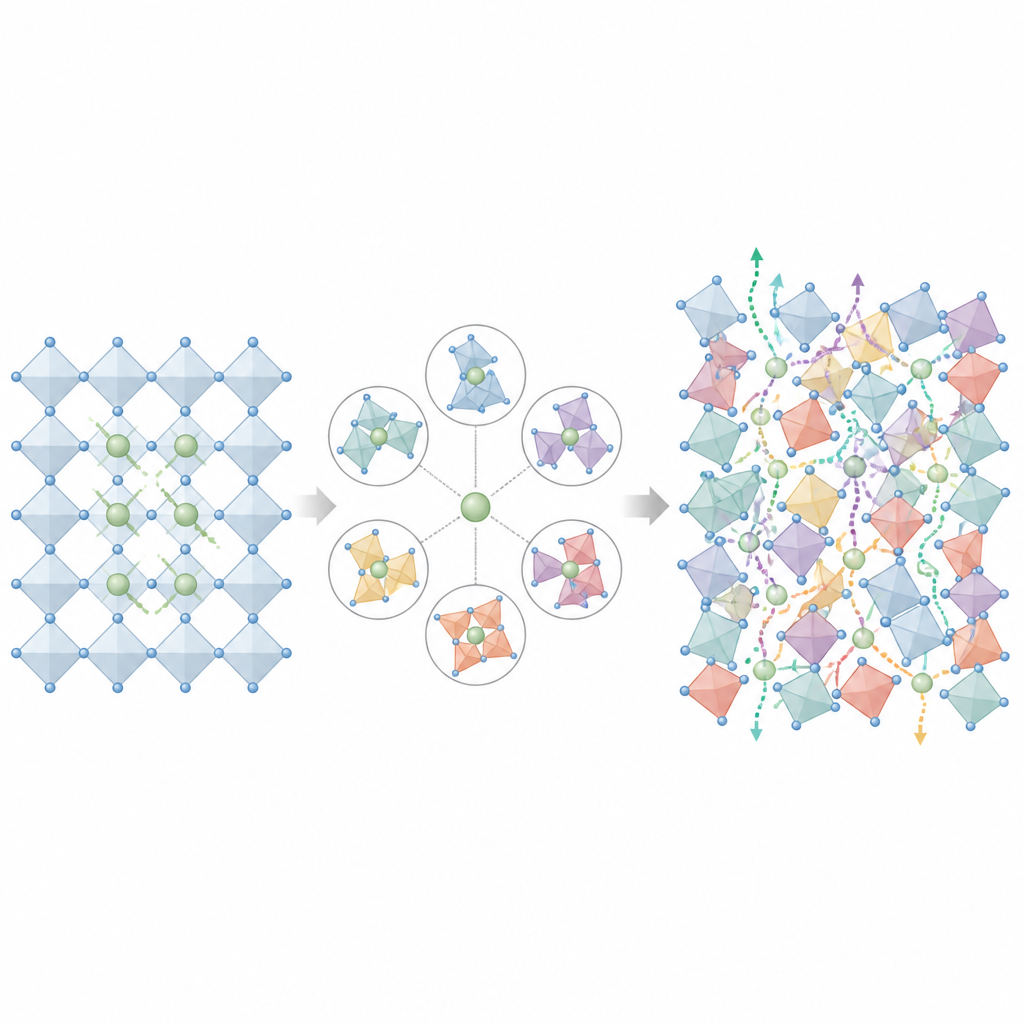
In today’s solid-state batteries, lithium ions have to weave their way through a rigid crystal. Traditional design tricks try to boost performance by adding chemical “disorder” to that crystal, for example by mixing different atoms into the structure or creating empty spots. These changes are thought to increase entropy, a thermodynamic measure often linked with better ion movement. But the usual measures of entropy mostly count how atoms are arranged in the framework, not what the lithium ions are really doing as they travel. As a result, some materials that look highly disordered still conduct poorly, while others with modest disorder let ions race through.
Watching ions move, step by step
The authors tackle this gap by borrowing ideas from information theory and advanced computer modeling. They simulate lithium movement in a family of sulfide-based solid electrolytes known as argyrodites, which are leading candidates for all-solid-state batteries. Using a technique called a Markov state model, they divide the material into many small local regions that lithium ions can occupy, then track how frequently ions hop from one region to another. This approach turns ion motion into a network of possible pathways, where each path has a certain likelihood that can be quantified.
Measuring the richness of ion pathways Figure 1. How tweaking a solid battery material turns a quiet crystal into a busy highway for moving ions.
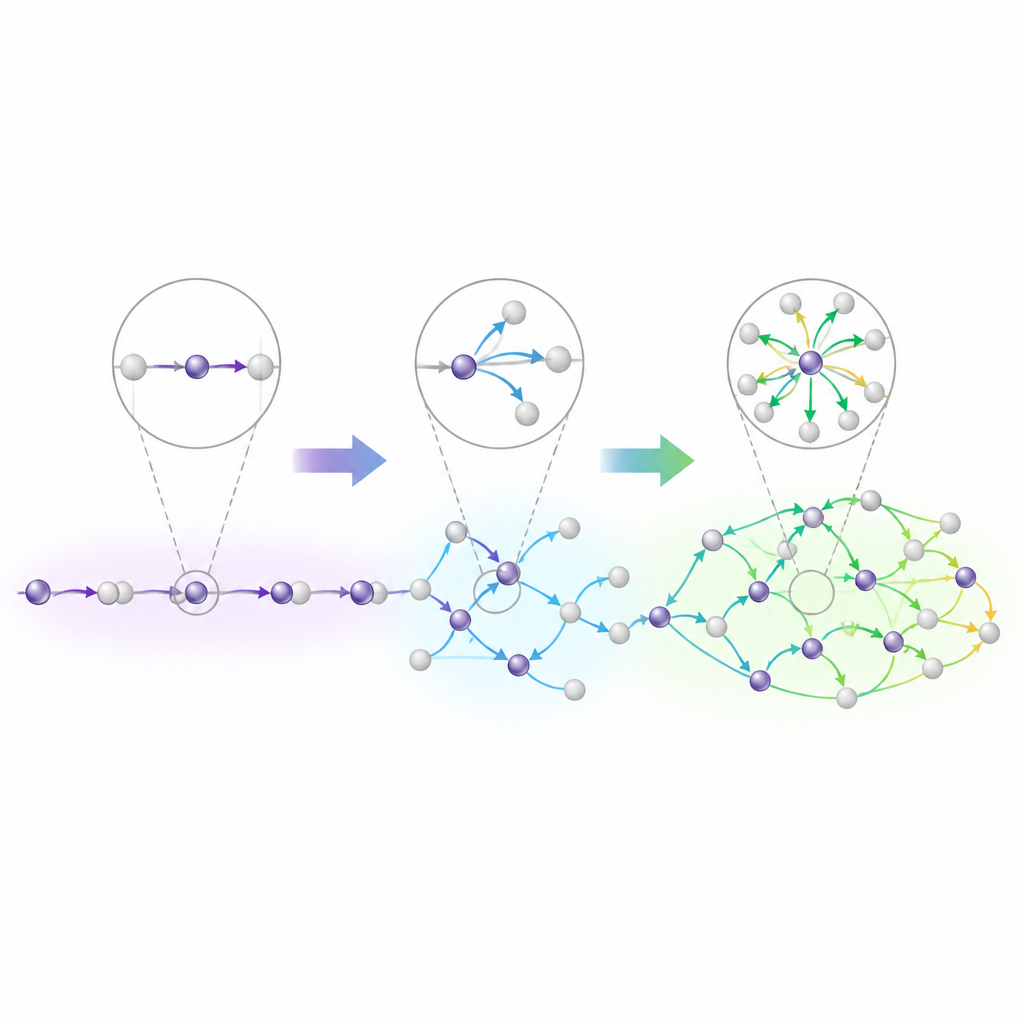
With this network in hand, the team defines a new quantity called path entropy. Instead of asking how disordered the crystal framework looks, path entropy counts how diverse the actual diffusion routes are. If ions are stuck on just a few routes, the path entropy is low; if they can choose among many interconnected paths, it is high. The authors also separate out “escape” entropy, which reflects how easily ions leave their original local region and contribute to long-range transport. In argyrodite samples where lithium vacancies and mixed anion sites were introduced, path entropy and escape entropy rose sharply, and so did measured ion conductivity, by several orders of magnitude compared with a more ordered reference material.
Comparing structure disorder and motion disorder Figure 2. How ions gain many branching routes through a solid, turning confined motion into fast, long-range travel.
To see how this new lens compares with older ideas, the researchers also measured configurational entropy, which captures how distorted and varied the surrounding anion framework is. They found that different design tweaks, such as swapping certain atoms in the framework, could raise this structural entropy but did not always deliver the biggest boost in ion flow. In contrast, path entropy correlated strongly with how well lithium moved. In some cases, materials showed only a small change in framework disorder yet a huge jump in path entropy and conductivity, underscoring that the richness of possible routes matters more than how scrambled the host lattice looks.
Finding new candidates by their hidden routes
Finally, the team used path entropy as a screening tool. Mining large materials databases, they first filtered thousands of sulfide compounds for basic stability and electronic suitability. Then they ran fast simulations to estimate lithium motion and calculate path entropy and escape entropy. This process flagged only a handful of strong candidates, including several known high-performance electrolytes and a less familiar compound, Li4Cr2C4SO16, which their calculations suggest conducts lithium ions almost as well as leading argyrodite materials. Because its long-range pathways are not yet fully activated, the study suggests that further tweaks, such as adding vacancies, could unlock even better performance.
What this means for future batteries
For non-specialists, the key message is that how lithium ions thread through a solid can be more important than how messy the solid appears on paper. By introducing the idea of path entropy, this work provides a practical way to count and compare those hidden routes. That, in turn, can guide scientists toward solid electrolytes that combine safety with the fast ion traffic needed for high-power, all-solid-state batteries, bringing more reliable renewable energy storage a step closer.
Citation: Guan, Q., Wang, K., Yeo, J. et al. Path entropy-driven design of solid-state electrolytes.
Nat Commun17, 4736 (2026). https://doi.org/10.1038/s41467-026-71316-z