Clear Sky Science · en
An ultrathin ionic thermoelectric cell design utilizing near body heat for self-powered wearable electronics
Powering gadgets from gentle warmth
Most of the heat our bodies and everyday surroundings give off is wasted, even though it represents a huge, constant source of energy. This study shows how a very thin, flexible strip placed on the skin can quietly turn a few degrees of body warmth into electricity, enough to run devices like smartwatches without plugging into a charger.
Why low-temperature heat matters
Heat below the boiling point of water makes up more than half of the world’s lost energy, from factory exhaust to warm skin. Turning this gentle warmth into useful power is especially attractive for wearable electronics, which need light, soft, and safe power sources. Traditional thermoelectric materials are stiff, costly, and work poorly near body temperature. New ionic devices based on gels have looked promising because they can produce much larger voltages at room temperature and feel more like soft plastics than hard ceramics.
The problem with making devices thin
Until now, these gel-based heat harvesters have faced a stubborn trade-off. To work well, they usually rely on a temperature difference across their thickness, with one face hotter than the other. When engineers try to make them thinner so they sit comfortably on the skin, that temperature difference nearly vanishes. The voltage drops and the power becomes too small to be useful, especially when the heat source is just slightly warmer than the air. At the same time, making them thicker to recover performance makes them bulky and less wearable.
A new way to harvest heat in a thin strip
In this work, the authors design a gel-based cell only about a millimeter thick that avoids this compromise. Instead of depending on a strong temperature difference across the material, the device uses a pair of unlike electrodes placed side by side on one face of the gel. One is a porous carbon cloth that behaves like a fast, reversible capacitor when warmed. The other is coated with a polymer that behaves more like a battery, storing charge through slower chemical changes. When the whole strip is gently heated, ions in the gel respond differently at each electrode. These coordinated reactions shift the electrical potentials and create a useful voltage, even though the temperature within the gel is almost uniform. 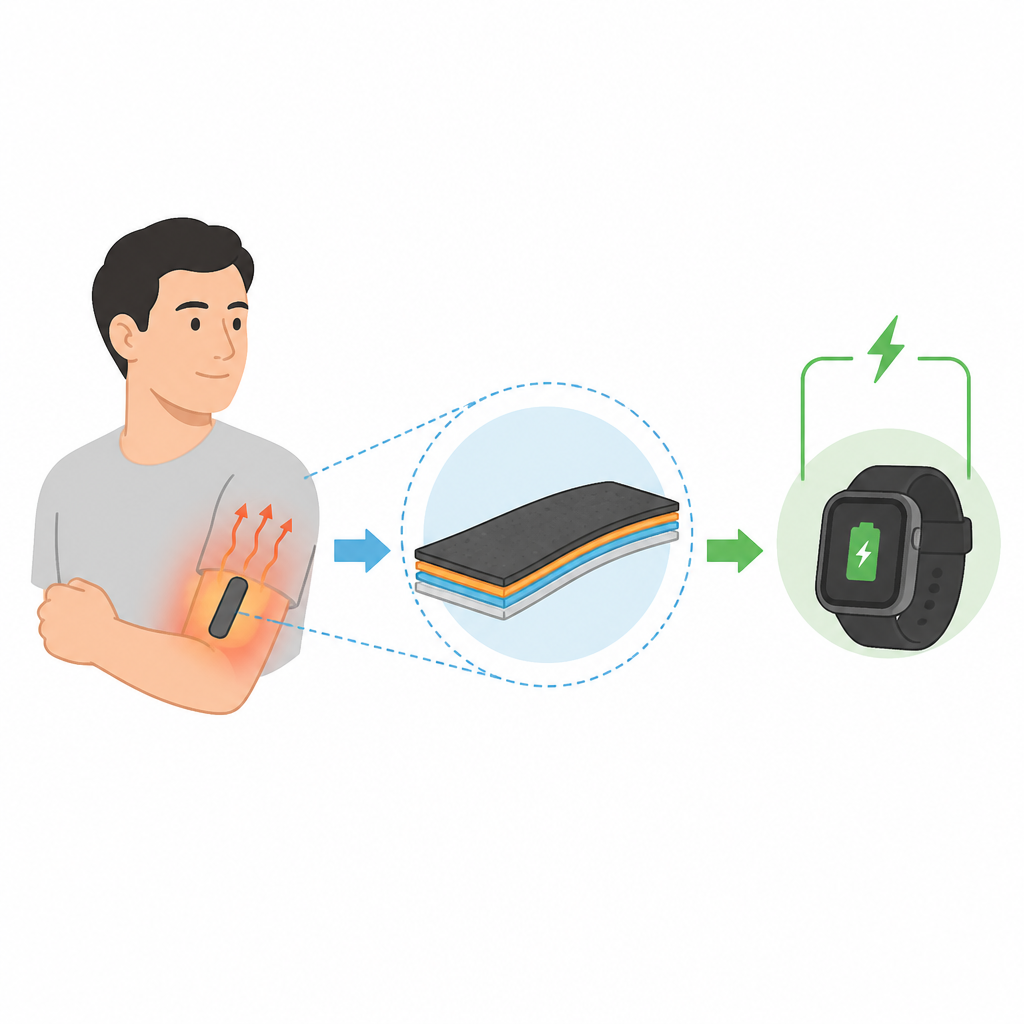
How the microscopic dance of ions stores energy
The gel contains dissolved iron ions that can switch between two charge states. As the device warms, a fraction of these ions change state at the battery-like electrode, while others interact with oxygen-containing groups on the carbon cloth. This motion and transformation of ions builds up a charge imbalance between the two sides, similar to charging a tiny internal battery. When the device is connected to an external circuit, electrons flow from one electrode to the other, delivering current to whatever is attached. As the device later cools, the iron ions and polymer gradually return to their original states, ready for another heating cycle without the need for external recharging. 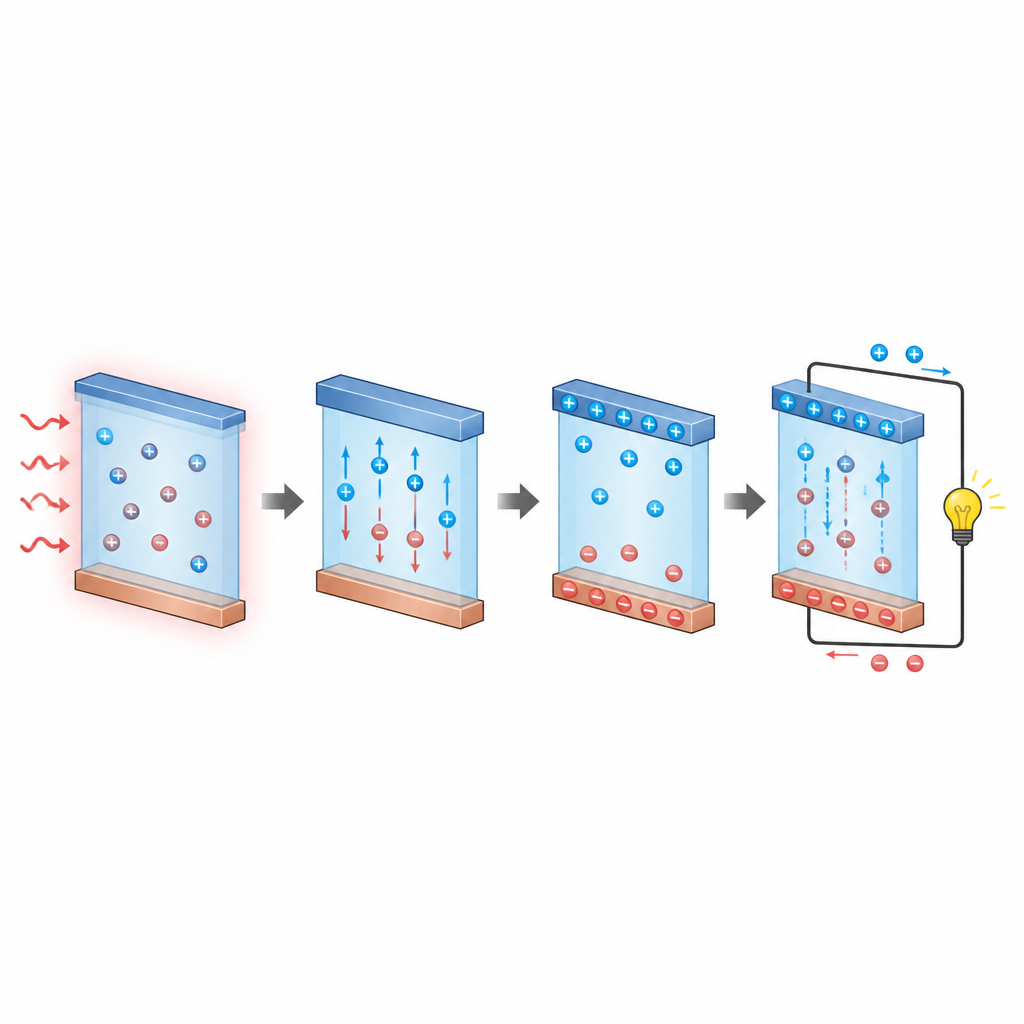
Performance in real-world conditions
Despite being ultrathin, a single cell can generate around one tenth of a volt and deliver a power density up to 1.6 watts per square meter when warmed by a temperature difference of only a few degrees, similar to skin sitting in room air. Over two hours of operation it stores about 1500 joules per square meter, which is far higher than earlier gel-based designs at similar temperatures. By wiring 20 of these cells in series into a soft, bendable strip, the researchers obtain nearly two volts and a power density of 23 watts per square meter. This strip can wrap around an arm and continuously run a commercial smartwatch or even a small digital meter using only the wearer’s body heat.
What this means for future wearables
For a non-specialist, the key message is that it is now possible to build very thin, soft power sources that live on the skin and quietly charge themselves from ordinary body warmth. By rethinking how heat is converted to electricity, and letting ions and electrode chemistry do most of the work, the authors show a path toward self-powered watches, sensors, and other wearables that need no batteries or chargers while being comfortable and safe to wear for long periods.
Citation: Meng, H., Gao, W. & Chen, Y. An ultrathin ionic thermoelectric cell design utilizing near body heat for self-powered wearable electronics. Nat Commun 17, 4684 (2026). https://doi.org/10.1038/s41467-026-71286-2
Keywords: wearable energy harvesting, body heat power, ionic thermoelectric cell, flexible electronics, gel electrolyte