Clear Sky Science · en
Roadmap of phase transitions in hafnia-based superlattice films
Why tiny crystal shifts matter for future memory
Modern gadgets rely on memory that can store data even when the power is off. Hafnia based materials, built from the element hafnium, are strong contenders for the next generation of such non volatile memory in phones, computers, and data centers. But their internal crystal structure is restless and prone to changing form, which can quietly erase or weaken the electric signals that encode information. This study looks deep inside these crystals, atom by atom, to map out exactly how their structure shifts under stress and how engineers might tame those changes to build faster, cooler, and more reliable memory chips.
Building a clean playground for tricky crystals
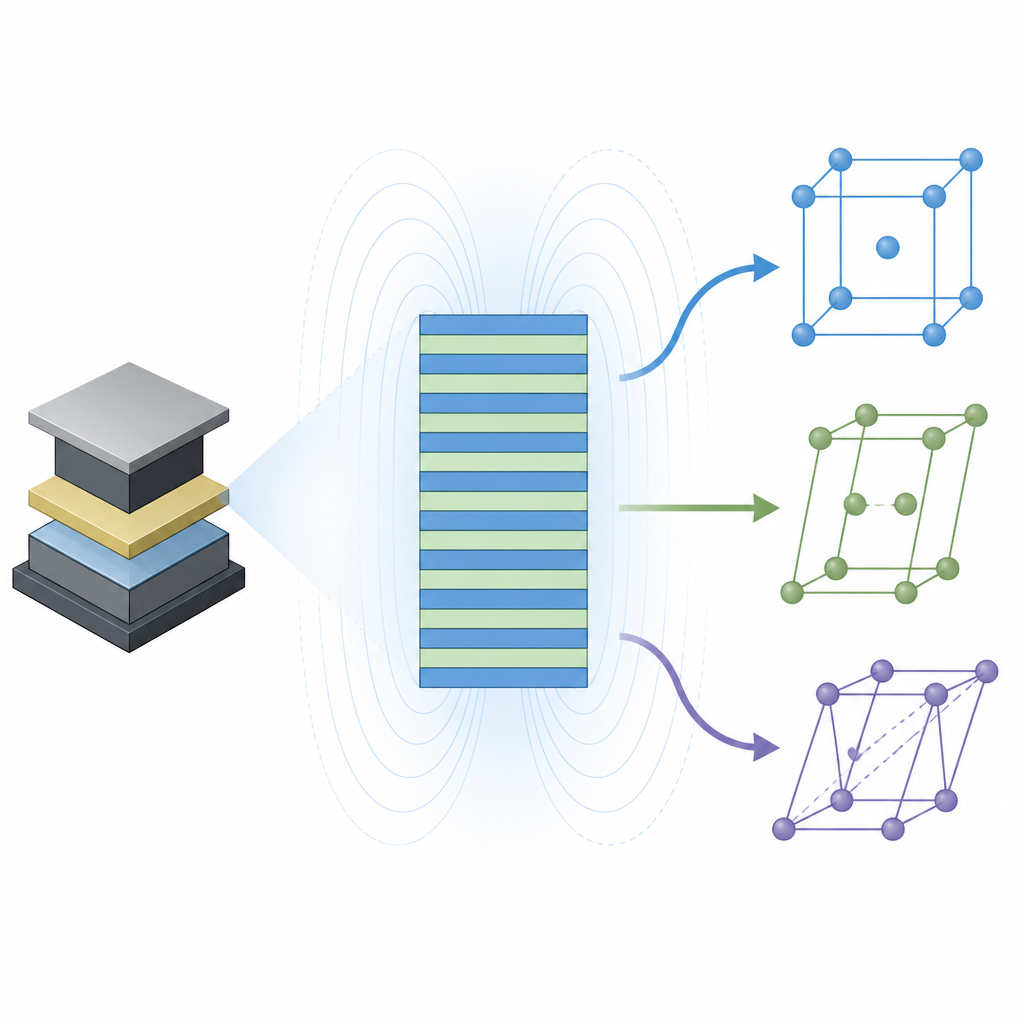
To remove the clutter found in ordinary thin films, the researchers fabricated ultra tidy “superlattices” made of alternating layers of hafnium oxide mixed with zirconium and pure zirconium oxide. These stacks were grown on a matching crystal substrate so that the entire film behaved as a single, well ordered crystal. Using advanced electron microscopes, they could see both the heavy metal atoms and the lighter oxygen atoms in the lattice. The films naturally hosted several crystal forms that hafnia can adopt, including one that is polar and can hold an electric polarization, and others that are non polar and tend to spoil ferroelectric behavior. This carefully engineered structure provided a clear stage for watching how one form morphs into another.
Watching phases switch under an invisible push
The team used the electron beam of the microscope not only to image the atoms but also as a controlled trigger. The beam created a subtle electrical environment in the film, nudging the atoms to rearrange. By taking images over time, they followed how the crystal shifted between three key forms: an orthorhombic phase that carries electric polarization, a tetragonal phase that is non polar, and a monoclinic phase that also lacks polarization and harms memory performance. They observed that the path between these phases was not a simple snap but a sequence of intermediate steps, each marked by slightly different spacings and distortions of the metal and oxygen sublattices.
Asynchronous motion of metal and oxygen atoms
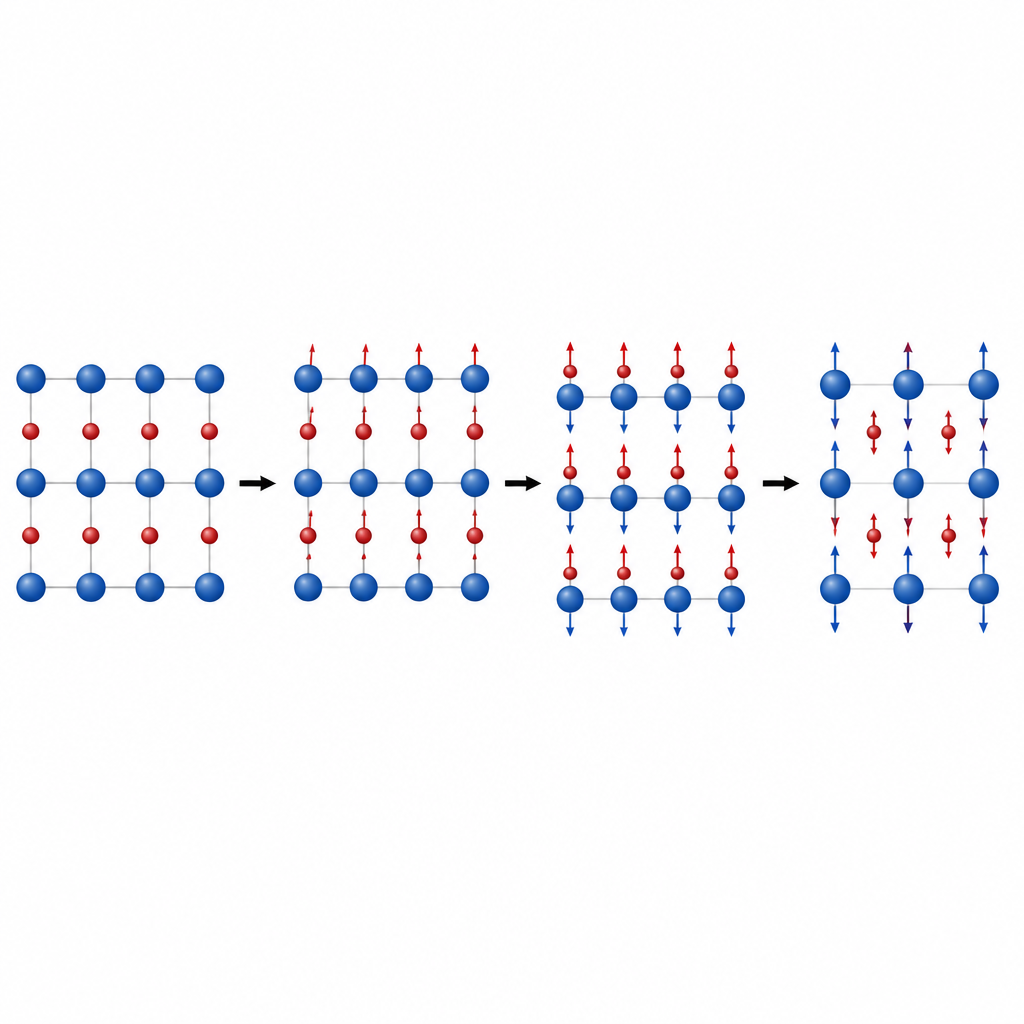
A central finding is that the metal atoms and oxygen atoms do not move in lockstep. In some transitions, such as between the tetragonal and polar orthorhombic forms, the metal atoms shift first to create a pattern of wider and narrower rows, while the oxygen atoms remain nearly fixed. Only afterward do the oxygen ions slide to create or remove electric polarization. In other transitions, especially between the polar phase and certain monoclinic forms, the oxygen atoms can move first, followed later by the metal atoms. This “asynchronous sublattice distortion” means that the crystal follows distinct step by step routes depending on which phase it starts from, which direction the polarization points, and how strain is distributed across the layered structure.
Switching between polar and anti polar states
Within the orthorhombic phase itself, the material can behave in two different ways. In the ferroelectric state, the local electric dipoles line up, while in the antiferroelectric state neighboring dipoles point in opposite directions and cancel. The study shows that switching between these two does not require the metal framework to be rebuilt. Instead, only the oxygen ions reverse their dipole order, flipping sections from polar to anti polar and back. Because this change involves relatively small movements, it likely costs less energy and can occur quickly, which is desirable for low power, long lived memory devices. The experiments also show that under the right conditions, even layers that normally avoid the polar form can be coaxed into the antiferroelectric state.
What this means for future memory technologies
By mapping how each crystal form grows, shrinks, and interconverts, the authors provide a practical roadmap for engineers who want to stabilize the useful polar phase and avoid the harmful non polar ones. Their work suggests that careful control of crystal orientation, built in strain, and layer design can steer the material toward favorable transition paths and keep the memory active over many cycles. Most importantly, the finding that polarization reversal can proceed mainly through oxygen motion hints at a route to ultra low energy switching. For a lay reader, this means that by learning how each atom moves inside these tiny crystals, scientists are discovering reliable ways to shrink and improve future memory chips that underpin everyday electronics.
Citation: Geng, WR., Wang, BR., Zhu, YL. et al. Roadmap of phase transitions in hafnia-based superlattice films. Nat Commun 17, 4676 (2026). https://doi.org/10.1038/s41467-026-71265-7
Keywords: hafnia ferroelectrics, phase transitions, superlattice films, non volatile memory, oxygen ion motion