Clear Sky Science · en
Flexible active-matrix micro-LED display with 1T-1FeMFET architecture featuring scaling-limit-free design
Why thinner, bendable screens matter
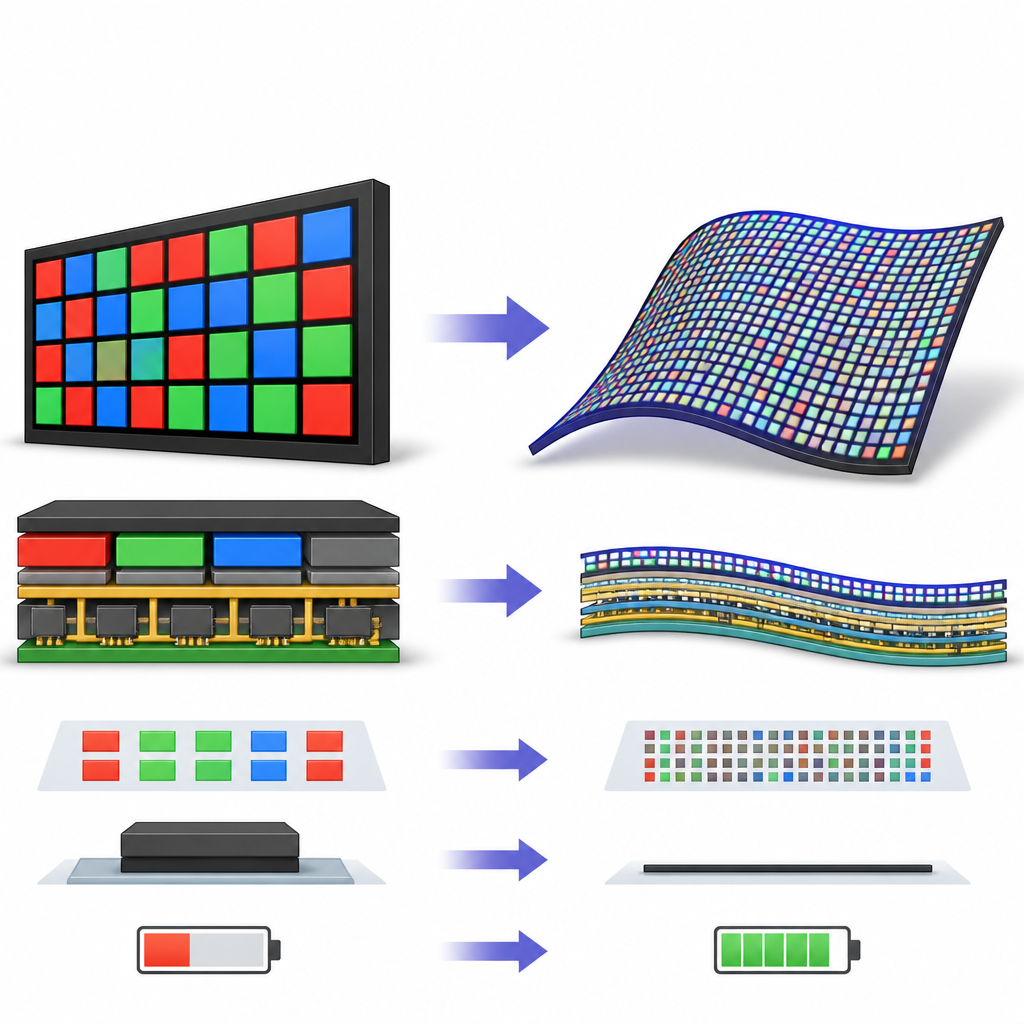
From smart watches that hug your wrist to rollable tablets that slip into a pocket, tomorrow’s gadgets will need screens that are not only bright and sharp but also able to bend without breaking and sip very little power. This research presents a new way to build such displays, using tiny light sources and built‑in memory so that each pixel can stay bright while consuming far less energy, even on flexible plastic film.
Moving beyond today’s pixel designs
Most modern displays rely on pixel circuits that use several transistors and a large storage capacitor to keep each pixel’s brightness steady over time. That capacitor must be big enough to hold charge, which sets a practical floor on pixel size and limits how closely pixels can be packed. It also has to be refreshed again and again, wasting energy as devices redraw the image many times per second. These limits are especially troublesome for flexible screens, where space is tight and batteries are small.
A new pixel that remembers on its own
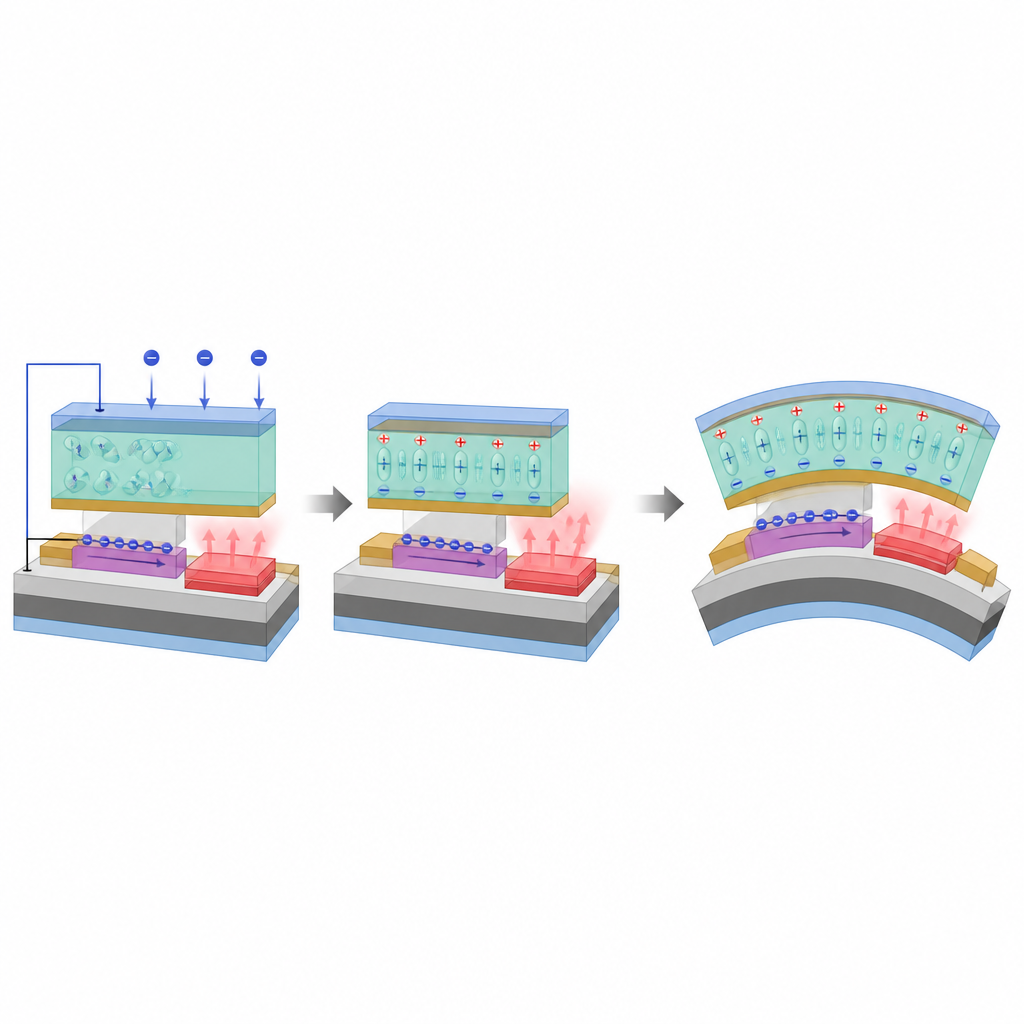
The authors replace this bulky approach with a pixel built around a special device called a ferroelectric metal field‑effect transistor, combined with an indium tin oxide channel. In simple terms, this transistor can both drive the tiny light‑emitting diode in each pixel and remember the brightness setting without a separate storage capacitor. It does so by using a thin layer whose internal electric dipoles can be flipped and left in place, like tiny compass needles. Once set, that state holds the charge pattern that controls the current through the pixel, allowing the circuit to be much smaller and to avoid constant refreshing.
Building bright pixels on flexible plastic
To make this work on a bendable base, the team grew the ferroelectric layer from a hafnium‑zirconium oxide mixture and sandwiched it between metal layers, then added a very thin indium tin oxide channel on top, all processed below 400 °C on a polyimide film. They showed that the ferroelectric parts can be switched more than one hundred million times and still maintain strong polarization, and that the devices survive being bent to a tight 4 mm radius for one hundred thousand cycles without losing performance. The resulting transistors switch cleanly between on and off states over a huge range, enabling precise control of the tiny micro‑LEDs beneath the display surface.
Sharper images with less power
With this one‑transistor‑plus‑memory design, each pixel can be shrunk because the ferroelectric element is much smaller than a traditional storage capacitor, and it does not need to be topped up constantly. The researchers demonstrate an active‑matrix micro‑LED display on flexible plastic with a pixel density of 428 pixels per inch and dynamic power use of only about 0.6 nanowatts per pixel at typical refresh rates. The pixel circuit supports two common ways of setting brightness: changing the height of the drive pulses or adjusting their width, which together allow smooth grayscale control at very high refresh speeds suitable for high‑resolution video.
From lab prototype to future wearables
Finally, the authors show that these flexible driver circuits can be bonded to arrays of gallium nitride micro‑LEDs and individually addressed to form patterns of glowing pixels, while the light output of the LEDs remains essentially unchanged by the processing steps. To a non‑specialist, the key message is that they have created a thin, bendable display technology in which each pixel can remember its own brightness using built‑in ferroelectric memory. This makes it possible to pack pixels more tightly and cut power consumption, pointing the way toward lightweight, high‑resolution, and long‑lasting screens for future wearable and portable devices.
Citation: Huang, T., Yang, G., Sang, Y. et al. Flexible active-matrix micro-LED display with 1T-1FeMFET architecture featuring scaling-limit-free design. Nat Commun 17, 4628 (2026). https://doi.org/10.1038/s41467-026-71182-9
Keywords: flexible display, micro LED, ferroelectric transistor, indium tin oxide, low power electronics