Clear Sky Science · en
Axial oxygen coordination drives spin-regulated electron transfer in single-atom Fe catalysts for selective pollutant transformation
Turning polluted water into a cleaner resource
Clean, affordable water is a growing global concern as industrial chemicals and everyday products leave behind stubborn pollutants. This study explores a new way to clean water more efficiently by steering how a catalyst moves electrons, allowing it to quietly convert toxic small molecules into larger, easier-to-manage solids without generating a storm of reactive radicals that can damage other components of the water.
Building a single-atom cleaning platform
The researchers designed a special catalyst built around single iron atoms anchored on tiny carbon particles called nanodiamonds. They started with commercial nanodiamond powder and partially transformed its surface into a mix of diamond-like and graphite-like carbon. They then oxidized the surface to add oxygen-containing groups and finally attached an iron-containing ring molecule called iron phthalocyanine. This produced a structure where each iron atom sits in a flat ring and also bonds to one oxygen atom sticking out of the surface, creating a five-coordinate iron center that is both stable and highly exposed to the water and chemicals flowing past.
Extensive structural tests confirmed that this architecture behaves as intended. X-ray diffraction, infrared and Raman spectroscopy showed that the iron ring structure remains intact after anchoring. High-resolution electron microscopy revealed that no iron clusters or particles formed; instead, individual iron atoms are dispersed across the nanodiamond support. Advanced X-ray absorption measurements further verified that each iron center keeps its four in-plane nitrogen neighbors and gains one axial oxygen neighbor, which fine-tunes the local electronic environment of the metal.
How the catalyst changes the chemistry of cleaning
To test performance, the team used peracetic acid, a common disinfectant and oxidant, to degrade a model pollutant called 4-chlorophenol. 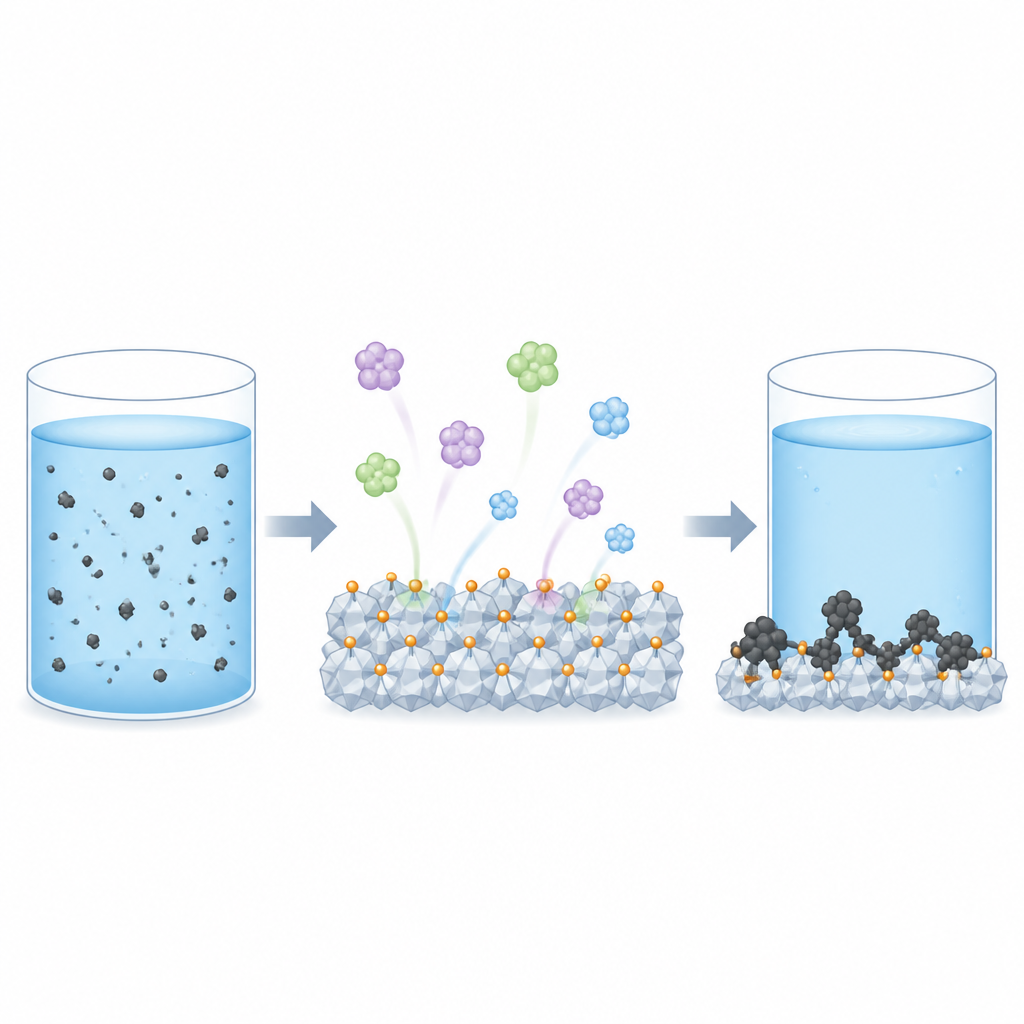
Electrochemical measurements and reaction studies across many different phenolic compounds showed that the reaction speed closely tracks how easily a pollutant donates electrons. The catalyst prefers electron-rich molecules and uses peracetic acid more efficiently, turning most of it into simple acetic acid rather than wasting it. Rather than breaking pollutants down completely to carbon dioxide, the process selectively couples phenolic molecules together into larger chains that stay stuck on the catalyst surface, which makes them easier to capture and prevents them from re-entering the water.
Spin state and atomic design as control knobs
At the heart of this selectivity is how the axial oxygen changes the electronic and magnetic state of the iron atom. 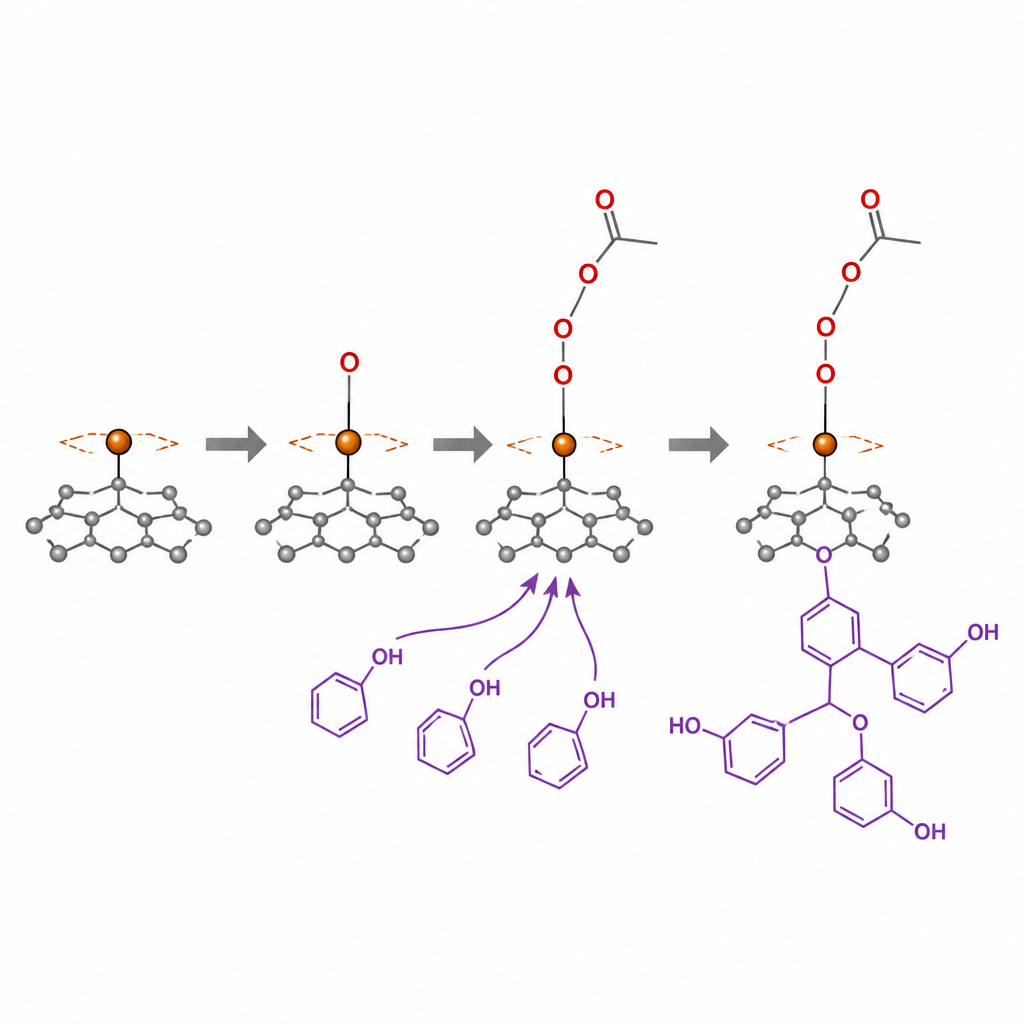
From lab concept to practical water treatment
Beyond basic science, the team evaluated how this catalyst might work in real-world water treatment. The oxygen-coordinated material maintained its performance over multiple test cycles, resisted interference from salts, natural organic matter, and pH changes, and worked well in diverse real waters, including river water, seawater, and treated wastewater. When loaded onto cotton fibers and run in a continuous-flow setup for more than 130 hours, it kept removing pollutants with very low iron leaching, well below drinking water limits. Toxicity tests of the treated water showed no inhibition of bacterial growth, suggesting that the residual solution is safe while the potentially harmful polymeric products remain immobilized on the solid catalyst.
What this means for future clean water technologies
Overall, the study demonstrates that carefully arranging atoms around a single iron center, especially through an added oxygen bond, can steer how electrons flow during pollutant treatment. Instead of destroying contaminants outright, the catalyst stitches small phenolic pollutants into larger, solid-like polymers that are trapped on its surface, turning dissolved waste into a removable resource. This strategy of spin-state and coordination control offers a new design pathway for robust, selective water purification systems that make better use of oxidants while keeping byproducts contained.
Citation: Miao, F., Wang, Y., Zhou, H. et al. Axial oxygen coordination drives spin-regulated electron transfer in single-atom Fe catalysts for selective pollutant transformation. Nat Commun 17, 4589 (2026). https://doi.org/10.1038/s41467-026-71163-y
Keywords: water purification, single-atom catalyst, peracetic acid, phenolic pollutants, electron transfer